PART 4
“Katya,” he whispered, “do not read that here…”
But the paper was already open in my hands.
My father’s handwriting leaned forward across the page, impatient and familiar. I had not seen it since I was six, yet I recognized the way he crossed his letter t, as if every sentence were running late.
Katya, if anything happens to us, Grandfather knows what to do. The meadow must remain with the village. It is not only land. It is where people come when they have nowhere else to go.
Below that was a list of names, addresses, and signatures. Three families. The school. The old well. A small clinic beside the river.
At the bottom, my father had written one final sentence.
When Katya is old enough, let her choose. Do not choose for her because you are afraid.
The page trembled between my fingers.
“Why did you hide this?” I asked.
Grandfather lay against the wall, one hand pressed to his chest. Nina had returned with Doctor Belov, who was kneeling beside him and opening a worn leather case.
“I did not hide it from you,” Grandfather said. “I hid it from everyone who might use you to reach the land.”
“You told me my parents left only debts.”
“They did leave debts. The truck was not insured. The hospital bills remained. I sold the orchard to pay them.”
His breath caught.
“But the meadow was different. Your father wanted it protected. He trusted me.”
“And Pavel?”
“Pavel knew the agreement existed. He also knew I was old, and that you lived far away. He thought distance made you weak.”
Doctor Belov pressed two fingers to Grandfather’s neck.
“Your heart is racing. You need the clinic.”
“I need her to understand.”
“I understand enough,” I said. “You frightened me into coming because you believed Pavel would take everything before I returned.”
Grandfather looked at the floor.
“I frightened you because I had asked gently for years.”
The words were not an excuse. That made them harder to reject.
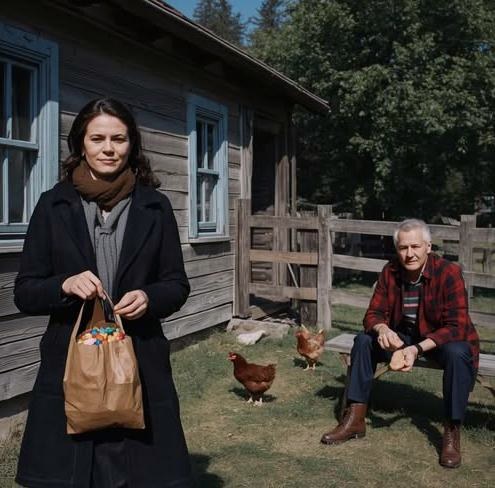
Nina set the grocery bag down. Inside were bread, medicine, and a jar of raspberry jam. Her voice shook.
“He did not tell me to say he was dead until yesterday. He had another attack. He fell beside the well, and I found him in the mud.”
I turned toward him.
“You had an attack?”
“It passed.”
“That is not an answer.”
“The doctor said stress could kill me.”
“Then you should have told me!”
“I did not want you to come out of pity.”
“You made me come out of terror.”
He closed his eyes.
“Yes.”
There it was. Not a clever defense. Not a proud old man pretending to be right. Just a confession that made both of us smaller.
Doctor Belov helped him stand. Before leaving, Grandfather pointed at the paper in my hand.
“Pavel will return.”
“He will.”
“He will say the land is useless.”
“Then I will show him the agreement.”
“He will say you are a city woman who does not understand this place.”
“I understand that he forged my name.”
Grandfather almost smiled, but the effort became a cough.
At the clinic, the walls smelled of disinfectant and boiled linen. A clock above the examination bed had stopped at 2:17. Doctor Belov gave Grandfather medicine and ordered him to remain overnight.
Pavel arrived before sunset.
He did not come alone. The village clerk followed him, pale and sweating, carrying a folder beneath his coat.
“I brought the original,” Pavel announced. “You can waste everyone’s time with family stories, or you can sign the sale and leave with enough money to forget this place properly.”
I stood beside Grandfather’s bed.
“You paid the clerk.”
The clerk flinched.
Pavel turned on him. “Do not look at me.”
I placed my father’s letter on the counter.
“The agreement says the meadow cannot be sold without the signatures of all three families and the village council.”
Pavel laughed. “Two of those families moved away.”
Nina stepped into the clinic carrying a bundle of papers.
“Not one,” she said. “I found their addresses.”
Behind her came the headmistress, the owner of the fishing shed, and two brothers whose parents had signed the original agreement. They had traveled from neighboring settlements after Nina called them.
Pavel’s face hardened.
“This is private property.”
“No,” I said. “It is protected property.”
The clerk began to cry. He confessed that Pavel had brought him the forged power of attorney and promised him a job on the tourist road. He had never seen me sign anything. He had copied my name from an old school document Pavel obtained from the district archive.
Pavel stared at him as if betrayal were something only other people committed.
Grandfather pushed himself upright.
“Take your money,” he said. “Take your promises. Leave the river.”
Pavel looked at me.
“You think this makes you a local?”
“No,” I answered. “It makes me the owner who finally came to read what she inherited.”
He left with the folder pressed against his side. The clerk remained behind, sobbing into both hands, while Nina began arranging the documents into separate piles.
No one applauded. Nothing felt victorious.
Grandfather watched the papers spread across the clinic table.
“You will have to manage all of this,” he said. “The council, the families, the maintenance. You cannot do it by telephone.”
“I know.”
“You have a job.”
“I know.”
“You have that apartment in the city.”
“I know.”
He waited.
I took his hand. His palm was dry, ridged, and warm despite the hospital blanket.
“I am not promising to become someone else,” I said. “I am promising to stop treating you like a postcard.”
His thumb moved over my knuckles.
“That is all I wanted.”
“No. You wanted me to think you were dead.”
A faint smile touched his face.
“I wanted you to come.”
“Then next time, say that.”
“Next time,” he murmured, “I will try.”
The phrase sounded fragile. More honest than any grand apology.
Before dawn, Doctor Belov allowed us to take him home under strict instructions. Nina went ahead to light the stove. I carried the wooden box and the folder containing my father’s agreement.
At the edge of the meadow, Grandfather asked me to stop.
The river moved beneath a skin of dark ice. The old well stood near the birches, its wooden cover tilted sideways. Someone had tied a strip of red cloth to the fence so travelers could find the path in snow.
“Your father tied that there,” Grandfather said.
I touched the cloth.
“He thought people would forget where the well was.”
“He was right.”
“Did you ever regret keeping it for me?”
Grandfather leaned heavily on his cane.
“I regretted keeping you away from it.”
We continued toward the river. At the bank, he pointed to a flat stone half buried in ice.
“Your father proposed to your mother there.”
“What did he say?”
“Something foolish.”
“What exactly?”
Grandfather’s eyes brightened.
“He said, ‘If you marry me, I will build you a house where the river can hear us argue.’”
I laughed, and the laugh broke into tears.
Grandfather rested his shoulder against mine.
“Your mother said yes because she knew the house would need someone sensible.”
For a while, we stood beside the water, holding the papers that had brought Pavel there and the memory that had kept Grandfather there. The future was not simple. I still had a job, bills, and a city life that would not vanish because I had finally come home. The meadow would require meetings, repairs, signatures, and arguments. Grandfather would need medicine and supervision, whether he liked it or not.
But when we reached the house, he did not sit on the porch and pretend none of this had happened.
He pointed toward the stove.
“Potatoes?”
“Only if you let me peel them.”
“You always leave half the potato on the skin.”
“Then you will have to teach me again.”
He handed me the knife.
The blade caught the pale morning light, and from the table came the soft rustle of my father’s agreement beneath my hand.
Grandfather watched me make the first uneven cut.
“Not like that, Katya.”
“Then show me.”
He covered my hand with his.
“Slowly,” he said. “There is no train to catch.”
Outside, the river kept moving under the ice, carrying my father’s promise toward the village—and carrying my grandfather’s voice back to me from the kitchen table: “Slowly, Katya. This time, stay for dinner.”
Missed the beginning?






