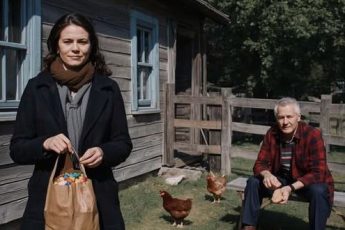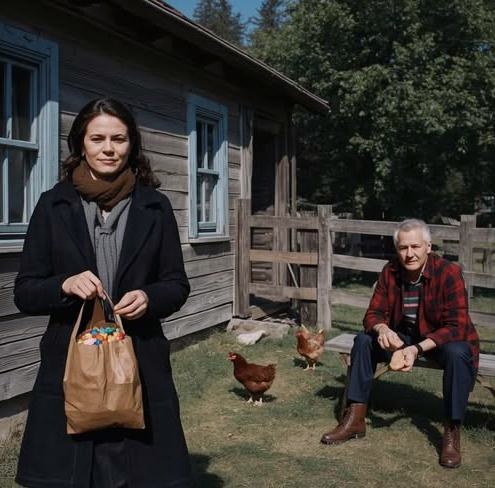
The woman on the phone told me my grandfather was dead while I was standing beneath the cold white lights of my office lobby.
“Katya? This is Nina from the house beside your grandfather’s,” she said. “You need to come home. Yegor Stepanovich died last night.”
For several seconds, I heard only the elevator bell behind me and the rain ticking against the glass doors. Employees hurried past with coats over their arms, already free from the week. I could not move.
“How?” I whispered.
“In his sleep. Peacefully. The funeral is Tuesday.”
My fingers tightened around the phone until the edge cut into my palm. “Are you sure?”
There was a pause.
“Come, child.”
The call ended.
I stood beneath the lobby clock and watched the second hand crawl forward. My grandfather had been eighty-one. He had raised me after my parents died in a highway accident when I was six. He had taught me to split kindling, mend a fishing net, and swallow bitter medicine without making a face.
He had also spent the last five years waiting for me.
I had answered his calls while checking work messages. I had promised to visit after the quarterly report, after the promotion, after winter. Then his birthday became a postcard. New Year became another postcard. Eventually, even the postcards felt like tasks I might forget.
The guilt arrived before the tears.
I bought a train ticket that night. On the way home, I stopped at a station shop and filled a paper bag with caramel candies, biscuits, and the dark chocolate he used to hide in the cupboard from me. I knew he would never eat them now. I bought them anyway.
The journey took two days. A night train carried me north through black forests and frozen fields. In the morning, an elderly woman across the aisle noticed my black scarf and touched my wrist.
“Someone close?” she asked.
“My grandfather.”
“Then you should have gone sooner.”
She meant kindness. It still struck like a slap.
At the regional station, I took a bus to the last village on the route. The driver dropped me beside a crooked sign and pointed toward the fields.
“Three kilometers,” he said. “You remember the way?”
“I remember.”
The wind tore at my scarf as I walked. My suitcase bumped against my knee. Snowmelt filled the ruts, and my shoes soaked through before the first birch trees. I remembered my grandfather carrying me through this same mud after I cut my knee on a broken fence.
“Be strong, Katya,” he had said. “We are strong together.”
The village appeared beyond the hill. Smoke rose from one chimney.
His chimney.
I stopped breathing.
The house stood at the edge of the settlement, with carved window frames, blue shutters, and a row of crooked wooden ducks he had made for me when I was a child. The gate hung open. Chickens scratched beneath the porch.
Then I saw the figure sitting there.
A checked shirt. Padded trousers. Felt boots. A knife moving through a potato.
The man lifted his head.
My grandfather stared directly at me.
He was alive.
The paper bag slipped from my hand. Candies rolled across the frozen ground.
He set down the knife and rose slowly, one hand pressed to his lower back.
“Well,” he said. “You came.”
I could not answer.
He looked at my black scarf, my wet shoes, and the suitcase at my side. His mouth tightened—not with surprise, but with something almost like satisfaction.
“Nina told you, didn’t she?”
My heartbeat slammed against my ribs.
“Told me what?”
He reached beneath the bench and pulled out a flat wooden box. Inside it lay a folded document, a brass key, and a small red notebook tied with twine.
“Come inside,” he said. “There are things you need to know before you start shouting.”
His hand moved toward the folded document…
PART 2
His hand moved toward the folded document, but I caught his wrist.
“Before I start shouting?” I said. “You told Nina to say you were dead?”
The porch boards creaked beneath us. A chicken flapped away from my suitcase, scattering damp feathers across the steps.
Grandfather studied my hand on his sleeve.
“You have your mother’s grip.”
“Do not change the subject.”
“I am not changing it. I am explaining why you are here.”
“You could have called me.”
“I did.”
“You could have said you missed me.”
“I did.”
“You could have said you were sick.”
His expression shifted so slightly that I almost missed it.
“Sick?”
“Yes. Anything would have been better than making me believe you were lying in a coffin.”
He pulled his wrist free and climbed the steps. I followed because my legs were shaking too badly to remain outside.
The house smelled of birch smoke, boiled potatoes, and the pine soap he had used all my childhood. A blue enamel basin stood beneath the stove. On the wall hung my school medal, the ribbon faded almost white. Beside it was a photograph of my parents, their faces young and hopeful, their hands resting on the hood of a battered car.
I turned away.
Grandfather placed the wooden box on the table.
“Sit.”
“I am not staying for tea.”
“You crossed half the country for my funeral. You can spare ten minutes for the living.”
The sentence broke something in me.
I sat.
He poured tea into a glass with a metal holder. The spoon struck the rim three times. He had always done that when nervous.
“Why?” I asked.
He stared into the tea. “Because when Nina called you last spring, you said you were preparing a presentation.”
“I was.”
“When I called in summer, you said you had a deadline.”
“I did.”
“When I sent you the photograph of the river, you answered with a thumbs-up.”
I looked at the table.
“I was busy.”
“I know.”
That was worse than anger.
He opened the red notebook. Every page contained a date and a short line. Katya called. Katya did not answer. Katya sent a card. Katya said she might come in August. Katya’s birthday today.
The entries continued for years.
I reached for the notebook, but he closed it.
“You kept a record?”
“I kept hope. The record was easier.”
My throat tightened. “You are cruel.”
“Perhaps.”
“You let me travel here believing you were dead.”
“And you came.”
I stood so quickly that the chair struck the stove. A metal ladle rattled against the wall.
“I came because I loved you!”
“Then why did it take death to prove it?”
The question hung between us, sharper than anything he had said before.
Outside, a truck groaned along the road. Somewhere near the river, a dog began barking.
I covered my face. “I am sorry.”
He did not touch me.
After a moment, he said, “Sorry is not what I called you for.”
I lowered my hands.
He pushed the folded document across the table but kept one finger on it.
“There is a man named Pavel Sidorov. He has been coming here since autumn.”
“What does he want?”
“The house. The land beside the river. He says the district plans to build a tourist road. He says I am too old to understand the papers.”
“Did you sign anything?”
“No.”
“Then why do I need to be here?”
His eyes moved to the photograph of my parents.
“Because Pavel brought me a document with your name on it.”
Cold spread through my fingers.
“I have never signed anything.”
“I know.”
“Then what is it?”
Grandfather finally removed his hand from the folded paper. Before he could open it, three hard knocks struck the front wall.
A man’s voice called from outside.
“Yegor Stepanovich, I know your granddaughter arrived. We should settle this before she leaves.”
Grandfather looked at me.
“Pavel.”
The brass key in the wooden box trembled as his fingers closed around it.
Then the latch began to lift…
PART 3
Then the latch began to lift, and Grandfather shoved the wooden box toward me.
“Take the red notebook,” he whispered.
The door opened before I could ask why. Pavel Sidorov entered without waiting for permission, bringing in the smell of wet wool and automobile exhaust. He was broad, clean-shaven, and dressed in an expensive coat that looked absurd beside the chipped stove.
His eyes landed on me.
“So the funeral brought you home after all.”
I stood. “You knew this was a lie?”
Pavel smiled. “Your grandfather has always been dramatic.”
Grandfather’s hand tightened around his cane.
“Leave my house.”
“Your house?” Pavel placed a leather folder on the table. “That depends on the registry.”
I opened the folder before he could stop me. The top page was a power-of-attorney form. My name was printed beneath a signature that resembled mine from a distance, but not up close. The last letter in my surname curled too neatly. I always ended it with a sharp downward stroke.
“This is forged,” I said.
Pavel’s smile thinned. “Be careful.”
“Who witnessed it?”
“A local clerk.”
“Which clerk?”
He glanced at Grandfather.
“The one who watched you abandon an old man for five years.”
The insult struck hard, but Grandfather reached for the red notebook instead of answering. He opened it to a page near the back.
“September fourteenth,” he said. “Pavel came with a contract. He offered me money for the river meadow.”
Pavel’s face changed.
“Put that away.”
Grandfather continued. “October second. He said if I refused, the bank would take the house. October nineteenth. He brought a paper already carrying Katya’s signature.”
I looked at Pavel. “How did you get my signature?”
He stepped toward me.
“Your grandfather is confused.”
“Answer me.”
A woman appeared behind him in the doorway. Nina. She held a canvas grocery bag against her chest, and her cheeks were wet from the wind.
“Tell her,” Nina said.
Pavel spun around. “You stay out of this.”
“I copied the paper before you took it away,” Nina answered. “And I saw you bring the clerk here at night.”
Grandfather pushed a second sheet toward me. It was a bank receipt, dated three months earlier. Pavel had transferred a large sum to the clerk who supposedly witnessed my signature.
My stomach turned.
“You paid him.”
Pavel’s jaw tightened. “It was a consulting fee.”
“For a document transferring my grandfather’s property?”
“Your grandfather cannot maintain the land. The village needs development.”
“No,” Grandfather said. “You need the river.”
Pavel slammed his palm onto the table. The tea glass jumped and spilled across the receipt.
“You think this patch of dirt makes you important?” he shouted. “You think she will stay? She will sell it, take the money, and disappear again.”
The room went still.
He had said it himself.
I pulled the red notebook close. Between its pages was a carbon copy of a letter Grandfather had sent to the district office, reporting the forged document and naming Pavel. Beneath it, in careful handwriting, was a note: I waited for Katya because only Katya can protect what her parents left here.
“What did my parents leave?” I asked.
Grandfather’s face crumpled.
“Not money,” he said. “A promise.”
He explained that my father had owned the river meadow with two neighboring families. Before the accident, they had signed an agreement keeping it open for the village wells and fishing paths. The land was legally mine, but Grandfather had guarded it until I was old enough to decide.
Pavel laughed bitterly. “She does not even live here.”
I looked at the forged signature, then at the photograph of my parents.
“I live where my name is being stolen,” I said.
Pavel snatched the folder from the table. Nina stepped between us.
“Go,” she said.
He pointed at Grandfather. “You will regret this.”
Grandfather answered quietly, “I already regretted waiting so long to call her.”
Pavel left, but the danger did not leave with him.
A moment later, Grandfather pressed a hand to his chest. His face drained of color. The brass key slipped from his fingers and struck the floor.
“Grandfather?”
He tried to speak, but only air came out.
Nina ran for the village doctor while I knelt beside him. Under the wooden table, my fingers found the key and a second folded paper hidden beneath the floorboard.
It bore my father’s handwriting.
The first line made Grandfather open his eyes in terror.
“Katya,” he whispered, “do not read that here…”
The paper beneath the floorboard changed everything…
I thought the lie had only been about getting me home. Then I learned what my grandfather had been protecting all along.
The final part turns his cruelest decision into something neither of us expected.
“Your father trusted me with this.”
My hands began to shake.
👇 The final part of the story is already open.