PART 4
The conference room door opened before anyone could move.
A courier in a rain-darkened jacket stood there with a tablet pressed to his chest.
“Which one of you is Grace Bennett?” he asked.
“I am.”
He held out a printed document.
“Your resignation was submitted electronically at 5:43 this morning. The grant office needs confirmation before noon.”
Victor stepped forward.
“I’ll handle that.”
The courier looked at me instead. “I was instructed to obtain her signature in person.”
Victor’s hand stopped halfway toward the paper.
Daniel noticed.
“So was the forged letter signed electronically?” he asked.
The courier nodded. “From the operations office.”
Lena turned toward the computer on Victor’s desk.
“Let me see the access record.”
Victor moved between her and the machine.
“It’s a personnel matter.”
“No,” Lena said. “It’s a grant matter.”
Her voice had changed. She was no longer asking permission.
Victor looked at Marissa. “Tell them what really happened.”
Marissa’s lips parted, but nothing came out.
He stepped closer to her.
“You took the crutches. You cut the camera. You put them in the corridor.”
Marissa recoiled. “You told me to do it.”
“I told you to scare her.”
“You said she had to disappear before the audit.”
The courier quietly began typing on his tablet.
Victor saw the movement.
“Put that away.”
“I’m documenting a disputed submission,” the courier replied.
Daniel pointed at the black glove. “And the glove?”
Marissa looked at her own hands.
“I tore it on the cabinet,” she whispered. “Victor said the camera cable had to be cut first. Then he said Grace would be placed on leave before she could speak to the board.”
My body felt cold from the inside.
Not because I was surprised anymore.
Because I understood how carefully he had chosen the method. He had not wanted me dead. He had wanted me dependent, embarrassed, and easy to dismiss.
Victor turned on me.
“You were going to destroy this hospital over paperwork.”
“Those were veterans’ names.”
“You think the grant office cares about six missing appointments?”
“I do.”
“So do I,” Lena said.
She pressed a button on the conference phone.
The hospital board chair, the grant auditor, and the chief medical officer were already connected. Lena had called them while Victor argued.
Victor stared at the speaker.
“You planned this?”
“No,” Lena said. “You provided it.”
The auditor spoke through the phone. “Mr. Hale, the electronic resignation originated from your office terminal. The access code belonged to your administrative account.”
Victor’s face tightened.
“Anyone could have used it.”
Eli raised his hand slightly.
“I saw him at the computer at 5:36.”
Victor spun toward him. “You were not supposed to be there.”
Eli’s shoulders shook, but he stayed standing.
“I was delivering the morning medication log.”
That detail mattered. It gave him a reason to be there. It gave the truth somewhere solid to stand.
The auditor asked for the original attendance records.
I opened my notebook and read each patient number aloud.
Lena checked the therapy schedule.
Every name had been billed on a day the patient was somewhere else.
One veteran was in surgery.
Another was receiving hospice care in Louisville.
A third had died two weeks before the appointment Victor had charged to his name.
Marissa began crying quietly.
Victor remained rigid until the last name.
Then his shoulders dropped.
“What happens now?” he asked.
The auditor answered, “The grant is frozen. The board will remove you from financial authority effective immediately. The records will be turned over for investigation.”
Victor looked at me.
“You wanted this job so badly,” he said. “You have no idea what running this place costs.”
“No,” I replied. “But I know what it costs when someone decides injured people are useful only as numbers.”
That was the unexpected part: Victor did not deny the money.
He admitted the motive.
The hospital had been losing funds for months. He had hidden the deficit with false therapy claims, convinced the grant would be renewed before anyone checked. When I began comparing patient names, he panicked. He believed my injury gave him an easy excuse to remove me.
Marissa had followed him because he promised to protect her job.
Now she placed the maintenance key on the table and said, “I’ll give them every message and every ledger.”
Victor stared at her.
“You’ll lose everything.”
Marissa wiped her face. “I already did.”
At 10:12, the board suspended Victor and placed the rehabilitation wing under Lena’s control. The veterans’ appointments were not canceled. Volunteers from Daniel’s service-dog network helped transport patients from the parking lot while replacement crutches were brought from a medical supplier.
Shadow stayed beside me the entire morning.
When the first veteran entered therapy, he touched the dog’s gray head.
“Did he come for Grace?” Harold asked.
Daniel answered, “He came because Grace had spent years teaching people that no one gets left behind.”
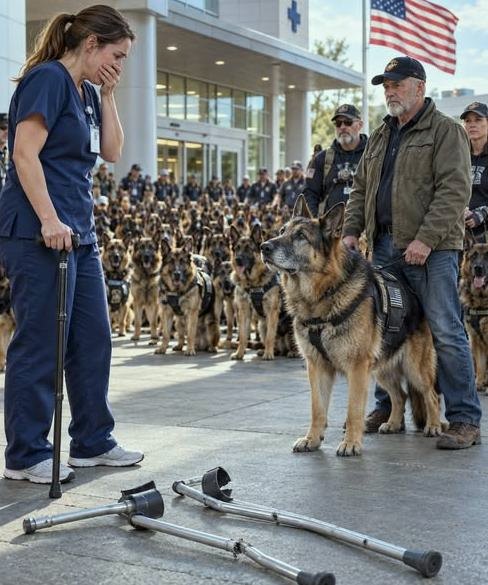
I looked at the seventy dogs beyond the glass. Their handlers had arrived from across Kentucky, some driving through the night. Many had served beside soldiers who never came home. They had not been summoned by a whistle.
Daniel finally explained the old cord around his neck.
“It belonged to my first service dog,” he said. “Shadow learned to follow it when he was trained. I almost used it last night.”
“Why didn’t you?”
He smiled faintly. “Because you were the one who needed to choose what happened next.”
I understood then. The dogs had not come to punish anyone. They had come to stand witness.
At noon, I returned to the parking space with a new pair of crutches under my arm. The medical supplier had fitted them with black cork handles and bright orange cuffs so nobody could mistake them for hospital property.
Daniel watched as I tested the height.
“Better?” he asked.
“Strange.”
“Strange is allowed.”
I looked toward the maintenance corridor. The broken pieces of my old crutches had been sealed in an evidence bag, but one small washer remained in Daniel’s saddlebag. He handed it to me.
“You kept that too?”
“Evidence has a way of becoming history.”
I closed my fingers around the washer.
Behind us, the dogs began to move. Not in formation this time. One by one, they followed their handlers toward the waiting vehicles.
Shadow stayed.
Harold called from the rehabilitation entrance, “Grace, we’re ready!”
I started toward him, each step supported by the new crutches and the steady rhythm of paws behind me.
At the edge of the lot, Shadow stopped and looked back at the broken parking space.
Then he nudged the brass whistle against Daniel’s hand.
Daniel understood.
He raised it to his lips, but did not blow.
Instead, he hung it around my neck.
“For the day you need a signal,” he said.
I touched the worn metal, feeling its weight settle beneath my collarbone.
From the doorway, Harold called again, “Grace?”
I turned toward the veterans waiting for therapy.
“Coming.”
And behind me, seventy dogs walked away from the place where my crutches had been destroyed, leaving only their paw prints around the one parking space no one would ever call empty again.
Missed the beginning?






