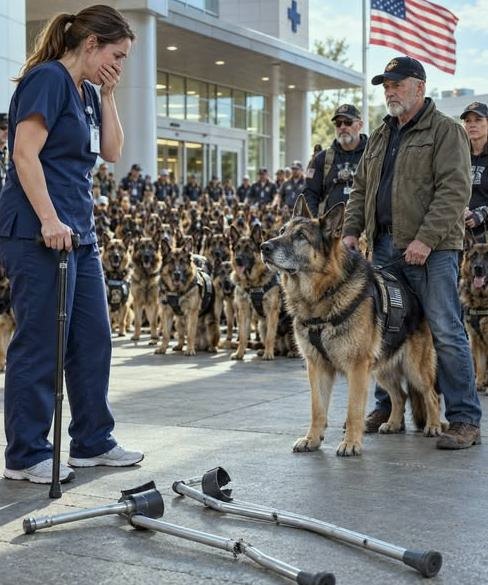
The hospital security guard found me on the pavement with one useless leg and two broken crutches, then asked whether I had done it myself.
It was 10:47 p.m. in St. Andrew Memorial’s employee parking lot in Lexington, Kentucky. Rain ticked against the metal roof above the walkway, and one fluorescent lamp kept flickering over the empty spaces.
I had just finished fourteen hours in the rehabilitation wing. My right leg throbbed beneath my scrubs, but I was already thinking about the veterans waiting for therapy in the morning. Then I saw the first crutch lying beside the curb.
The aluminum shaft was bent like a straw.
The second lay six feet away. Its forearm cuff had been snapped in half, and both rubber tips had been sliced cleanly across.
I grabbed the side mirror of a parked car before my knee gave out.
“Ms. Bennett?” the guard called from the entrance. “Did you fall?”
“No.” My voice came out smaller than I wanted. “Someone did this.”
He glanced at the broken equipment, then at me.
“Maybe they were already damaged.”
I stared at him. “I walked in with them this morning.”
My hands shook as I lowered myself onto a concrete bench. The pain in my leg was nothing compared with the sudden, humiliating terror of realizing that someone had deliberately taken away my ability to move.
Three months earlier, I had returned to work after a highway collision permanently damaged my leg. I had learned how to turn, how to climb shallow steps, how to hide pain behind a calm voice. My crutches were not a symbol of weakness. They were how I reached my patients.
A motorcycle rolled into the lot before the guard could answer.
Daniel Walker removed his helmet and crossed the wet asphalt. He was a retired Marine who volunteered with veterans and had spent years handling military service dogs. His beard was silver at the edges, and a brass service whistle hung from a faded brown cord at his neck.
He crouched beside the broken crutches.
“Who touched these?” he asked.
“I don’t know.”
Daniel ran one finger over the sliced rubber tip. “This wasn’t a fall.”
The guard shifted uneasily. “We can file an incident report in the morning.”
“Why not tonight?” Daniel asked.
“Because it’s equipment damage, not a crime scene.”
Daniel looked at me. “Do you have a way home?”
“Not without help.”
He opened his motorcycle’s saddlebag and took out a folding cane with a red rubber handle.
“Use this.”
“I can’t take it.”
“You can, and you will.”
He gathered every broken piece, even a tiny metal washer near the drain.
“Why keep the fragments?” I asked.
His eyes moved toward the maintenance gate at the far end of the lot.
“Because what’s missing can tell us where someone went.”
At 6:05 the next morning, seventy retired service German Shepherds stood outside St. Andrew Memorial. They formed a silent line beneath the hospital canopy, leashes slack, ears raised.
At the center stood Shadow, Daniel’s aging dog, gray around the muzzle. He ignored the entrance and stared at the parking space where my crutches had been destroyed.
Inside, I limped toward the rehabilitation wing with Daniel’s cane. At 6:19, a veteran named Harold caught my sleeve.
“You’re hurt.”
“I’m still here.”
“That’s not what I asked.”
I forced a smile. “Neither is the workday.”
Outside, Shadow lowered his nose to the wet pavement. He circled the parking space twice, then moved toward the hedges. Daniel followed and found a torn piece of rubber matching one of my crutches.
A younger dog suddenly stopped beside the locked maintenance gate.
Shadow sniffed beneath it.
Then a door slammed somewhere inside the restricted corridor.
Daniel’s hand tightened around the old whistle at his throat as every dog turned toward the sound, and the gate began to move from the other side…
PART 2
The gate opened less than an inch, then stopped.
Daniel stepped in front of Shadow. The dogs remained perfectly still behind him, but their attention filled the corridor like pressure before a storm.
“Maintenance?” Daniel called.
No answer.
He pushed the gate wider. Its bottom scraped over concrete, leaving a bright line in the dust. Beyond it, the service corridor smelled of bleach, wet cardboard, and diesel fuel. A red emergency light blinked above the loading dock.
At 6:31 a.m., Daniel found a trail of water leading past the boiler room.
He followed it until a side door swung loosely on one hinge.
Inside, a mop bucket had been knocked over. A wall cabinet stood open. On the floor lay a black nylon glove with a jagged tear across the thumb.
Daniel picked it up with a paper towel.
The guard who had questioned me the night before arrived behind him, breathing hard.
“You can’t enter restricted areas.”
“Then call whoever can,” Daniel said.
“I’m calling security.”
“You are security.”
The guard’s face reddened. “I said I’m calling the supervisor.”
Daniel looked at the glove. “Call him quickly.”
At 7:02, I was summoned to the administration floor. My cane struck the polished tile with a hollow tap as I entered Victor Hale’s office.
Victor was St. Andrew’s operations director. He wore a navy suit, a silver watch, and the calm expression of a man who had already decided how the conversation would end.
Beside him stood Marissa Cole, the night supervisor.
Victor folded his hands over a thin folder.
“Grace, this incident is unfortunate,” he said. “But we need to discuss whether you can safely continue working.”
“I worked yesterday.”
“You worked while injured.”
“I was injured months ago. The crutches were destroyed last night.”
Marissa looked down at her watch.
Victor sighed. “We have patient safety obligations.”
“Then replace the equipment.”
“We can place you on unpaid administrative leave while we review your mobility.”
My fingers tightened around the red handle of Daniel’s cane.
“You’re removing me because someone vandalized my crutches?”
“No one is removing you. We’re protecting you.”
That was when I noticed the folder’s corner. A thin strip of green paper stuck out from inside it—the same color as the rehabilitation transfer forms I had been reviewing all week.
I had discovered that six veterans listed as completing therapy had never appeared in our unit. Their sessions had been billed anyway. I had marked the discrepancies and planned to bring them to the clinical board.
Victor knew.
“Are those the attendance records?” I asked.
His expression hardened for half a second.
“Those are confidential documents.”
“So you have them.”
Marissa stepped forward. “You’re becoming agitated.”
“I’m becoming careful.”
At 7:18, Daniel called me from the loading dock.
“We found something,” he said.
“What?”
“A glove. A broken cabinet. And a camera cable cut clean through.”
My stomach dropped. “The parking lot cameras?”
“Only the camera facing your space.”
Behind him, Shadow stood beside the maintenance door, his nose pressed to a strip of dark oil on the concrete.
Then a hospital transporter named Eli appeared at the end of the corridor. He was twenty-two, pale, and clutching a ring of keys so tightly that they rattled.
Daniel asked, “Did you see someone here?”
Eli swallowed.
“I saw Marissa after midnight.”
Marissa’s voice came from behind us.
“Eli, be very careful.”
The young man flinched.
Victor stepped into the corridor, his polished shoes stopping beside the oil stain.
“You’re all making a serious mistake,” he said.
Daniel lifted the torn glove. “Then explain why your night supervisor was inside a locked corridor after midnight.”
Victor’s gaze shifted to me.
“You should think about your patients, Grace.”
It sounded like concern.
It felt like a warning.
At 8:04, the rehabilitation director called an emergency meeting and told me to bring every note I had made about the missing therapy sessions.
I reached into my locker for the folder.
It was gone.
In its place lay a single strip of green paper, damp at the edges, with six patient names crossed out in black ink.
On the back, someone had written three words: Stop looking, Grace…
PART 3
I carried the green strip into the conference room at 8:17 a.m., still holding Daniel’s cane in my other hand.
The rehabilitation director, Dr. Lena Morris, sat at the head of the table. Victor stood near the blinds. Marissa remained beside the door, arms folded, while Daniel and Eli waited behind me.
“Where are your records?” Lena asked.
“Someone removed them from my locker.”
Victor shook his head. “This is becoming theatrical.”
Eli’s keys rattled again.
“No,” he said. “It’s not.”
Everyone turned toward him.
He placed a small brass key on the table. A red plastic tag marked it as belonging to the old supply room.
“Last night, Ms. Cole asked me to unlock the maintenance corridor,” he said. “She said a delivery had been left inside.”
Marissa’s jaw tightened. “That is not what happened.”
“You told me to wait by the loading dock,” Eli continued. “Then I saw you carrying something wrapped in a towel.”
Victor stepped toward him. “You’re confused.”
“I saw Grace’s crutches.”
The room seemed to contract around those words.
My breath caught. I looked at Marissa.
She stared at the table.
Victor turned sharply. “You don’t know what you saw.”
Eli pulled a folded receipt from his pocket. “I wrote down the time because the delivery alarm went off. Twelve twenty-six.”
Daniel placed the torn glove beside it.
Shadow, who had been lying beneath the table, lifted his head and fixed his eyes on Marissa.
Lena looked from the glove to Victor. “Why would the night supervisor destroy a nurse’s mobility equipment?”
Victor answered too quickly.
“Because Grace has been unstable since the accident.”
The words landed harder than a slap.
I felt heat rise under my collar. “Say that again.”
Victor realized what he had revealed, but it was too late.
He pointed at the green strip. “She has been making accusations based on incomplete records. We needed to remove her from the unit before she damaged the hospital’s reputation.”
“By breaking her crutches?” Lena asked.
Marissa whispered, “Victor told me she would never stop.”
The room went silent.
Victor turned on her. “I told you to frighten her, not confess.”
Eli’s face went white.
Daniel slowly looked at me. “The missing sessions.”
I opened my medical notebook. I had copied six patient identification numbers by hand before the folder disappeared.
“They were billed to the state veterans’ rehabilitation grant,” I said. “But the veterans were transferred before their appointments. Their names were used to create payments for therapy that never happened.”
Lena stared at Victor. “How much?”
“Nearly four hundred thousand dollars.”
Marissa covered her mouth.
Victor laughed once, but there was no confidence in it. “You have no proof.”
Eli reached into his jacket and placed a second item on the table: a duplicate maintenance log.
“Victor signed out the corridor key at 12:11,” he said. “Marissa signed it back in at 12:42.”
Victor looked at the signature.
His signature.
The one he had forgotten to disguise.
He grabbed the log, but Daniel caught his wrist.
“Don’t touch anything else.”
For a moment Victor’s face looked almost ordinary—tired, frightened, human. Then his eyes went to the window, toward the seventy dogs outside.
“You think those animals change anything?” he asked.
“No,” I said. “The names do.”
Lena reached for the telephone.
Before she could dial, every phone in the room rang at once.
The caller identification showed the state grant office.
Lena answered.
A woman spoke briefly, then Lena’s face drained of color.
She covered the receiver and looked at me.
“The grant office says they received a resignation letter from you this morning,” she whispered. “It says you admitted falsifying the records.”
Victor had not only destroyed my crutches.
He had signed my name to a confession.
And downstairs, the hospital was already preparing to release my patients under my name…
Then the grant office called—and used my name…
I thought the broken crutches were the whole attack. I was wrong. The final part reveals what Victor risked, and why the dogs came before anyone understood.
“I’ll give them every ledger,” she said.
Victor finally understood what he had lost.
👇 The final part is open now






