PART 4
The ballroom doors opened before I could answer.
A young woman in a dark service uniform entered, carrying a slim red folder. She crossed the room without looking at the wedding guests, the floral arrangements, or the man whose name was printed across every table card.
“General Ulette?” she asked.
“Yes.”
She handed me the folder. “The legal office sent this by courier. They said you needed the original in your hands.”
Gerald took one step toward me.
“What did I submit?” I asked.
The officer glanced at him. “A power of attorney claiming you authorized your father to represent you in a federal benefits matter.”
My fingers tightened around the folder.
“I never authorized him.”
“We know. The signature was compared with your service records. The document was also filed using an address you have not lived at since 2011.”
Gerald’s mouth opened.
Margaret turned to him. “What benefits?”
He looked at her as if she had become a stranger.
“Nothing,” he said.
Mrs. Vale gave a dry, exhausted laugh. “It was never nothing.”
She removed the ledger from her case and laid it beside the wedding cake. The page was covered with columns of figures, dates, and transfers.
“Gerald took the dividends from Evelyn’s shares,” she said. “He deposited them into the family account for twelve years. After that, he routed them through Hail Holdings.”
Richard stepped backward.
Clare stared at him. “You knew?”
Richard rubbed his thumb against his wedding ring. “I knew there was a trust.”
“You knew my sister was being cheated.”
“I knew Gerald was desperate to keep control.”
“You helped him.”
“I helped keep the company alive,” Richard snapped. “Your father had debts. If the sale didn’t happen Monday, the bank would take everything.”
Gerald turned on him. “You promised me the sale would be clean.”
Richard’s face twisted. “It was clean until your daughter walked in with an entire military career and a dead woman’s paperwork.”
The room flinched at the phrase.
I looked at Gerald. “You told everyone I left because I was selfish.”
He said nothing.
“You told Clare I never wrote.”
His eyes moved toward the floor.
“You told me Grandma wanted nothing to do with me.”
Margaret’s hand rose to her pearls. One of the strands had broken. White beads rolled across the floor, slipping beneath chairs and catching in the folds of tablecloths.
“Gerald,” she whispered, “did you intercept her letters?”
“I was protecting the family.”
“No,” I said. “You were protecting your control.”
The words landed harder than the insult had.
Clare stepped close to him. Her veil brushed against a fallen bead.
“Why did you do it?” she asked.
He looked at his youngest daughter, and for the first time that evening, the polished man in the expensive suit seemed very old.
“Your grandfather left the company to me,” he said. “I built it.”
“Grandma owned forty percent.”
“She would have handed it to Evelyn, and Evelyn would have sold it or walked away.”
“You didn’t know that,” Clare said.
“I knew she hated the business.”
“I hated what you did with it,” I said. “That wasn’t the same thing.”
He looked at me then.
I saw the answer before he spoke.
He had not thrown me out because I joined the Air Force. He had thrown me out because my refusal made me impossible to control, and my grandmother’s trust made me dangerous to his authority.
The attorney from Washington remained on my phone. Her voice came through the speaker.
“General Ulette, the filing has been flagged. The transfer cannot proceed without your verified consent. We also located three additional documents bearing the same forged signature.”
Gerald gripped the back of a chair.
Margaret stared at him. “Three?”
“One for the shares,” I said. “One for the benefits. What was the third?”
Mrs. Vale opened the ledger to the final page.
“The third document transferred the Hawthorn Lane house,” she said. “Your childhood home. Gerald sold it last year.”
Clare covered her mouth.
I felt something inside me go still—not numb, not broken. Finished.
“That house was where you watched me leave,” I told Clare.
“I know.”
“Did Dad sell it because he needed money?”
Mrs. Vale shook her head. “No. He sold it because Helen’s will required the house to pass to Evelyn. He wanted the asset gone before she discovered the trust.”
Clare turned to Gerald. “You sold my sister’s home.”
“I had no choice.”
“There is always a choice,” David said quietly.
Gerald looked at him with sudden fury. “You married into this family. You don’t understand what it took to keep it standing.”
David reached for Clare’s hand. “I understand what it costs to make someone disappear.”
A long table had been set beneath the chandeliers for the wedding meal. No one sat down.
The cake leaned slightly because someone had bumped its table. A sugar flower slid down the frosting and came to rest beside the legal folder.
I picked up my phone.
“Please send the documents to my attorney,” I told the woman in Washington. “And notify the company’s board that the sale is unauthorized.”
Gerald’s head snapped toward me. “You would destroy everything?”
“No.”
“You don’t know how to run Ulette Mutual.”
“I don’t intend to run it alone.”
Clare looked at me, uncertain.
I turned to Richard. “You said the company is failing because of the debt. How much?”
He hesitated.
“Answer her,” Margaret said.
“Six point eight million,” he muttered.
“And how much did you expect to make from the sale?”
“Fourteen.”
The room shifted again.
Gerald had planned to lose the company’s future and keep the profit. Richard had planned to buy the damaged shell, strip its profitable divisions, and leave the debt behind. They had not been saving the family business. They had been dividing its remains.
Clare looked at the guests who had spent the evening praising Gerald’s loyalty.
“Did any of you know?” she asked.
No one answered.
That silence belonged to them.
I folded the trust document and placed it in the red folder.
Gerald came toward me, stopping just far enough away to avoid touching me.
“Evelyn,” he said.
My name sounded strange in his voice. Not an accusation. Not a warning. Almost a request.
“What?”
“I was afraid.”
The admission did not repair anything. But it explained the shape of the damage.
“Of what?” I asked.
“That you would come back and see what I had done.”
I looked at the man who had once been the tallest person in my world.
“You could have told me the truth.”
“I thought you would hate me.”
“I did hate you,” I said. “But I would have hated the lie less.”
His shoulders sank.
Clare stepped between us, her wedding dress brushing the scattered pearls.
“This day is not for him,” she said. “It is for the person he tried to erase.”
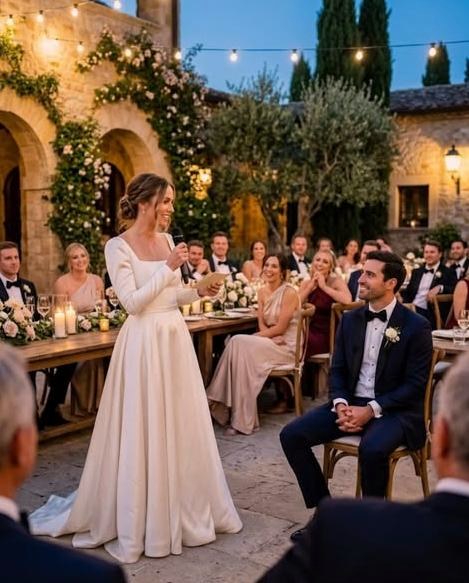
She turned toward the guests and raised the microphone again.
“I invited my sister because she is family,” Clare said. “Not because she needs anyone’s pity.”
Then she looked directly at Gerald.
“And I am postponing the reception until every person here understands whose money paid for this room.”
A gasp passed through the ballroom.
Clare handed me the microphone.
I did not make a speech about courage. I did not describe medals, missions, or the people I had carried through smoke. Those things belonged to the work, not to the man who had mocked it.
I simply said, “Clare, I came because you asked me to stay.”
Her eyes filled.
“Then stay,” she whispered.
So I did.
Not for Gerald. Not for the company. Not for the name printed on the wedding invitations.
I stayed while the board members gathered around the legal folder. I stayed while Richard called his own attorney and Margaret collected the pearls from beneath the chairs. I stayed while Gerald sat alone at table one, staring at the place card bearing his name.
The sale was stopped before midnight. The trust was restored through the proper channels, and the company’s independent board accepted my condition: no secret transfers, no family member with unchecked control, and a fund created from the recovered dividends for employees who had been promised severance by men planning to sell the business from under them.
Gerald kept his title for exactly nine more days.
Then the board removed him.
He did not lose everything. Clare refused to let the company become an instrument of revenge. He kept enough to live on, but not enough to command anyone’s future. The Hawthorn Lane house could not be recovered, so I sold the proceeds from the trust’s remaining assets into a foundation for service members forced out of their homes while deployed.
When the paperwork was complete, Mrs. Vale gave Clare the last letter my grandmother had written.
Clare brought it to me at the reception, where the cake still stood crooked beneath the chandelier.
“You should read it,” she said.
I opened the letter.
Evelyn, your father may confuse possession with love. Do not make the same mistake. If you return, return because the door is yours to choose—not because he finally remembers your name.
I read it once.
Then I folded it carefully and placed it beside Clare’s wedding vows.
“Are you all right?” she asked.
I looked at the bride, at the scattered pearls, at the red folder containing the truth that had crossed fifteen years to reach us.
“No,” I said. “But I’m here.”
Clare smiled through her tears and lifted her glass.
“To Major General Evelyn Ulette,” she said.
This time, the entire room rose before she finished the toast.
And on the table where my father had called me a guest, Clare set a new place card in front of my untouched wine.
It read: Evelyn Ulette, sister of the bride.
Missed the beginning?






