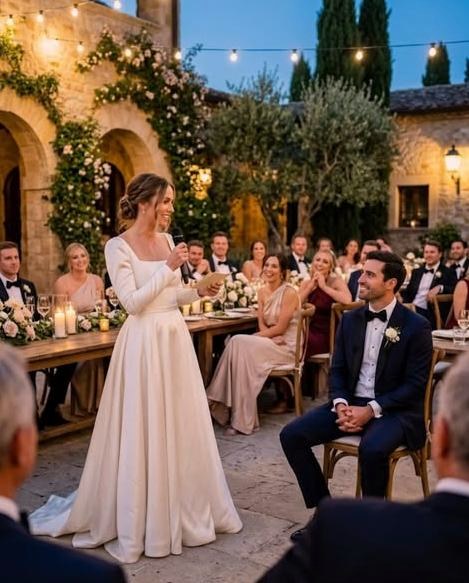
My father had just called me a charity case when the bride’s hand tightened around the microphone and every conversation in the ballroom died.
It happened at Greenfield Country Club, eight minutes before dinner. Crystal chandeliers glittered above two hundred and fifty guests, while rain tapped against the tall windows like impatient fingers. I stood beside the cocktail tables in a navy dress, holding a glass of Pinot Noir so carefully that my knuckles had gone white.
Gerald Ulette looked exactly as I remembered him, only older. Silver hair. Expensive suit. The same cold eyes that made every room feel like his property.
“I didn’t realize Clare’s guest list included charity cases,” he said.
Margaret, his wife, appeared at his shoulder in a red silk dress, her pearls resting against her throat like a row of polished teeth.
“Gerald,” she murmured, pretending to warn him. “Not before dinner.”
He smiled. “I’m only being honest.”
I set my glass down on the table. “Hello, Dad.”
His gaze traveled over my dress and stopped at the small silver stars pinned beneath my left collarbone.
“Still playing soldier?”
“I’m still serving.”
“Some people never learn when to come home.”
The words pulled me backward fifteen years, to the front porch of this same family’s old house. I had been twenty-two, carrying one suitcase and a folder containing my Air Force enlistment papers.
“You’re throwing away your future,” Gerald had said.
“I’m choosing it.”
“You’re choosing embarrassment.”
By Friday, the locks had changed. My health insurance had vanished. Every photograph of me began disappearing from the walls.
My little sister Clare had watched from her bedroom window, fifteen years old, braces flashing as she cried into both hands.
Now she was twenty-seven and wearing a beaded wedding gown.
She found me near the service corridor before Margaret could parade me past another table of strangers. Clare ran toward me, her veil sweeping over the polished floor, and hugged me so tightly that the beads pressed into my shoulder.
“Dad doesn’t know I invited you,” she whispered.
“Clare, you shouldn’t have put yourself in the middle.”
“I’m not in the middle.” She pulled back and gripped both my hands. “I’m standing beside you. Please stay.”
There was something in her face I recognized from airfields under fire: fear held in place by determination.
So I stayed.
I stayed when the welcome board read The Ulette Family, Established 1988, and left my name off entirely. I stayed when my place card at table twenty-two said guest of the bride instead of Evelyn Ulette. I stayed when Margaret introduced me during cocktails as “Gerald’s older daughter, the one who went off to do something with planes.”
“I’m a general officer in the Air Force,” I corrected.
Margaret tilted her head. “Of course you are.”
At dinner, Gerald raised his Bordeaux and delivered a speech about loyalty, family, and children who understood their place. Then his eyes flicked toward table twenty-two.
Richard Hail, Margaret’s brother, joined him a few minutes later. His watch flashed beneath the candlelight.
“Military people follow orders,” Richard said. “They don’t build anything.”
Gerald leaned close. His cologne filled my lungs.
“You see all these guests?” he asked. “Every one of them knows you abandoned us.”
“I didn’t abandon Clare.”
“You’re still looking for my approval.”
“No.”
His smile tightened. “If it wasn’t for pity, no one would have invited you.”
A waiter froze with a bread basket in his hands.
I lifted my wine and took a slow sip. “The people who offer pity usually need it most.”
Across the ballroom, Clare stood.
The band softened. Her husband, David, gathered the train of her gown as she walked toward the microphone. In her hand was a kraft-paper envelope sealed with blue wax.
Gerald leaned back, expecting a toast to him.
Clare looked straight at me.
“Tonight,” she said, her voice trembling through the speakers, “I need to honor someone this family tried to erase.”
Gerald’s smile stopped moving.
Clare broke the seal, unfolded the document, and began to read…
PART 2
The paper crackled beneath Clare’s fingers, loud enough to reach the last table near the kitchen doors.
“For extraordinary leadership under hostile conditions,” she read, “and for bringing thirty-six airmen home during the Red Valley evacuation…”
A murmur traveled through the ballroom.
My throat tightened. The citation was familiar. I had received it in a hangar three years earlier, surrounded by mechanics, exhausted pilots, and the smell of hot metal. I had never told Clare the details because I assumed Gerald would dismiss them as another performance.
Clare lifted her eyes from the page.
“Major General Evelyn Ulette.”
No one moved.
Then David rose beside her and saluted.
Clare saluted too.
It was not the casual gesture of a bride making a dramatic toast. It was sharp, precise, and full of everything she had not been allowed to say for fifteen years.
A retired colonel at table six stood next. Then a nurse. Then two young officers who had come with David. Chairs scraped across the floor until half the room was on its feet.
Gerald remained seated.
“Put your hand down,” he said to Clare.
She lowered it slowly. “Why?”
“Because this is my wedding.”
“No,” she said. “It’s mine.”
Margaret rushed toward the stage, her heels striking the floor like small shots.
“Clare, darling, this is inappropriate.”
“You said Evelyn left because she was selfish.”
“I said she made choices.”
“You told me she never became anything.” Clare’s voice grew steadier. “You told me she was too unstable to keep a real career.”
Gerald stood at last. His face had turned the color of candle wax.
“Enough.”
“No.” Clare reached beneath the lectern and pulled out a second envelope. “You don’t get to say enough anymore.”
My pulse began to hammer. “Clare, what is that?”
She came down from the stage and stopped beside my table.
“I found it in Dad’s study,” she whispered. “Behind the false panel in the bottom drawer.”
Gerald moved toward us. “Give me that.”
David stepped between them.
“Don’t touch her,” he said.
The room changed. Guests who had laughed at Gerald’s jokes were suddenly studying the floor, their champagne glasses untouched. Richard slipped his phone into his pocket.
I noticed. So did Clare.
“What did you find?” I asked.
“Letters,” she said. “Dozens of them.”
My breath caught.
“For me?”
She nodded. “Letters you sent me after you left. Birthday cards. A photograph from your first overseas posting. And a letter from Grandma Helen.”
My grandmother had died two years after I enlisted. Gerald had told me she never wanted to see me again.
“What did the letter say?”
Clare glanced at our father. “That she left something for you.”
Gerald’s voice cracked across the ballroom. “This is a private family matter.”
“No,” I said. “You made it public when you called me a charity case.”
He turned on me. “You have no idea what you’re talking about.”
“Then why are you afraid of an envelope?”
For a moment, no one breathed.
Clare held the document against her chest. “I didn’t invite Evelyn to shame you, Dad. I invited her because I finally learned why you worked so hard to keep her away.”
Gerald’s eyes flashed toward Richard.
That glance was quick. Almost invisible.
But I had spent twenty-five years reading danger in a cockpit. I saw Richard’s jaw tighten. I saw Margaret touch the pearls at her throat.
“What did you do?” I asked.
Gerald laughed, but it sounded hollow. “You really think your military title makes you important here?”
“No,” I said. “I think the truth does.”
Clare opened the second envelope.
Inside was a single folded page, and at the bottom of it was a signature I knew as well as my own…
PART 3
The signature belonged to my grandmother.
Clare placed the page on the white tablecloth beneath the candlelight. The ink had faded brown, but the letters were unmistakable.
“To my granddaughter Evelyn,” the document read, “I leave forty percent of Ulette Mutual and the house on Hawthorn Lane, provided she chooses her own path and refuses no honest work.”
For several seconds, all I heard was the low hum of the heating vents.
Gerald reached for the page.
I caught his wrist.
“Don’t.”
His skin felt cold beneath my fingers. He stared at my hand as if he had forgotten I was strong enough to stop him.
Clare continued reading. “If Evelyn is absent when this is executed, my son Gerald will hold the shares in trust until she returns or reaches thirty-five.”
I looked at my father. “I reached thirty-five years ago.”
“You never returned,” he said.
“You never told me about the trust.”
Margaret’s face drained. “Gerald, you said the shares were settled.”
Richard snapped, “This is not the place.”
“It is exactly the place,” Clare said. “That’s why I chose it.”
She took another paper from the envelope. This one was a photocopy of a letter, marked with a date from fifteen years earlier.
My grandmother had written it two days after I left.
Evelyn, your father says you rejected the family and the inheritance. I do not believe him. The attorney has been instructed to contact you directly.
I read the line twice.
“Why didn’t I receive this?”
A woman near the bar stepped forward. She was small, silver-haired, and wearing a green scarf pinned with a brass bird.
“I know why,” she said.
Gerald turned so sharply that his chair struck the table behind him.
“Mrs. Vale,” he whispered.
The woman walked toward us with a leather document case pressed to her ribs.
“I was Helen Ulette’s secretary for twenty-eight years,” she said. “Your father told me Evelyn refused all contact. Then he dismissed me and ordered me never to speak of the estate again.”
“Why speak now?” I asked.
“Because Clare came to my apartment three weeks ago with your old letters.” Mrs. Vale opened the case. “And because I kept copies.”
She removed a ledger, a receipt book, and a notarized transfer dated three days after my father changed the locks.
My signature appeared at the bottom.
It was badly forged.
“I never signed this,” I said.
“No,” Mrs. Vale replied. “You signed enlistment papers in Texas that week. Your father used a blank signature page from your insurance file to create a renunciation of your inheritance.”
The ballroom erupted in whispers.
Gerald looked at Richard. “You told me the copies were destroyed.”
Richard’s expression collapsed.
That was the moment the truth became larger than any accusation Clare or I could have made.
Gerald had not merely thrown me out. He had taken my shares, used them to secure loans, and spent fifteen years telling everyone I was too proud to come home.
Margaret stared at him. “You said the company belonged to us.”
“It does,” he snapped.
Mrs. Vale opened the ledger. “Not according to the trust. And not according to the sale agreement Gerald signed yesterday.”
My stomach dropped. “Sale agreement?”
Richard finally spoke. “The company is being sold Monday morning.”
“To whom?” Clare asked.
He looked at Gerald.
Gerald’s face had gone gray.
Mrs. Vale drew out one final page. “The buyer is Hail Holdings. Richard’s company.”
Richard reached for the document. “You don’t understand what you’re doing.”
“I understand perfectly,” I said.
Then my phone rang.
The caller was the Air Force legal office in Washington. I answered, and a woman said, “General Ulette, we need to tell you what your father submitted under your name before the sale can be stopped…”
The document beside the wedding cake changed everything…
I thought my sister had brought me there to expose an insult. I was wrong. The truth waiting in that folder reached back fifteen years and put the entire family at risk.
“Tell them whose money paid for this room.”
His face turned gray.
👇 The final part of the story is now open






