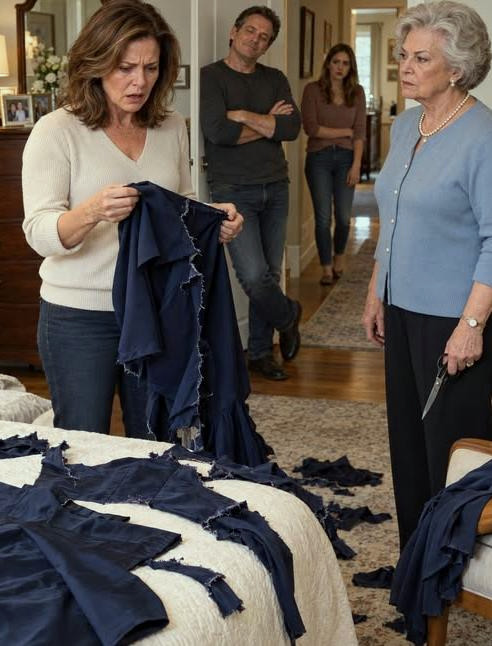
My mother-in-law was still cutting through the bodice of my $1,400 ceremonial gown when she reminded me that Harold hated spicy food.
The scissors snapped shut with a small, neat sound.
I stood in the doorway of the guest room, holding my coffee, and stared at the ivory fabric spilling across the carpet. Patricia looked up as calmly as if I had asked where she kept the salt.
“Well,” she said, lowering the scissors, “now you won’t need it.”
I set the mug on the hall table. “What did you do?”
She lifted one shoulder. “You heard me.”
I bent down and picked up a piece of the skirt. The fabric was soft beneath my fingers, with a narrow row of pearl-colored stitching along the hem. I had spent three weeks arguing with myself before buying that dress. Mark had called it ridiculous. Patricia had called it “a little showy.”
It was fitted at the waist, modest at the shoulders, and the only beautiful thing I had ever bought simply because I wanted it.
“Why did you cut my gown?” I asked.
Patricia gave me the expression she used when she thought I was being deliberately difficult. “Because you have dinner tomorrow.”
“What dinner?”
“My dinner. Twelve people.”
“You said you were thinking about inviting a few friends.”
“I invited them.”
I looked at the ruined gown, then at the scissors in her hand. “My award ceremony is tomorrow.”
“I know about the ceremony, Claire.”
“Apparently, you don’t know what it is.”
Her mouth tightened. “It’s an award.”
“Yes.”
“And this is family.”
The words landed harder than the scissors had. Patricia gestured toward the torn dress. “Someone has to cook. Linda can’t stand for long, Harold cannot eat anything spicy, and your pot roast is the only thing everyone likes.”
For one strange second, the scene became so absurd that I nearly laughed.
“You destroyed my dress because Harold dislikes pepper?”
“Don’t be dramatic.”
Mark appeared behind me. He had been listening. His eyes moved from the dress to his mother, and the corner of his mouth lifted.
“Mom,” he said, almost amused, “seriously?”
Patricia shrugged. “She was going to abandon me with twelve guests.”
“I didn’t invite them.”
Mark leaned against the doorframe. “Claire, don’t start.”
I held up the cut sleeve. “Don’t start?”
“You’re acting like somebody died.”
“I am supposed to wear this tomorrow.”
“So wear something else.”
“To accept a national award.”
He sighed as though I had explained a childish obsession for the hundredth time. Then he said, “You’re a wife, not a celebrity. Act like one.”
His voice was casual. That was the cruelty of it. He did not think he had said anything terrible.
Melissa appeared at the end of the hallway. I had helped raise Mark’s daughter since she was nine. She looked at the scraps on the floor.
“Oh my God, Grandma.”
“Don’t be dramatic,” Patricia said.
Melissa picked up a torn piece. “Can’t they just mail you the award?”
Twenty-two years of homework, wedding invitations, hospital visits, and birthday cakes. Apparently, she believed national ceremonies worked like replacement bank cards.
Nobody apologized.
I crouched and gathered the pieces. Patricia immediately began talking about when I should start the roast. I carried the gown into the guest room and shut the door.
An hour later, I sat in my car in the driveway with the engine off. Through the living-room window, I could see Patricia drinking tea on my sofa as though nothing had happened.
My phone buzzed at 10:43.
Sam Ortega, the event producer, had written: “Please arrive by 4:30 tomorrow. Your presenter has requested a private meeting before the ceremony.”
I typed, “Who is presenting my award?”
The reply took nearly a minute.
“ She specifically asked us not to tell you.”
I read it twice. Then I noticed one narrow strip of the gown lying on the passenger seat. Without thinking, I tied it around my wrist.
By Saturday morning, Patricia had placed a yellow grocery list beside my coffee. Pot roast. Carrots. Green beans. Cheesecake.
She tapped the paper. “People still have to eat.”
I pushed it back. “I’m not cooking tonight.”
Mark lowered his phone. “Claire.”
“I didn’t invite twelve people.”
Patricia looked at him. He looked at me.
I took my coffee and walked away before I could repair their discomfort for them.
At 1:15, while I was packing the torn gown into a garment bag, someone knocked on the front door. Patricia called from the kitchen, “Claire, get that. It’s probably the caterer.”
I opened the door.
A woman in a navy coat stood on the porch, holding a leather portfolio against her chest. She glanced at the strip of fabric around my wrist, then at my face.
“Claire Bennett?”
“Yes.”
Her eyes shifted past me toward the kitchen, where Mark and Patricia had begun arguing.
“I’m sorry,” she said quietly. “We need to speak before your family hears what’s inside this folder.”
She opened the portfolio and reached for the first document…
PART 2
The woman’s hand stopped above the portfolio.
“Who are you?” I asked.
“Dr. Evelyn Shaw.” Her voice was low, controlled. “I chair the National Service Foundation.”
I knew the name. Everyone in my field did. The foundation had funded emergency food programs across the country, including the network I had spent six years building from my dining-room table.
Mark’s footsteps sounded behind me.
“Claire?” he called. “Who is it?”
Evelyn closed the portfolio. “Not here.”
Patricia appeared over his shoulder, wiping her hands on a dish towel. “The delivery is late. Tell them to leave the groceries by the garage.”
Evelyn looked at the kitchen, the yellow list, and the torn garment bag hanging from my hand.
“Is this what you were expected to do today?”
I felt heat rise into my face. “Apparently.”
Mark stepped onto the porch. “Can we have a little privacy?”
Evelyn studied him. “You must be Mark.”
He straightened. “Yes.”
“I’ve heard your name.”
Something in his expression changed. It was tiny, but I saw it. The smile disappeared before it fully formed.
“From where?” he asked.
“Claire’s reports.”
Mark glanced at me. “She has reports?”
I almost laughed. He had spent years calling my work “volunteer paperwork.”
Evelyn turned to me. “The ceremony begins at seven. We can arrange a replacement gown, but that is not why I came.”
Patricia’s fingers tightened around the dish towel. “She cannot go anywhere. The guests arrive at six.”
Evelyn looked at her. “The guests can eat somewhere else.”
“That is not your decision.”
“No,” Evelyn said. “It is Claire’s.”
The sentence struck me harder than it should have. I had forgotten what it felt like to hear another person assume my time belonged to me.
Mark took my elbow. His fingers pressed into the spot where the fabric strip was tied.
“Claire, we have discussed this. You are not going to let a little family problem ruin everything.”
I pulled away. “You cut my dress.”
“My mother cut your dress.”
“And you told me I was a wife, not a celebrity.”
He looked toward Evelyn. “That was private.”
“No,” I said. “It was loud enough for everyone.”
Evelyn opened the portfolio again. Beneath the top page was a cream-colored invitation embossed with the foundation’s seal. My name appeared beneath the words NATIONAL COMMUNITY IMPACT AWARD.
Under it, in smaller print, was a second line I had never seen.
“Claire Bennett,” Evelyn said, “the board has voted to appoint you national director of the Emergency Table Initiative. We wanted to ask you in person before the ceremony.”
My breath caught.
Mark stared at the page. “That is a full-time position.”
“Yes,” Evelyn replied.
“And she would be traveling.”
“Yes.”
Patricia gave a short, disbelieving laugh. “She cannot possibly do that. She has responsibilities here.”
Evelyn’s gaze moved to the torn dress. “So I understand.”
For six years, I had designed the system that moved meals through churches, schools, and neighborhood kitchens whenever floods, fires, or factory closures left families without food. I had written the procedures, trained the coordinators, and solved problems at three in the morning. I had never told Mark the full truth because every time I tried, he asked whether the work paid enough to justify the trouble.
The foundation knew.
My hands trembled as I touched the invitation. “Why didn’t you tell me?”
“Because the board wanted to make the offer publicly,” Evelyn said. “And because you kept saying your family needed you.”
Mark’s face hardened. “She is not moving across the country for a title.”
“It is not a title,” Evelyn said. “It is the position from which she has already been doing the job.”
Patricia stepped closer. “Claire, you are being emotional. You have dinner to prepare.”
I looked at the grocery list still clutched in her hand.
Then Evelyn said, “There is one more matter. Before Claire accepts, she needs to see the financial review.”
Mark turned sharply. “What review?”
Evelyn reached beneath the invitation and pulled out a thin white folder. “The foundation found irregularities in the travel and consulting accounts attached to the initiative. Several approvals carry Claire’s name, but the handwriting is not hers.”
The porch seemed to tilt beneath my feet.
Mark’s eyes dropped to the folder.
Evelyn placed it in my hands. “The signature comparison was completed yesterday. We are meeting with the board at five.”
I opened the cover.
The top page contained a single line, followed by a signature that looked almost like mine…
PART 3
The signature was mine only from a distance.
Up close, the final letter leaned too far to the left, exactly as Mark’s did when he signed birthday cards for Melissa.
I looked at him. “Why is your signature on a foundation account?”
His face went pale. “It isn’t.”
Evelyn placed a second page beside the first. “This approval authorized consulting payments to Bennett Strategic Solutions.”
“That is my company,” Mark said.
“You have a company?” I asked.
He opened his mouth, then shut it.
Patricia stepped between us. “Claire, lower your voice.”
I turned to her. “You knew?”
“I knew Mark was helping with the administrative side.”
“He told me he was reviewing hospital contracts.”
Mark’s jaw tightened. “It was temporary.”
Evelyn held out another document. “The payments began eleven months ago. The total is eighty-four thousand dollars.”
My fingers went numb around the folder. “From the initiative?”
“Yes. Money intended for emergency meal sites.”
Mark shook his head. “I was going to replace it.”
“With what?” I asked. “The promotion you were expecting because you used my work to impress your employer?”
His silence answered before he did.
Patricia’s face changed. “He said the foundation owed him. He said you had promised to compensate him.”
“I never promised him anything.”
“You were married,” she said. “What was yours was his.”
Evelyn’s expression became very still. “That is not how the accounts were represented.”
Mark grabbed the folder. “This is a misunderstanding.”
I held on. “Let go.”
He did not.
For a moment, we stood on the porch pulling against opposite ends of the paper. I could feel the rough edge cutting into my thumb.
Then the front door opened wider, and Sam Ortega stepped inside the entryway with two staff members behind him.
He looked at the torn gown, the scattered pages, and Mark’s hand locked around the folder.
“Claire,” he said, “the board meeting has been moved up.”
Mark released the papers.
Evelyn retrieved them and faced him. “You are not attending.”
“I am her husband.”
“You are the subject of the financial review.”
The words hung in the afternoon air.
Patricia turned to Mark. “You said this was approved.”
“I said I was handling it.”
“You said Claire knew.”
“I thought she would understand.”
That was the moment the truth stopped being hidden behind paperwork. He had not made one careless mistake. He had built a private business around my unpaid labor, my reputation, and the trust people placed in my name.
I looked at the grocery list on the hall table through the open door.
“You cut my gown because you needed me home,” I said.
Mark’s eyes flickered. “That had nothing to do with this.”
“It had everything to do with this. You wanted me small enough to keep serving dinner while you stood on my work.”
Patricia whispered, “Mark.”
He turned on her. “You told me she would not leave if the ceremony became impossible.”
Patricia stared at him.
I felt something inside me settle, not gently, but firmly.
Evelyn touched my arm. “Claire, the board will protect the initiative, but we need a decision from you tonight. If you accept the directorship, the review becomes public. Your marriage and your household will be examined alongside the accounts.”
Mark stepped toward me. “You cannot do that to us.”
“To us?”
“I made a mistake.”
“You used my name.”
“I was trying to build something.”
“You built it with money meant to feed people.”
Sam checked his watch. “We have forty minutes.”
Patricia looked at the ruined gown. “Claire, if you walk out now, do not expect this family to be waiting for you.”
I picked up the invitation and the folder.
“I have been waiting for this family to see me for years,” I said. “Tonight, I’m going somewhere they cannot cut me down to fit.”
As I stepped toward the car, Evelyn’s phone rang. She listened, frowned, and handed it to me.
A woman on the other end introduced herself as the foundation’s auditor.
“Claire,” she said, “we found one more transfer. It was made this morning, after the review began. The money went to an account connected to someone in your house…”
The transfer made that morning changed everything…
I thought the ruined gown was the deepest betrayal. I was wrong. The last document forced every person in that house to choose a side.
“Someone else’s scissors do not decide what the fabric becomes.”
I finally understood why she had come herself.
👇 The final part of the story is open.






