PART 4
I stopped beside the car.
The strip of ivory fabric around my wrist had begun to unravel. One loose thread brushed my knuckles while I listened to the auditor breathe on the other end of the call.
“Whose account?” I asked.
The woman hesitated. “Patricia Bennett’s.”
Behind me, Patricia made a sharp sound.
Mark turned toward her. “What?”
The auditor continued, “The transfer was for twenty thousand dollars. It was labeled as a household reimbursement, but the authorization used the same false signature attached to the other payments.”
I lowered the phone.
Patricia’s face had gone white.
Mark looked from her to me. “Mom?”
She backed against the doorframe. “I didn’t know what it was.”
“You accepted twenty thousand dollars without asking?” I said.
“Mark told me it was a bonus.”
“You told her it was a bonus?”
He rubbed both hands over his face. “I needed her help.”
“With what?”
He looked toward the kitchen, toward the yellow grocery list, the unfinished vegetables, and the roast waiting in its plastic tray.
“I needed someone to keep you occupied,” he said.
The sentence entered the room like a dropped glass.
Patricia stared at him. “You said she was neglecting the family.”
“I said she was becoming impossible.”
“You said she would leave us.”
“I was trying to stop her from making a scene at the ceremony.”
Evelyn took the phone from my hand and spoke to the auditor. “Freeze every account connected to the initiative. Send the full report to the board. We are leaving now.”
Mark stepped in front of me. “Claire, please. We can fix this privately.”
“Privately?”
“The money can be returned.”
“With what?”
He looked at the floor.
The answer was obvious. He had already spent most of it.
A car horn sounded at the curb. Sam had brought the replacement gown. It was dark green, simple, and too large through the shoulders, but it was clean and wearable. A woman from the event staff carried it inside on a padded hanger.
Patricia reached for it.
“Don’t,” I said.
Her hand stopped in midair.
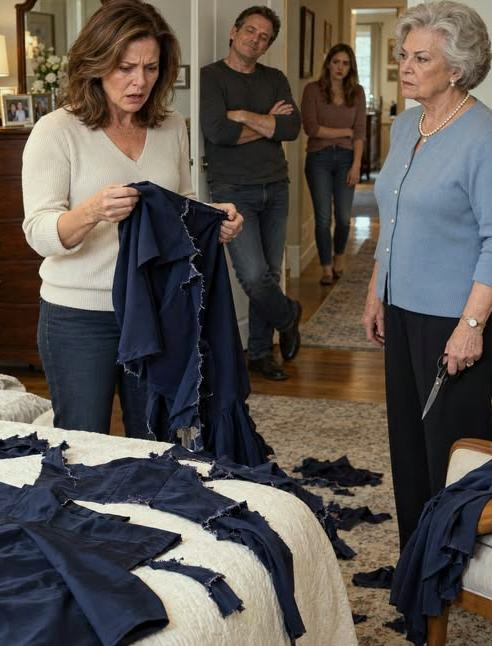
That small movement carried the whole night with it: the scissors, the torn hem, the grocery list, and every time she had treated my work as a service she could demand.
The staff woman gave me the gown. “The dressing room is at the venue.”
“I’ll change there.”
Mark followed me onto the porch. “You are really going to expose your husband over a bookkeeping mistake?”
“You forged my name.”
“I used the name attached to the project.”
“It was my name.”
“I made the project visible. I introduced it to people at the hospital.”
“You introduced yourself as the person behind it.”
His shoulders dropped. “Nobody respects a woman who works from home.”
Evelyn, standing by the car, looked at him. “The foundation respected her because she solved problems you could not even describe.”
He faced me again. “I was finally about to become something.”
There it was. Not greed alone. Not even hatred. He had wanted the status he believed my work could buy him, and he had mistaken my patience for permission.
“You were already something,” I said. “You just wanted strangers to believe you were me.”
At 4:58, we drove to the convention center.
The board meeting lasted twenty-six minutes.
Mark was not there. Patricia was not there. I sat beneath a framed photograph of volunteers unloading food boxes during a winter power outage while Evelyn laid out the documents one by one.
The board did not ask whether I had known. They asked why I had stayed silent about the work for so long.
I told them the truth.
“I thought if I explained it carefully enough, my family would understand why it mattered.”
Evelyn folded her hands. “And now?”
“Now I understand that being understood cannot be the condition for doing what is right.”
The board voted unanimously to appoint me national director. They also voted to suspend every contract connected to Mark’s company and to recover the diverted funds through civil action. No dramatic handcuffs. No shouting cameras. Just signatures, canceled access cards, and a line in a report that reduced his secret ambition to a measurable loss.
Patricia returned the money before the board could pursue her separately. She sold the jewelry she had bought with it and brought the receipt to the foundation herself.
She came to my hotel room after the ceremony, still wearing the navy dress she had planned for her dinner guests. The sleeves were wrinkled. Her hands smelled faintly of roasted onions.
“I did not know the whole truth,” she said.
“You knew enough to cut my gown.”
Her eyes filled, but she did not ask me to comfort her.
“I thought Mark was protecting the family,” she said.
“He was protecting the version of himself he wanted people to admire.”
She looked down. “I helped him.”
“Yes.”
The word hurt her. I could see it. I let it remain between us.
“Are you leaving him?” she asked.
“I am leaving the marriage.”
She gripped the strap of her handbag. “And the house?”
“I am not keeping it.”
That surprised her.
The house was tied to too many demands. Every room had a task waiting inside it. Every chair seemed to remember someone asking me to give up an hour, a plan, a piece of myself.
I had already signed the lease on a small apartment near the foundation’s office. The decision had frightened me. It had also made my breathing easier.
“What will you do with it?” Patricia asked.
“Sell it. The proceeds will cover the repayment schedule and the emergency fund Mark damaged.”
She looked at me for a long moment. “You are still helping the people he stole from.”
“I am helping them because they need it. Not because he does.”
At seven o’clock, the ceremony began.
The replacement gown pulled awkwardly at my shoulders, but under the stage lights no one could tell. The audience rose when my name appeared on the screen.
Then Evelyn walked onto the stage.
She did not introduce me as a devoted wife, a supportive daughter-in-law, or someone who had managed to balance everything gracefully. She told the truth.
“Claire Bennett built the Emergency Table Initiative from a folding table in her dining room,” she said. “She connected thousands of volunteers before most of us understood what the next disaster would require. She did not wait for permission to make a system work.”
My throat tightened.
The camera moved across the audience.
At home, Mark and Patricia were watching with the television turned too loud. Melissa sat between them, holding her phone. I learned that later from Melissa herself.
When Evelyn handed me the award, I saw my reflection in its polished surface: tired eyes, borrowed gown, and the narrow torn strip still tied around my wrist.
Evelyn leaned close. “You kept that?”
“It reminded me to leave.”
“No,” she said. “It reminded you that someone else’s scissors do not decide what the fabric becomes.”
I laughed, and the sound came out uneven.
After the ceremony, Melissa called.
I almost let it go to voicemail.
“Claire,” she said when I answered, “I’m sorry.”
I sat on the edge of the backstage table. A volunteer was packing unused meal cards into a cardboard box nearby.
“For what?”
“For saying they could mail your award.”
Despite everything, I smiled. “That was not the worst thing anyone said.”
“I know. I heard the broadcast.”
Her voice shook. “I also found the emails Dad sent you. He told me you were too busy with charity work to help with my wedding because you did not care.”
I closed my eyes.
“I did care.”
“I know that now.”
There was a long pause.
“Do you want me to come with you?” she asked.
The question was not an apology large enough to erase twenty-two years. But it was a choice, and for once, it was hers to make.
“Come tomorrow,” I said. “Not to fix anything. Just to help pack the food kits.”
“I will.”
When I returned to the hotel room, the award stood beside the lamp. The gold letters caught the light. My torn gown lay in its garment bag on the chair, the skirt still separated into uneven pieces.
I removed the strip from my wrist and placed it on top of the award.
Then I noticed the final stitch still holding two fragments together.
It was a tiny, stubborn line of pearl-colored thread.
I picked up the needle from the emergency sewing kit, pushed it through the fabric, and began stitching the pieces back together—not to wear the gown again, but to carry it into the foundation’s first public exhibition as evidence of the night someone tried to reduce my life to dinner.
The next morning, beside the meal kits, Melissa found the repaired sleeve and asked what we should call the display.
I looked at the crooked seam and said, “Call it the night the scissors missed.”
Missed the beginning?






