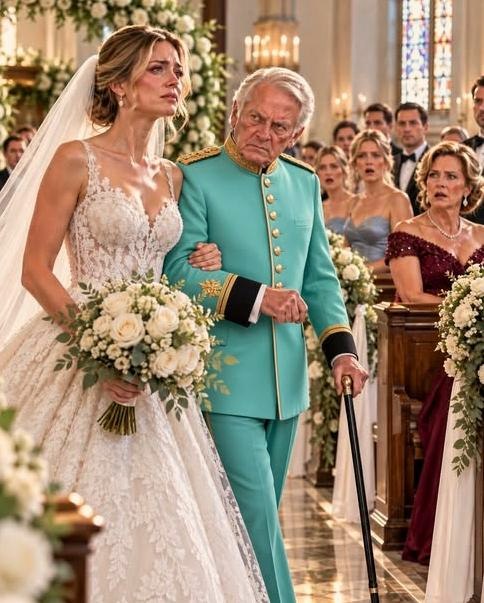
My mother refused to touch my veil on the morning of my wedding, and then she told the room exactly why.
“I will not walk my greatest regret to the altar,” Margaret Stone said.
The words landed harder than any slap. My fingers tightened around the pearl comb holding my veil, and one tiny pearl pressed painfully into my scalp. Behind her, my sisters watched with the same bright, satisfied expressions they had worn whenever I was punished as a child.
Lauren glanced at my face in the mirror.
“Try not to cry, Emma. That mascara was cheap.”
Paige adjusted the diamond bracelet Mother had bought her for finishing business school. The stones flashed beneath the dressing-room lights while I stood in a dress I had paid for myself, with a smile I no longer recognized.
My father remained by the hotel suite’s brass-trimmed door in his gray tuxedo. He looked almost bored.
“Your mother is entitled to her feelings,” he said. “You’ve always made important days difficult.”
“Difficult,” I repeated.
That was the word they had used whenever I asked why my college fund had vanished. Whenever I wondered why Grandpa Arthur’s letters suddenly stopped arriving. Whenever I chose forensic accounting instead of marrying a wealthy man and smiling beside him at charity dinners.
Daniel moved toward my father.
“Don’t speak to her like that.”
I caught his sleeve before he could take another step. The fabric was warm beneath my fingers.
“Not yet,” I whispered.
Mother gave a small laugh.
“Still dramatic. Even in a wedding dress.”
At 8:17 that morning, the suite door opened again.
Grandpa Arthur stood in the hallway, leaning on a black cane with a silver horse’s head. He was eighty-one, thin as a walking stick himself, and wearing a navy suit that had been pressed so carefully the cuffs looked sharp enough to cut paper.
He looked at my mother.
“What did you just say?”
Margaret’s face hardened.
“This is family business.”
“I am family.”
My father stepped away from the door.
“Arthur, don’t make a scene before the ceremony.”
Grandpa ignored him. He came to me and held out his hand.
“I’ll walk you.”
My throat closed.
“Grandpa, you shouldn’t have to—”
“You were never something to regret,” he said quietly. “You were the only one who came back looking for the truth.”
Mother’s smile flickered. Only for half a second.
But Grandpa saw it.
So did I.
At 9:03, the church organ began. The chapel was packed with relatives, neighbors, business partners, and donors connected to my parents’ family foundation. Everyone believed the Stones were generous, polished, untouchable.
They did not know that for eighteen months I had been following the money.
Every transfer. Every altered invoice. Every charity account that emptied at midnight and refilled through a company no one had heard of.
Daniel knew enough to understand why I had spent my engagement nights surrounded by spreadsheets instead of wedding magazines. Grandpa knew only that I had asked questions he once thought my mother would answer.
We reached the chapel doors. Sunlight fell across the brass handles, turning them white.
Grandpa placed his hand over mine.
“Ready?”
“No,” I admitted.
“Good. Courage rarely feels ready.”
The doors opened.
Hundreds of faces turned toward us. At the front, Mother sat rigidly beside my father. Her chin was raised. His hands were folded over one knee.
We walked halfway down the aisle.
Then Grandpa stopped.
The organ continued for three more notes before the musician realized something had changed.
Mother’s posture locked. My father’s smile vanished.
Grandpa slowly turned toward them, tightened his grip on his silver-headed cane, and lifted his voice so every donor could hear.
Then he began to speak…
PART 2
“The missing charity money is in your accounts.”
Grandpa said the eight words calmly, almost gently.
But the chapel reacted as if someone had shattered every stained-glass window at once.
A woman in the second pew gasped. Someone behind me whispered, “What?” The organist’s fingers slipped from the keys, leaving one thin, ugly note hanging in the air.
Mother rose halfway from her chair.
“Arthur, you are confused.”
“No,” he replied. “I am late.”
My father’s face had turned the color of candle wax.
“Sit down,” he hissed. “You don’t understand the accounts.”
“I understand them better than you think.”
Grandpa reached inside his suit jacket and removed a narrow leather folder tied with a brass clasp. I recognized it immediately. It had belonged to his old bookkeeper, Miriam Cole, the woman who had handled the foundation’s first grants before she disappeared from every family photograph.
My mother stared at the folder.
“Where did you get that?”
“From the person you paid to destroy it.”
The chapel fell silent again.
Daniel stepped closer to me.
“Emma, what is happening?”
I swallowed. The truth had lived inside my chest for so long that saying it aloud felt like breaking a bone.
“I found transfers from the Stone Family Foundation to three companies registered to a warehouse on Calder Street,” I said. “Those companies paid for the new house, Paige’s wedding, Lauren’s graduate tuition, and the private clinic renovation Dad called a donation.”
Paige’s bracelet stopped moving.
“That’s impossible,” she said.
“Your wedding deposit was transferred through North Vale Consulting,” I answered. “North Vale has the same mailing address as the foundation’s storage office.”
Lauren looked at our father.
“Dad?”
He did not answer.
Mother’s voice rose above the murmurs.
“She has been obsessed with numbers for years. She steals private documents and calls it investigation.”
“I requested them,” I said. “From the bank.”
“You had no right.”
“I had every right. I was hired by the foundation’s audit committee after the annual report showed a six-hundred-thousand-dollar gap.”
My father took one step toward me.
“You were dismissed.”
“I resigned when you ordered me to sign a report I knew was false.”
A man in the front pew stood. He was Harold Vance, the foundation’s current chair, and his red tie was pulled crooked beneath his collar.
“Margaret,” he said, “is this true?”
Mother turned on him.
“Not here.”
“Then where?” Grandpa asked. “At another fundraiser? Beneath another banner promising help to families who never received it?”
My pulse hammered against the pearls at my throat. I had expected anger. I had expected denial. I had not expected the shameful relief of hearing someone else say the words I had been afraid to say alone.
My father leaned close enough for me to smell his bitter coffee.
“If you continue, you will destroy this family.”
I looked at the crowded chapel, at the donors who had trusted us, at Daniel waiting beside me in his rumpled tuxedo.
“No,” I said. “The missing money did that.”
Grandpa opened the leather folder. Inside were bank statements, handwritten notes, and a single page covered in blue-black ink.
Mother saw the page and suddenly stopped breathing normally.
Grandpa lifted it between two fingers.
“This is the signature that started everything,” he said. “And the person who wrote it is sitting in this church.”
A woman near the rear aisle began to sob.
My father stared at the paper.
Then, before Grandpa could name the signer, the chapel doors slammed open behind us…
PART 3
A courier stood in the open doorway, clutching a wooden document box against his chest.
He was small, gray-haired, and wearing a brown coat darkened by rain. I knew him immediately, though I had not seen him since I was seventeen.
“Miriam,” I whispered.
My mother gripped the back of her chair.
The old bookkeeper walked down the aisle without looking at anyone. Her shoes made soft, deliberate taps against the stone floor. When she reached Grandpa, she placed the box in his hands.
“I should have come sooner,” she said.
My father’s voice cracked.
“You signed a confidentiality agreement.”
Miriam turned toward him.
“You stopped paying me when I refused to falsify the grant records.”
Mother shook her head.
“You were dismissed for incompetence.”
“No,” Miriam said. “I was dismissed because I found the second ledger.”
She opened the box. Inside lay a bound register, its corners worn and its pages marked with small red tabs.
Every face in the chapel angled toward it.
Miriam looked at me.
“Your grandfather asked me to keep this safe after your mother changed the foundation’s structure. I mailed you letters because I thought you deserved to know why his contact with you ended.”
My breath caught.
“Those letters never reached me.”
“I know that now.”
Grandpa’s jaw tightened.
“Margaret told me Emma wanted nothing to do with us. She showed me a note supposedly written in Emma’s handwriting.”
Mother’s eyes flashed.
“You were unstable after your surgery. I protected you from a daughter who only wanted money.”
Miriam removed a folded sheet from the register.
“The note was not written by Emma. I compared it with her old school forms. The pressure marks, the loops, the ink were different.”
She placed the page beside my hand.
I recognized the handwriting immediately. It belonged to Mother.
For years, she had made me believe Grandpa had abandoned me because I had disappointed him. She had let me grieve a relationship she had secretly cut apart.
Daniel took my elbow.
“Emma, breathe.”
I barely heard him.
Miriam pointed to the ledger.
“Margaret created North Vale Consulting. Your father approved the transfers. The money was meant for housing grants, medical transport, and emergency food programs. Instead, it paid private expenses and loans to relatives.”
Paige stared at her bracelet.
“I thought Mom paid for my wedding.”
“She did,” Miriam replied. “With funds marked for displaced families.”
Lauren began to cry.
“I didn’t know.”
“I believe you,” I told her. “But the families still went without.”
Harold Vance took the ledger from Miriam and turned several pages. His hands began to tremble.
“Margaret, you signed these approvals.”
Mother looked at my father.
He finally spoke.
“You said the accounts would be restored.”
Her head snapped toward him.
“You agreed.”
“I agreed to protect the foundation, not to bury it.”
The confession escaped before he could pull it back. A wave of horror moved through the chapel.
Grandpa closed the document box.
“The foundation board meets at noon,” he said. “The assets will be frozen, the grants audited, and the people who were denied help will be contacted first.”
My wedding had become a public reckoning, but the worst blow had not yet landed.
Harold’s phone rang. He answered, listened, and turned pale.
“What is it?” I asked.
He looked at my father.
“Daniel’s mother is calling from the hospital. The Stone Foundation’s emergency clinic has been shut down because the medication account is empty.”
Daniel went still.
His mother was the clinic’s director.
And my father had signed the last transfer out of that account that morning…
The document in Grandpa’s box changed our wedding forever…
I thought the wedding had already exposed every betrayal. I was wrong. The final discovery forced us to choose between protecting our family and protecting the people it had harmed.
“Tell them where the money went.”
My father’s hands began to shake.
👇 The final part of the story is now open.






