PART 4
Daniel was already moving before Harold finished the sentence.
“My mother is there,” he said.
“I know,” Harold replied. “She says the insulin shipment was never paid for.”
Daniel turned to my father.
“What did you do?”
My father’s mouth opened, but no answer came. His cuff link caught on the edge of the pew, and he tore the fabric trying to pull free.
Mother reached for him.
“Richard, say something.”
He shook her off.
That small movement changed everything.
For years, I had watched them stand shoulder to shoulder while I was blamed for every fracture in the family. But now, beneath the church’s old stone arches, they separated as if the floor had opened between them.
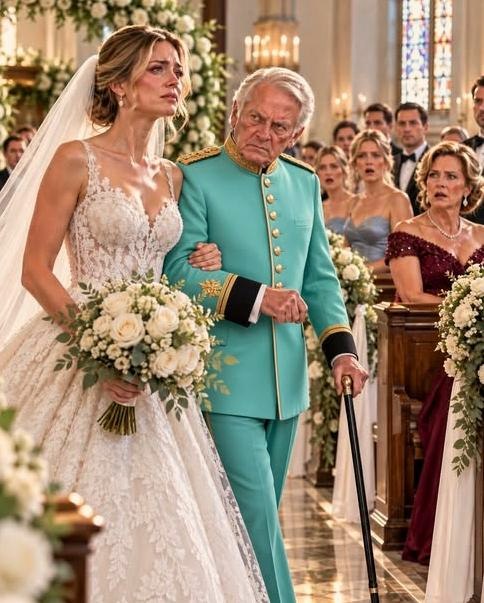
Grandpa pressed the document box into my hands.
“Go with Daniel,” he said. “I will bring the board to the clinic.”
“You can’t manage a crisis like this alone.”
He tapped the silver horse’s head of his cane against the floor.
“Child, I managed worse before you were born.”
At 9:21, Daniel and I left through the side entrance. The wedding guests followed us in a confused stream, carrying programs with our names printed in gold. No one knew whether to offer congratulations or condolences.
The clinic stood six blocks away, a narrow brick building with a blue medical cross above the entrance. When we arrived, the automatic doors were propped open with a box of empty saline bags.
Daniel’s mother, Claire, rushed toward us in a white coat.
“Daniel, the refrigeration unit is running on borrowed power. We have enough insulin for four hours.”
“Why wasn’t the account funded?” he asked.
Claire looked at me.
“Your father called at seven. He told me the transfer had been delayed because of an internal review.”
I felt the wedding comb press against my hair as I turned.
“Did he say anything else?”
“He asked whether your name was on the clinic’s emergency authorization.”
Daniel stared at me.
“What does that mean?”
I remembered a document my father had forced me to sign two years earlier, when I still believed he wanted me involved in the foundation. It had been described as a routine authorization for outside auditors.
I had never seen the final page.
At 9:46, Grandpa arrived with Harold, Miriam, and two board members. Arthur was breathing hard, but his eyes were clear.
Miriam carried a second folder.
“I found the missing page,” she said.
My hands went cold.
The document named me as the foundation’s protected financial officer, effective on the date of my twenty-ninth birthday. It also stated that no major transfer could be approved without my signature.
My father had removed my access, hidden the appointment, and continued moving money as though I did not exist.
“He intended to use your name,” Miriam explained, “then claim you approved the expenditures if anyone discovered them.”
Daniel stepped toward my father.
“You were going to blame her?”
Richard looked older than he had an hour earlier.
“I was trying to keep the foundation alive.”
“You emptied the medicine account.”
“I needed to cover the shortfall.”
“Created by whom?” Harold demanded.
Richard looked at Margaret.
She flinched.
He pointed at her with a shaking hand.
“She borrowed against the foundation to pay the contractors for the resort property.”
Mother’s face collapsed.
“That property was supposed to secure our future.”
“Whose future?” I asked.
She turned toward me, furious and frightened.
“You think I wanted this? Do you know what it was like raising three daughters while your grandfather treated this family like an investment portfolio? Paige was promised a life. Lauren was promised security. You were always looking at us as if we were evidence.”
“Because you kept making us into expenses.”
Her eyes filled.
“I was afraid.”
The admission did not excuse her. But it gave the betrayal a human face, and that was somehow harder to bear than hatred.
Grandpa leaned against his cane.
“You intercepted her letters because you were afraid she would ask questions.”
Margaret looked at me.
“I thought if you knew what the foundation was worth, you would take it from us.”
“I wanted my grandfather back.”
That sentence broke through her defenses. She sat down on a plastic waiting-room chair, gripping the edge until her knuckles whitened.
Miriam opened the second folder.
“There is one more matter. Arthur did not merely preserve the records. He transferred his voting shares to an independent trust last night.”
Harold looked at him.
“You did what?”
Arthur glanced at me.
“I was tired of leaving power in the hands of people who confused family loyalty with silence.”
The trust named an independent board, the clinic, and a housing cooperative as beneficiaries. Not me. Not Paige. Not Lauren. The foundation would survive, but the family’s control would end.
My father stared at him.
“You would give it all away?”
“It was never yours to spend.”
At noon, the emergency board meeting took place in the clinic’s supply room. Boxes of gauze lined the walls. A portable refrigerator hummed beside the folding table. Every person there had a reason to be angry, but the patients waiting beyond the partition had a more urgent reason to need us.
The board voted to suspend my parents’ authority. The resort property would be sold. The diverted funds would be traced and returned where possible. Paige and Lauren would repay what they could, not because they had designed the scheme, but because they had benefited from it.
Paige removed her diamond bracelet and placed it on the table.
“Sell this first,” she said.
Lauren took off her engagement ring.
“My tuition can wait,” she whispered.
I looked at both of them. Their guilt could not feed a family or restore a missed treatment, but it was the first honest thing they had offered me in years.
“I won’t pretend this fixes everything,” I said.
Paige nodded.
“I know.”
Mother remained outside the room until the meeting ended. When she finally entered, she held a small envelope against her chest.
Not gray. Not sealed with wax. Just a cream envelope softened at the corners from being carried too long.
She placed it in front of me.
“Those were the letters,” she said.
My hands shook as I opened the envelope. Inside were eighteen letters from Grandpa, one for every month I had believed he had forgotten me.
The first began, “My dear Emma, your mother tells me you no longer wish to hear from me. I hope she is wrong.”
I could not read further.
Grandpa took the letter gently from my hand.
“Not today,” he said.
Mother lowered herself into the chair beside me.
“I cannot ask you to forgive me.”
“No,” I said. “You can’t.”
Her face tightened, accepting the wound.
“But you can answer one question,” I continued. “Why did you call me your greatest regret?”
She looked toward the clinic hallway, where nurses hurried past with medicine trays.
“Because I regretted the person I became when you started asking questions,” she said. “It was easier to call you the problem than admit you were seeing me clearly.”
I had imagined this moment for years. In every version, I delivered a perfect speech. In reality, I only felt tired.
“Then remember that answer,” I told her. “Every time you want to blame me again.”
She nodded.
Daniel came to stand beside me. His wedding jacket was wrinkled, his collar open, and there was a smear of dust on one sleeve from the clinic floor.
“We still have a ceremony,” he said quietly.
I looked at the church program in his hand. Our names were still there, surrounded by gold leaves and promises written by someone who had never seen a family fall apart before lunch.
“I don’t want the ceremony we planned.”
“Good,” he said. “Neither do I.”
At 3:12, we held the wedding in the clinic courtyard because the chapel had become a place of evidence, accusation, and broken appearances. The nurses stood along the brick wall. Claire brought out two folding chairs for Grandpa. Miriam stayed near the medicine refrigerator, still guarding the inventory sheets.
There was no orchestra.
There were no speeches from my parents.
Grandpa walked me across the courtyard with his silver-headed cane tapping beside us. Halfway to Daniel, he stopped and whispered, “You may still turn around.”
I looked at the clinic sign, the ledger under Miriam’s arm, and the cream envelope tucked safely inside my dress.
“I know,” I said. “I’m not turning around.”
Grandpa smiled.
When he placed my hand in Daniel’s, he did not give me away.
He gave me back to myself.
That evening, the first shipment of insulin arrived. Claire signed for it with a trembling hand, then carried the box inside as if it were a sacred object.
My parents left separately. Paige and Lauren stayed to help unload supplies. No one called it forgiveness. We had not earned that word.
But when Miriam handed me the foundation ledger, she pointed to the final blank page.
“What will you write there?” she asked.
I took the pen.
“Not my name,” I said. “The names of the people the money was meant to reach.”
Then, beneath the first name, I wrote the number of insulin boxes delivered that day, and Grandpa’s cane tapped once against the courtyard stones.
“Begin there,” he said.
Missed the beginning?






