PART 4
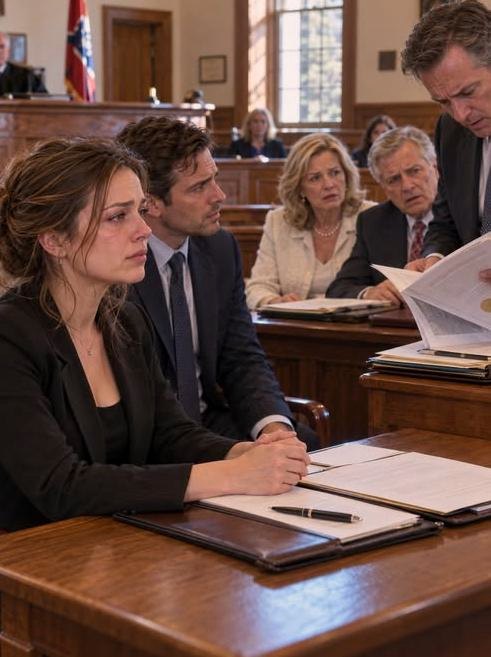
“That is not my signature,” Mom said.
The words landed harder than the phone call had.
Dad snatched the page from Evelyn’s hand. His knuckles whitened around the edges.
Martin Hale’s name appeared in the corner as the witness. Beneath it was a signature purporting to belong to Margaret Bennett, followed by a date three weeks before my parents had sued me.
Mom touched the ink with one trembling finger.
“I was at the eye clinic that day,” she said. “Claire drove me. We were there until noon.”
I remembered it immediately: the waiting room with the fish tank, the machine that puffed air into Mom’s eyes, and the paper cup of water she had crushed in her hand because she was afraid of the test.
Evelyn closed the folder.
“Then Martin Hale submitted a fraudulent notice in an attempt to challenge the easement.”
Dad lowered himself into the chair.
“He said it was only a letter of intent.”
“It contains a forged acknowledgment and a promise to grant access through protected land,” Evelyn said. “It is much more than that.”
I looked at my father.
“Why didn’t you tell me?”
He rubbed both hands over his face. “Because you would have stopped us.”
“Yes.”
“And because Martin said the farm was worth nothing if the restrictions stayed.”
“It was never supposed to be worth nothing,” I said. “It was supposed to stay intact.”
Mom’s mouth tightened. “We thought you were keeping us from our own property.”
“You thought I was keeping you from selling it.”
No one denied it.
Evelyn explained that the easement could not be erased by a private agreement. The land trust would reject Martin’s notice, demand restoration, and notify the county that no access permit existed. She also told my parents that the overdue work remained their responsibility.
Dad looked at me.
“Can we give it back to you?”
The question was so small that it almost disappeared beneath the hum of the fluorescent lights.
“No.”
Mom flinched.
I kept my voice steady. “Not because I don’t care about the farm. Because ownership cannot be passed around every time the work becomes inconvenient.”
Dad’s eyes filled, but he blinked the tears away.
“What do you want from us?”
I pointed to the ledger.
“Do the work. Sign the maintenance contract. Let Evelyn inspect the property. Tell Martin the deal is over. And stop telling people I manipulated you.”
Dad nodded once.
Mom whispered, “And if we cannot afford the restoration?”
“Then sell something else before you sell the promise Grandma made.”
That afternoon, Dad drove to Martin Hale’s office. I went with him, along with Evelyn and Calvin Rusk. The building stood beside the highway, all smoked glass and polished stone. Martin met us in a conference room where a scale model of the farm sat beneath bright lights.
He smiled at Dad.
“You brought the whole committee.”
Dad placed the preliminary agreement on the table.
“This is finished.”
Martin’s smile held. “You don’t understand what you’re throwing away.”
“I understand exactly what I almost threw away.”
Martin turned to me. “She filled your head with restrictions. You could have had a fortune.”
I looked at the model. In it, the farmhouse had been removed. The creek had become a straight blue line, and the woods were covered with tiny drawn roads.
“That isn’t our farm,” I said.
“It could be.”
“No. It could be yours.”
Dad pushed the forged notice across the table.
“And this?”
Martin’s expression changed.
“I didn’t forge anything.”
Mom stepped forward, leaning hard on her cane.
“You used my name.”
Martin looked toward his assistant.
“I had your authorization.”
“You never met me that day,” Mom said.
The assistant went pale.
Martin reached for the paper. Evelyn placed her hand over it.
“You will not remove that document,” she said. “It is evidence of an attempted interference with a recorded conservation agreement.”
There was no dramatic shout. No slammed door. Just Martin’s hand hovering above the page while the model of the destroyed farm sat between us.
Dad stood.
“I will not sign anything else.”
Martin’s voice hardened. “Then you will lose the property.”
Dad glanced at me, then at the model.
“Maybe,” he said. “But I won’t sell it to you.”
The land trust gave my parents thirty days to complete the first restoration phase. They sold the timber equipment Dad had bought and used only twice, emptied the account they had set aside for a new porch, and signed a payment plan for the remaining work.
Mom called me every Tuesday evening with questions about the inspection forms. At first she read them slowly, mispronouncing the technical words. I answered without correcting her tone.
Dad went to the creek with the restoration crew despite his back. He could not lift the heavy stones, but he marked the damaged bank with orange stakes and stayed until the last truck left.
One Saturday morning, he handed me a narrow metal box covered in dust.
“Found it behind the filing cabinet,” he said.
Inside were Grandma’s original easement papers, folded around a small brass compass. The lid carried her initials, E.B., scratched into the metal with uneven letters.
Dad had never shown it to me.
“She used it when she walked the boundaries,” he said. “She told me the creek was the easiest place to get lost.”
I turned the compass in my palm. The needle trembled, then pointed north.
“Why are you giving me this?”
“Because you were the one who knew where the boundaries were.”
It was not an apology yet.
But it was the first honest thing he had handed me in years.
The restoration inspection happened on a bright Thursday morning. Evelyn walked the creek with her clipboard. Mom waited beneath the sycamore tree, holding the reports. Dad stood knee-deep in grass beside the new stone reinforcement.
Evelyn crouched and examined the bank.
“The water is moving correctly,” she said.
Dad released a breath.
“Is that good?”
“It is what the agreement requires.”
He looked at me. “That is the nicest sentence I’ve heard all year.”
Mom gave a weak laugh, then reached for my hand.
“I was cruel,” she said.
I watched the creek slide around the stones.
“You were frightened.”
“I was both.”
That answer mattered more than an excuse would have.
Dad came closer.
“I told people you took the farm,” he said. “You didn’t. You took care of it.”
“I know.”
“And I made you prove the difference in court.”
I looked down at the brass compass. Its needle quivered above the scratched initials.
“You made yourself prove it.”
Martin Hale’s proposal disappeared. The land trust rejected his notice. The forged signature became part of the file that kept him away from the protected boundary, and the county refused his access request. He never came back to the farm.
My parents remained there, as the deed allowed, but the arrangement changed. They attended every inspection. They read every clause. They paid every bill tied to the land.
I did not move back into the farmhouse.
I did not become their unpaid caretaker again.
I became what Grandma’s compass had always understood me to be: someone who knew the boundaries and refused to pretend they were not there.
At the end of the inspection, Evelyn asked Dad to place the final orange marker beside the creek. His back forced him to move slowly. He pressed the stake into the wet earth, then looked toward the farmhouse.
“Claire,” he called, “is it straight?”
I checked the compass, the map, and the line of stones beneath the water.
“Yes,” I said. “Leave it there.”
Dad kept his hand on the marker while the creek moved around it, carrying Grandma’s promise safely toward the fields.
Missed the beginning?






