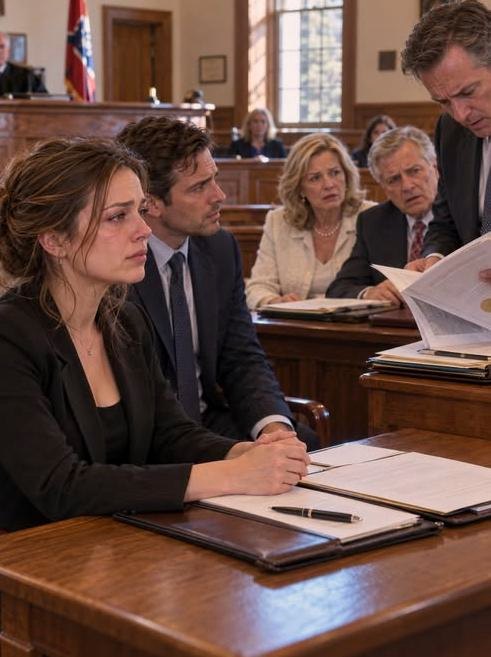
My mother smiled as I signed away the forty-two acres she had spent three years accusing me of stealing.
The courtroom smelled of floor polish, rainwater, and the peppermint candies Judge Holloway kept in a glass dish. I sat at the defendant’s table with my hands flat on the wood while Merritt, my attorney, watched the deed slide toward me.
“Claire,” he whispered, “you do not have to do this.”
Across the aisle, my mother adjusted the pearl button at her throat. Her eyesight had been failing for years, but she saw the smile on my face clearly enough.
My father sat beside her with his chin raised. His back hurt whenever he climbed the porch steps, yet that morning he looked carved from oak.
The judge studied me over her glasses.
“You understand that signing this document transfers the property back to your parents?”
“Yes, Your Honor.”
“And that you are surrendering any claim connected to the farm?”
“I understand.”
The pen felt strangely light.
That farm was not just land. It was the stone farmhouse where my grandmother measured flour with a chipped blue cup, the creek that flooded every spring, and the fields that turned copper beneath October sunsets. It had belonged to our family for three generations.
After Grandma died, my parents inherited everything. I left for college, married, moved to Nashville, and eventually returned near my hometown after my marriage ended. By then, Mom struggled to read a prescription label, and Dad pretended his back was fine whenever anyone asked.
I began helping with small things.
A property-tax notice hidden beneath seed catalogs. An insurance renewal that was eleven days overdue. A letter from the county asking for an inspection.
Then I found the conservation agreement.
Grandma had placed a permanent conservation easement on the farm in 1987. It protected the wetlands and stone walls from development, but it also required annual reports, inspections, restoration work, maintenance funds, and access for the land trust.
The obligations were recorded with the deed.
Nobody had been handling them.
So I did.
For years, I filed reports, paid taxes, arranged inspections, repaired the wetland buffer, and completed every agricultural recertification. My reward was a kitchen drawer stuffed with receipts and my father’s occasional grunt of approval.
Then he suggested transferring the farm to me.
“It will make things easier later,” Dad said at the dining table.
Mom reached across the table and squeezed my wrist.
“I trust you,” she said.
Their longtime attorney explained that they could live there for the rest of their lives. They signed voluntarily. I signed too.
Three years passed.
Then a certified letter arrived while I was sitting in my grocery cart outside a supermarket. My parents were suing me. They claimed they had not understood the transfer. Mom said I had pressured her. Dad described me as someone who had inserted herself into their affairs.
Merritt called the case weak.
“But family disputes aren’t decided by facts alone,” he warned.
He wanted subpoenas, witnesses, receipts, and every signature examined. I kept rereading the conservation easement instead.
One sentence became impossible to ignore.
The duties ran with the land.
Not with me.
Merritt stared when I told him I wanted to sign the farm back.
“You know what you’re handing them?”
“I know exactly what I’m handing them.”
Now Mom watched me sign the final page. She exhaled, almost happily.
Dad’s shoulders loosened.
The judge stamped the order.
Their attorney gathered the papers, reached for the deed, and suddenly froze. He flipped backward, found a paragraph, and read it again…
PART 2
Their attorney’s thumb remained pressed against the page as if he could hold the words in place and keep them from spreading.
“What is it?” Dad asked.
The attorney did not answer immediately. His name was Calvin Rusk, a careful man with silver hair and a wedding ring polished bright from years of nervous rubbing. He looked from the deed to the conservation agreement, then toward Judge Holloway.
“Your Honor, may I have a moment?”
Mom’s smile faded by a fraction.
“For what purpose?” the judge asked.
“I need to confirm an attachment.”
Merritt leaned toward me. “Did you include the full easement?”
“Every page.”
His eyes narrowed. “Why?”
“Because it belongs there.”
At the other table, Dad reached for the papers. Calvin pulled them away.
“Don’t,” he said quietly.
Dad’s face reddened. “I’m the owner.”
“You are about to be,” Calvin replied. “That is precisely the problem.”
The bailiff shifted near the door, and the brass ring of his keys tapped against his belt. I felt the sound in my ribs. I had heard that same little clink every time I visited the county office to file another report, another receipt, another form nobody in my family had ever asked to see.
Judge Holloway read the paragraph herself. Her expression tightened.
“Counsel, the transfer is voluntary and clear,” she said. “Are you suggesting the deed is defective?”
“No, Your Honor.” Calvin swallowed. “I’m suggesting the obligations are also clear.”
Mom turned toward me.
“What did you put in there?”
“Nothing I didn’t tell you before you signed.”
“You made it sound like paperwork.”
“It is paperwork,” I said. “It is also the farm.”
Dad shoved back his chair. The legs scraped the floor with a harsh cry.
“You planned this,” he said.
I looked at his trembling hand. “I planned to stop pretending I could manage your property forever while you told everyone I was taking it.”
Calvin asked for the hearing to be noted, but Judge Holloway refused to reopen what had already been decided. The order stood. The farm was theirs again.
Outside, rain stitched silver lines across the courthouse steps. Merritt caught my arm beneath the awning.
“You understand they may have just inherited a list of obligations worth more than the house?”
“I understand they inherited what they signed.”
“Claire, this isn’t revenge.”
“No.” I watched Dad struggle to button his coat. “That’s why it will be so difficult for them to call it that.”
At four that afternoon, Calvin called me from his office.
“Your father is asking whether the conservation agreement can be removed.”
“Not by me.”
“Can you help him?”
“I helped him for years.”
There was a long pause.
“What do you want?” he asked.
“I want him to read the document.”
The next morning, a land-trust inspector arrived at the farmhouse. I knew because she called me by mistake. Her voice was tense.
“Ms. Bennett, your parents told us you were no longer responsible.”
“That’s correct.”
“Then we need the new owner present for the inspection.”
I heard a cupboard slam in the background.
Mom shouted, “Tell her she can’t come here!”
The inspector lowered her voice.
“There is also an overdue restoration report.”
My stomach tightened. I had filed every report while the deed was in my name. But the last winter had damaged the creek bank, and the repair deadline had been set for the new owner.
That evening, Dad came to my apartment carrying a cardboard folder. He looked exhausted.
“Where did you get this?” he asked.
“From your desk, three years ago.”
He opened it. Inside were the easement, the maintenance schedule, and every warning letter I had answered for them.
His eyes stopped on the final page.
“Claire,” he said, “why does this say the land trust can demand immediate restoration?”
Before I could answer, his phone rang. He listened, turned pale, and handed it to me.
A woman from the land trust was speaking.
“Mr. Bennett,” she said, “we need to discuss the violation your daughter has been concealing…”
PART 3
“I have not been concealing anything,” I said into the phone.
The woman on the other end stopped breathing for half a second.
“Who is this?”
“Claire Bennett. I handled the reports before the transfer.”
Dad stood in my living room with the cardboard folder hanging from his hand. Its bottom had split, and old receipts spilled across my rug like fallen leaves.
The woman introduced herself as Evelyn Shaw, compliance director for the Cumberland Land Trust. She told us to come to her office the next morning.
At nine, the three of us sat beneath a framed survey map. Red ink marked the wetlands, creek buffer, stone walls, and a narrow strip of forest along the eastern boundary.
Evelyn placed a thick ledger on the table.
“This is not a surprise,” she said.
Dad stared at her. “My daughter managed everything.”
“Your daughter submitted everything. The owner remained responsible.”
Mom gripped the handle of her cane. “She never told us there was a violation.”
“I told you about the January inspection,” I said. “I told you the creek bank needed restoration. I told you the maintenance reserve was nearly empty.”
Dad’s jaw tightened. “You said you would take care of it.”
“While I owned the farm.”
Evelyn opened the ledger and turned it toward them. “Here is the transfer clause. The obligations do not disappear when ownership changes. They follow the land.”
She pointed to their signatures beneath the easement acknowledgment.
Mom bent closer. Her hand shook against the paper.
“I don’t remember this page.”
“You signed it in the same office where you signed the deed,” I said. “The attorney read it aloud.”
Dad looked at me as though I had struck him. “You let us take it back knowing this?”
“No. You took it back knowing this.”
Evelyn described the immediate work: stabilize the creek bank, remove invasive brush, fund the next inspection, and submit a corrected report within thirty days. If they failed, the land trust could seek enforcement under the easement.
“How much?” Dad asked.
“For the first stage, approximately twenty-eight thousand dollars.”
Mom’s cane slipped from her fingers and struck the floor.
Dad rose so quickly that his chair tipped backward.
“You’re trying to bankrupt us.”
Evelyn’s voice stayed calm. “We are trying to protect land your family promised to protect.”
The room seemed to contract around me. For years, I had carried binders through snow, crawled along the creek with mud soaking my knees, and borrowed money to finish repairs before deadlines. I had thought I was preserving Grandma’s promise alone.
Now the truth sat between us in black ink.
Dad picked up the acknowledgment page. His eyes moved across the paragraph.
“I thought the transfer was temporary,” he said.
I stared at him. “You sued me to get back something you believed was temporary?”
Mom looked away.
Then Dad said the sentence that changed everything.
“We needed the farm back because Martin Hale offered us money for the timber rights.”
Evelyn straightened. “Timber rights?”
“He said the easement wouldn’t matter if the property was in our names again.” Dad’s face drained. “He told us Claire had complicated the title.”
Martin Hale was the developer who had tried to buy the farm after Grandma died. He had been waiting beyond the creek for years.
“Did you sign anything?” I asked.
Dad opened his coat and removed a folded sheet. “A preliminary agreement.”
Evelyn read it, then looked at me.
“This document promises access across the protected wetlands.”
Dad’s phone rang.
The caller’s name was Martin Hale.
Dad answered on speaker.
“You got the deed back?” Martin demanded. “Good. I need the right-of-entry signed by Friday.”
Dad stared at the paper in Evelyn’s hand.
Martin continued, “And don’t let that girl interfere again. She already cost us one contract.”
The call ended.
No one moved.
Then Evelyn reached for her folder and pulled out a second document.
“Mr. Bennett,” she said, “there is another problem. The land trust received a notice this morning claiming the conservation easement was invalid.”
She turned the page around.
At the bottom was a signature that looked like my mother’s—but Mom was already shaking her head…
Then the signature at the bottom made Mom shake…
I thought the farm’s obligations were the whole secret. I was wrong, and the next document changed who had really been using my parents.
“Maybe we lose it. But I won’t sell it to you.”
His hand moved away from the agreement.
👇 The final part of the story is open






