PART 4
I gripped the phone so tightly that the edge of it cut into my palm.
“Who delivered the ledger?”
The woman on the other end hesitated.
“He gave the name Daniel Cross.”
Every person in the control room looked at me.
Adrian’s face changed first.
Not fear. Recognition.
“Where is he?” I asked.
“Waiting in the records office. He says he will speak only to you and the boy.”
I turned toward Matteo’s wheelchair. “Prepare the transport van.”
Adrian moved toward the elevator.
Dominic caught his arm.
“Let go of me.”
“You are staying here.”
Adrian looked at me. “Vincent, if you go to that clinic, you will hear a story designed to destroy us both.”
“You already destroyed one of us.”
His mouth tightened. “You think Elena was innocent because she died?”
The question struck me with a violence I did not expect.
Clara came to my side. “He is trying to make you angry enough to stop thinking.”
I looked at Adrian’s silver watch. Elena’s gift. Its second hand trembled over the black dial.
“Take it off,” I said.
He stared at me.
“The watch.”
“Why?”
“Because it belonged to my wife, and you have no right to wear anything she touched.”
For a moment he refused. Then he unclasped it and placed it on the desk.
The metal made a small, final sound.
At Harborview, the records office was buried behind a corridor that smelled of disinfectant and old paper. Rain tapped against the narrow windows. Matteo sat beside me, his red notebook on his lap, while Clara kept one hand near his shoulder without touching him.
The man waiting by the filing cabinets was perhaps fifty, with a flattened nose and a scar crossing his lower lip.
He looked at Matteo first.
“I am sorry,” he said.
Matteo stared at him.
Daniel removed a brown ledger from beneath his coat. “I drove the second vehicle that night. I was supposed to follow Elena’s car and report where she went. Adrian told me the device would only stop the engine.”
“You knew she was in the vehicle,” I said.
“I did.”
His shame was not an excuse. But it was real.
“Why come forward now?”
“Because the driver who planted the device is dead. Adrian paid him through my brother’s account. When my brother died, I found the payment records in a box of tax papers.”
He opened the ledger.
Every transfer was marked. Every date. Every authorization code.
Adrian had not merely stolen from the harbor company. He had moved money to a private construction firm, then used that firm to pay the mechanic, the driver, and the clinic employee who had switched the vehicle assignment.
Clara read the names aloud.
Margaret covered her face.
“I never touched the bomb,” she said. “I only changed the appointment record because they threatened my daughter.”
Matteo suddenly struck the armrest twice.
Everyone turned toward him.
Clara opened the notebook. “Is there something you want to tell us?”
He pointed at Daniel.
Then he pointed at the ledger.
Finally, he touched the scar on Daniel’s lip.
Daniel went rigid.
“You remember me?” he whispered.
Matteo’s eyes filled with tears. He tapped the page where the garage payment was written.
Daniel sank into a chair.
“I saw him,” he said. “The boy was awake after the crash. The car had folded around him. I pulled him free. Before the ambulance came, he saw Adrian standing over Elena’s side of the vehicle.”
My chest seemed to split open.
“Why did you never tell anyone?”
“Adrian came to the hospital. He told me the boy could not speak and no one would believe a frightened child. He said if I talked, Matteo would disappear before morning.”
I closed my eyes.
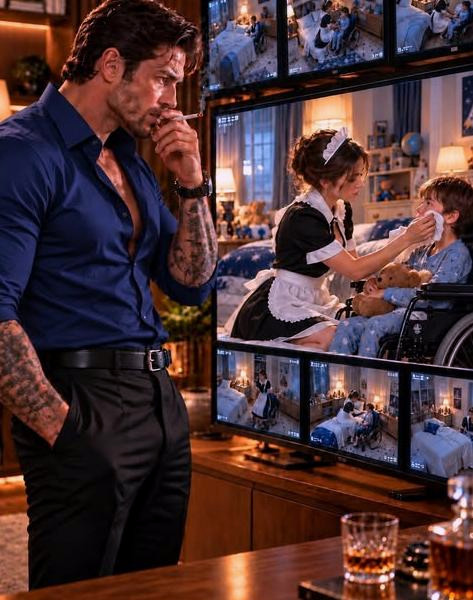
For fourteen months, I had watched my son through cameras, searching for proof that he was still inside the silent body left by the explosion.
The proof had been there all along.
He had been trying to tell me.
I had simply been too afraid to listen.
Back at the estate, Adrian was waiting in the library. Dominic had removed his weapon, but not his arrogance. The fire snapped behind him, lighting the rows of leather-bound books and the framed photograph of Elena holding Matteo on her shoulders.
“You brought a witness,” Adrian said.
“I brought the truth.”
He looked at Daniel. “You took money from me.”
Daniel stepped forward. “You paid me to watch a woman die.”
Adrian’s face tightened. “I paid you to protect a company.”
“No,” I said. “You paid everyone because you wanted my signature.”
He glanced at the contract on the desk.
That was what all of it had been about. While I grieved, Adrian had prepared documents transferring controlling shares of the harbor division to his shell company. He needed me declared incapable of managing the business. He needed Elena gone because she had found the transfers. He needed Matteo silent because the child had seen him at the garage.
The board members had followed us back from the control room. They stood near the bookshelves, clutching their folders.
Adrian looked at them. “You will lose your investments if he removes me.”
One of them lowered his folder.
“No,” she said. “We lose them if we keep you.”
Adrian turned to me. “You cannot run the company alone. You spend every hour watching screens.”
“I do not have to run it alone.”
I slid a document across the desk. It was a resignation agreement, already signed by me, transferring daily operations to an independent board and placing the harbor profits into a trust for families injured by the bombing.
Adrian read it twice.
“You would give up control?”
“I am giving up the part of my life you taught me to worship.”
His laugh came out broken. “And what do you think happens to me?”
Daniel placed the ledger beside the agreement.
“You answer for every payment,” he said.
There would be no dramatic procession of flashing lights through my gates. I refused to give Adrian the clean spectacle of becoming a headline. The financial records went to the company’s auditors, the families’ representatives, and every board member who had signed the original transfer. His empire did not collapse in one loud moment.
It came apart piece by piece, in rooms where nobody applauded.
Adrian lost the company first.
Then the accounts that had made him powerful.
Then the people who had mistaken fear for loyalty.
Margaret gave a full statement and entered a program that protected her daughter’s medical care. Daniel surrendered every payment he had kept and used the rest to fund a wheelchair-accessible transport service in the neighborhood where the bombing occurred.
Clara stayed with Matteo.
Not because I asked her to.
Because Matteo wrote her name in the red notebook and underlined it twice.
The rehabilitation center built a small therapy room for him using money from the trust. Its walls were painted the color of warm sand, and its windows faced the sea. I hated the sea after Elena died. Matteo did not.
On the first morning there, Clara positioned his chair before the parallel bars.
“Ready?” she asked.
Matteo shook his head.
“Good answer,” she said. “Ready is not required.”
I stood beside the bars, unsure where to put my hands.
Matteo looked at me and tapped the red notebook.
I opened it.
Beneath Clara’s name, he had written a sentence in uneven letters:
Dad, stop watching me. Help me.
The words blurred before I reached the final period.
“I can do that,” I said.
Clara met my eyes. “Then do not turn it into another cage.”
“I won’t.”
Matteo placed both hands on the bars. His arms shook. His shoulders rose with effort. For several seconds, nothing happened.
Then his chair moved forward.
One inch.
Another.
The rubber wheels squeaked against the therapy floor. No one spoke. Even the machines seemed to wait.
At the end of the bars, Matteo stopped beside a framed photograph the center had hung in the hallway. It showed the harbor after the bombing, crowded with volunteers carrying blankets, food, and wheelchairs.
Daniel’s transport van was visible in the corner.
Matteo reached toward the photograph and touched the glass over the van.
Clara came beside him.
“Your father says you are ready to go,” she said.
Matteo looked at me.
This time, his voice was rough but unmistakable.
“Not go,” he said. “Forward.”
The word crossed the room and struck me harder than the explosion ever had.
I rested my hand on the red notebook, not on his shoulder. I let him choose the distance.
Behind us, the brass key marked seventeen hung from a hook above the therapy schedule, no longer hidden inside a locked cabinet.
Matteo pushed the chair toward the open bars, and Clara counted each turn of the wheels.
“Forward,” he said again, and this time, I followed him.
Missed the beginning?






