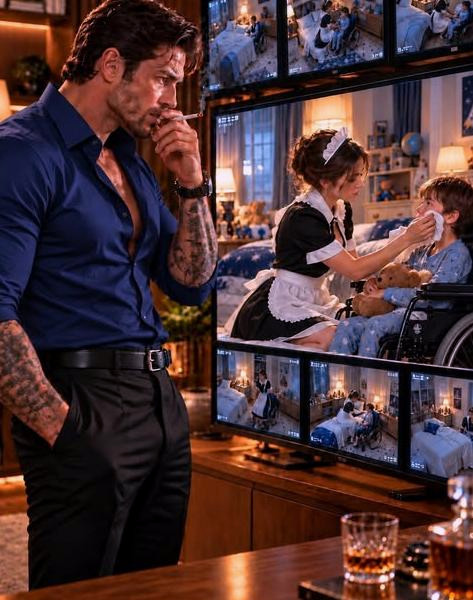
Matteo’s lips moved for the first time in fourteen months, and the woman beside him immediately locked his bedroom door.
I was underground in the surveillance room when it happened, surrounded by humming monitors and the cold glow of twelve screens. On monitor four, my eight-year-old son stared at Clara Hayes as if she had become the only person in the world.
“What did he say?” Dominic asked behind me.
I did not answer. My hand was already reaching for the intercom.
Clara leaned closer to Matteo, one palm resting beside his shoulder. She did not look frightened. She did not look surprised either.
“Again,” she whispered. “Take your time.”
Matteo’s fingers curled into the white sheet. His throat worked painfully.
“Do not force him,” I snapped into the microphone.
Clara’s head turned toward the camera.
For one impossible second, I felt as if she were looking directly at me.
Then she walked to Matteo’s door and closed it.
The small brass latch clicked into place.
“Open that door,” I said.
Dominic shifted beside the console. “Sir, she’s inside with the child.”
“I know where she is.”
“Then why are you asking?”
I pressed the button harder. Nothing happened. The bedroom camera continued transmitting, but Clara had moved just beyond its narrow angle. All I could see was the edge of a blue therapy mat, the wheelchair’s black tire, and Matteo’s trembling hand.
I had installed those cameras after Elena died because trusting people had cost me my wife. They covered every hallway, every service entrance, every room except the bathrooms. I had watched caretakers steal medication, mock my son, and once leave him strapped in his chair beside an open window during a winter storm.
Clara had been different.
That was precisely what frightened me.
At seven that evening, I found her in the kitchen washing a small plastic cup. Rain hammered the tall windows. The copper pan above the stove swung slightly whenever thunder shook the house.
“What did Matteo say?” I asked.
She dried the cup with a yellow-striped towel.
“You heard him try.”
“I asked what he said.”
“You asked him that before he was ready.”
My jaw tightened. “You work for me.”
“I work for Matteo.”
“Do not test me.”
Clara set the cup down. “Then stop testing everyone else.”
The words landed harder than an insult. I saw Elena’s face for half a second, lit by the dashboard before the explosion, and the pain behind my ribs returned like a fist.
“You have been alone with my son for three days,” I said. “You have no right to shut a door and keep secrets from me.”
“I have every right to give a frightened child one room where he is not being watched.”
“He is not a frightened child. He is my son.”
“He is both.”
For a moment, neither of us moved. The kitchen smelled of lemon soap and wet stone. Somewhere upstairs, a wheelchair brake squealed.
Clara picked up her leather bag.
“I am leaving at seven tomorrow.”
“You may not be here tomorrow.”
“Then tell Matteo yourself why you fired the first person who made him speak.”
She walked away before I could answer.
At 6:58 the next morning, I was already watching monitor four. Clara entered Matteo’s room carrying a folded blanket and a small red notebook. She checked the hallway, then slid the notebook from beneath the blanket.
Matteo looked toward the camera.
Clara whispered something I could not hear, reached beneath the cushion of his wheelchair, and pulled out a narrow brass key.
My breath stopped.
She placed the key in Matteo’s palm, turned toward the locked cabinet beside his bed, and reached for the hidden compartment…
PART 2
Clara’s fingers had almost touched the cabinet when I burst into the room.
The door struck the wall with a crack. Matteo flinched, and the brass key dropped onto the therapy mat.
Clara stepped between me and my son.
“What is that?” I demanded.
“Something Matteo found.”
“You removed it from his chair.”
“Because he asked me to.”
“My son cannot ask you anything.”
The moment I said it, Matteo made a harsh sound in his throat. His hand slapped against the armrest. The wheelchair rolled backward until its tire hit the bed.
Clara crouched beside him.
“Look at me,” she said. “Not at him. At me.”
Matteo’s breathing slowed.
That frightened me more than his anger.
I snatched up the key. It was warm from his palm and stamped with a tiny number: 17.
“Where did this come from?”
Clara looked at Matteo. “Tell him.”
His lips trembled. No sound came.
I knelt in front of him. “Matteo, did someone give you this?”
He blinked once.
“Was it your mother?”
Two blinks.
My hand closed around the key.
Elena.
The bedroom seemed to contract around us. I remembered the last morning of her life. She had stood beside the breakfast table wearing a cream sweater, twisting a brass key ring around her finger while telling me she needed to speak with me after Matteo’s school appointment.
I had been angry about a shipment delayed at the harbor. I told her that whatever it was could wait.
It never did.
“Where is the lock?” I asked.
Clara pointed to the cabinet. “Behind the medical supplies.”
I moved gauze, ointment, and bottles of lotion aside. The cabinet looked solid, but the number 17 had been scratched into the wood beneath the lowest shelf. I pressed it.
A panel sprang open.
Inside was a plastic hospital bracelet, a folded receipt, and a small envelope made from cream paper. My name was written across it in Elena’s unmistakable handwriting.
For several seconds, I could not touch it.
Clara stood behind me. “Matteo found it yesterday.”
“Why didn’t he tell me?”
“Because every time he tried, you answered for him.”
The receipt was from a private rehabilitation clinic on the morning of the bombing. The patient name had been cut away. At the bottom, someone had written a single sentence in pencil: Ask who changed the driver.
My skin went cold.
Dominic appeared in the doorway, one hand resting on his shoulder holster.
“Mr. Rossi,” he said, “you need to come downstairs.”
“Not now.”
“The board is here.”
I turned. “What board?”
“Adrian Vale brought them. He says there has been an emergency with the company accounts.”
Adrian had been my father’s partner before becoming mine. He had stood beside Elena’s coffin in a black coat and told me the bombing was random. He had also been the man who urged me to sell half the harbor division while grief made me careless.
I put the envelope inside my jacket.
Clara caught my wrist.
“Do not open that downstairs.”
“Why?”
“Because Adrian knows about it.”
The air left my lungs.
“How could he know?”
Clara glanced at the cameras hidden in the ceiling corners.
“Because he is not the only person who has been watching this house.”
In the underground control room, three board members sat beneath the monitors. Adrian stood before them with a folder tucked beneath his arm, wearing the silver watch Elena had given him.
He smiled when I entered.
“Vincent,” he said. “We need to discuss your fitness to remain in control.”
I placed the brass key on the table.
His smile vanished.
Then Clara entered behind me, holding the red notebook open to a page I had never seen, and Adrian whispered a name that made Matteo’s nurse drop her coffee…
PART 3
The coffee cup struck the stone floor and shattered.
Adrian stared at Clara.
“Margaret,” he said.
The nurse who had worked in my house for eleven months pressed both hands against her mouth. Her face had gone white beneath the soft powder she wore every morning.
I looked from her to Adrian. “You know her?”
“She was employed by the clinic,” Adrian said quickly. “That is all.”
Margaret shook her head.
“No,” she whispered. “It was not all.”
The control room smelled of burnt coffee and metal. Every monitor showed a different piece of my estate: gates, corridors, the empty dining room, Matteo’s wheelchair parked upstairs. I suddenly understood what it meant to be surrounded by eyes and still miss the truth.
“Speak,” I told her.
Adrian stepped toward her. “You signed a confidentiality agreement.”
Margaret looked at him. “You made me sign it after you threatened my daughter’s treatment.”
His expression hardened.
Clara opened the red notebook. “Margaret worked the overnight desk at Harborview Clinic the day Elena brought Matteo for his spinal evaluation. She saw Adrian arrive before the appointment.”
“I was visiting a business associate,” Adrian said.
Margaret reached into her uniform pocket and pulled out a laminated visitor card, its corner cracked and yellowed.
“He came under the name Aaron Bell,” she said. “But he dropped this when he argued with Elena.”
The card bore Adrian’s photograph and his company identification number.
My knees weakened.
“What did he argue about?” I asked.
Margaret swallowed. “Mrs. Rossi had discovered payments from the harbor accounts to a shell company. She said she would show you the ledger that night.”
Adrian gave a thin laugh. “This is absurd.”
“Then explain the receipt,” Clara said.
I placed Elena’s envelope on the table. My hands shook as I opened it. Inside was a photocopy of three transfers, each signed with Adrian’s authorization code. Behind it was a handwritten note.
Vincent, if you are reading this, do not trust the replacement driver. Adrian moved the money, and he knows I found out. Matteo saw him near the garage. I hid the original ledger where our son would look before anyone else would.
The final line had been pressed so hard into the paper that the ink had torn the fibers.
The ledger is not in the house.
Adrian lunged for the envelope.
Dominic blocked him, and the two men collided against the console. A monitor tipped sideways. Red light washed over Adrian’s face.
“You killed her,” I said.
“I did not plant the bomb.”
The room went still.
Adrian’s breath came fast. He realized what he had admitted, but the words were already between us.
“Who did?” I asked.
He looked at Margaret. “The driver was paid to frighten her. The explosive was supposed to disable the vehicle, not destroy it.”
Clara’s voice dropped. “But the vehicle was armored.”
“He changed the charge,” Margaret said. “I heard him say it in the clinic garage.”
Adrian grabbed the edge of the desk. “You do not understand. Elena was going to ruin everything. The company would collapse, hundreds of people would lose their jobs, and Vincent would tear the harbor apart looking for someone to blame.”
“You mean you would lose control,” I said.
His silence answered.
I looked at Matteo’s key, the note, and the visitor card. The truth had not arrived like thunder. It had gathered quietly in the hands of people I had ignored.
Then my phone rang.
The caller was listed as Harborview Children’s Center.
A woman said, “Mr. Rossi, we found the original ledger. But there is one problem. The person who delivered it claims your son was not the only survivor of the bombing…”
Then Matteo pointed to the name everyone feared…
I thought the hidden key would expose a betrayal. Instead, it revealed how badly I had misunderstood my own son.
The final part changes everything.
“Not go,” he said. “Forward.”
And I finally followed his lead.
👇 The ending of the story is now open.






