PART 4
The photograph showed the compass lying on a desk beside my name.
For three seconds, I couldn’t breathe.
That compass had been in my hand all morning.
I looked down at it. The dented brass lid was closed, and a smear of black soot still marked the hinge from the lodge fire.
“Where did they get that image?” I asked.
Clare took the phone back. “The water application was filed through a consulting firm in Boise. The attachment claims you personally authorized Cedar Harbor’s irrigation work.”
“That’s impossible.”
“I know.”
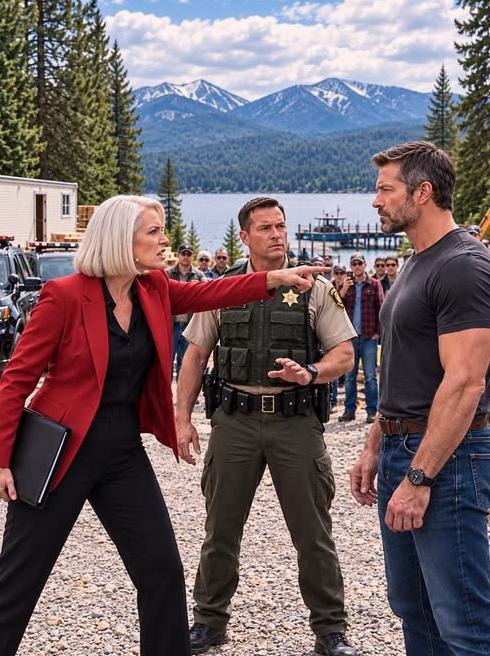
Paige stepped toward us. “You need to stop making accusations.”
I turned on her.
“You just admitted you altered my father’s document.”
“I admitted nothing.”
“You told Nolan he said the deal had to close.”
“That was a private conversation.”
Ruth gave a dry, humorless laugh. “Not anymore.”
The residents had gathered beneath the clubhouse awning. Some had come to defend Paige. Others held their phones low at their sides, listening to every word. Maribel Hart clutched a folder against her chest.
“Paige,” she said, “you told us the shoreline was ours.”
“It was going to be ours.”
“That is not what you said.”
“It was the only way to protect property values.”
Nolan Voss looked at her as if she had become an unexpected expense.
“You told investors title was clean.”
“I told them the trust had approved the transfer.”
“You told me Harlon Mercer was dead before you approached the county.”
Paige’s head snapped toward him.
The engineer stopped writing.
So did everyone else.
Nolan seemed to realize what he had just said, but the sentence was already standing in the open air.
Clare’s voice went quiet. “You approached the county before Caleb returned?”
Nolan rubbed his forehead. “The project had a schedule.”
“And you knew the owner was dead.”
“I knew there was no active representative.”
“I am standing here,” I said.
Nolan looked at me. “You were supposed to sell.”
“That was never offered.”
“It was implied.”
“By whom?”
His eyes moved to Paige.
She had spent months pretending I was a vagrant because the truth was more dangerous: I was the person who could stop a twenty-six-and-a-half-million-dollar deal with one deed.
At five twenty, the mayor ordered the construction road closed until the county could determine who had authority to use it. The engineer tagged the pavilion, dock, irrigation controls, and clubhouse foundation with bright orange notices. Nobody was arrested. Nobody needed to be. The project’s own paperwork had become a net tightening around the people who created it.
The next morning, Clare and I went to the state water office. Ruth came with us. She carried the original board minutes in a canvas grocery bag, while I carried the brass compass clipped to my clipboard.
The office administrator placed the irrigation application on a glass table.
“This signature is yours?” she asked.
“No.”
“Have you ever authorized Cedar Harbor to alter the watershed?”
“No.”
She turned to another page. “Then why did your father’s trust send this authorization?”
Clare pointed to the filing stamp. “It didn’t.”
Ruth leaned over the page. “The contact number belongs to a temporary office inside the Cedar Harbor clubhouse.”
That explained the photograph, but not who had made it.
I knew the answer before Clare did.
The image had been taken at the lodge six weeks earlier, when a restoration contractor photographed the burned dining room for insurance records. The compass sat on the table beside my father’s papers. Someone had cropped the photograph, placed it next to a forged authorization, and submitted the result as proof that I had cooperated.
The contractor’s invoice identified the person who had requested the photographs.
Paige.
She had entered the lodge while I was hauling timber from the north wall.
By noon, the water office rejected the application and referred the forged material to the state records bureau. The lender withdrew from Lake Glass Landing. Voss Meridian demanded its deposit back from Cedar Harbor. The residents received notices that their association could not lawfully sell, lease, mortgage, or promise land it did not own.
But the most painful meeting happened that evening in the clubhouse.
Every chair was filled. The chandelier flickered above the section of floor built on Mercer ground. Paige sat at the front table beside a stack of resignation letters. Nolan had not come.
Maribel stood first.
“Did you know the easement had expired?”
Paige stared at the table.
“Yes.”
A murmur went through the room.
“Did you know Harlon Mercer had not signed the transfer?” another resident asked.
Paige’s fingers tightened around a paper cup until the rim collapsed.
“Yes.”
“Why?”
She looked at me then.
“For the resort,” she said. “For the money. For the homes we were promised. Cedar Harbor was dying, and Lake Glass Landing was the only thing that could save it.”
“You weren’t saving it,” I said. “You were selling something that belonged to my family.”
“I thought you would accept a settlement.”
“You never asked.”
“You had no idea what was at stake.”
“My father’s land was at stake.”
Her face crumpled, but I did not mistake regret for innocence.
Ruth placed the original minutes on the table.
“The association can dissolve the development committee,” she said. “It can remove Paige and elect a board that negotiates legally with Caleb.”
All eyes shifted to me.
The residents expected a demand. A fence. A bill for every trespasser and every foot of gravel.
Instead, I unfolded a map Clare had prepared.
“The road can remain open to emergency crews,” I said. “The walking path can be restored as a public trail under a new agreement. The dock comes down, and the pavilion is removed. The clubhouse stays only if Cedar Harbor pays for the portion built over Mercer land and signs a real lease.”
Maribel blinked. “You would let us keep the clubhouse?”
“It was built without permission. But people live here who did not forge anything.”
“What about Paige?”
I looked at the woman who had called me homeless while standing on my father’s property.
“Her resignation is the beginning. The records bureau will decide what happens to the forged filings.”
Paige rose so quickly her chair scraped the floor.
“You want to destroy me.”
“No,” I said. “I want the ground named correctly.”
She opened her mouth, then saw the survey map spread beneath her hands. The red boundary line ran directly through the center of the table, across her name on the old development minutes.
The residents voted that night to remove her from the board. Nolan’s company abandoned the project two days later. The county erased the false development notation from its public parcel index after reviewing the original deeds and survey. The dock was dismantled plank by plank. The pavilion followed.
I kept the clubhouse lease simple. No resort. No private shoreline. No hidden expansion. The road became a permitted access route, and the restored walking path ended at a small public overlook above the lake.
Clare told me the trust could have demanded every structure be demolished immediately.
“You left money on the table,” she said.
“I left people a way to live with what happened.”
“You also lost months of rebuilding.”
“I know.”
The lodge took longer than I wanted. Part of the burned dining room had to be removed completely, including the wall where my father had marked the original property corners in pencil. I found one of those marks beneath a layer of charred plaster: a crooked arrow pointing toward the lake.
Under it, in his handwriting, were four words: Measure twice. Trust once.
I kept the scrap.
On the morning the county installed the permanent survey monument, the sky was clear enough to show the mountains across the water. Mark Ellison stood near the road, no longer holding Paige’s complaint packet. Ruth watched from the edge of the restored trail. Maribel brought coffee for the survey crew.
The engineer set the brass cap into the earth and stamped the Mercer Ridge number into its face.
He handed me the mallet.
“Your family’s corner,” he said.
I pressed the compass against my palm, felt the dent in its lid, and struck the cap once.
The sound traveled through the timber, across the road, and toward the dock that no longer reached into the lake.
Ruth came closer.
“Your father would have liked that,” she said.
I looked at the red survey line, the honest boundary cutting through everything Cedar Harbor had pretended to own.
“No,” I said. “He would have told me to check the other three corners.”
Ruth smiled.
So I walked with the survey crew toward the next marker, while behind us the clubhouse sign came down and the lake kept shining beyond the line no forged signature could cross.
Missed the beginning?






