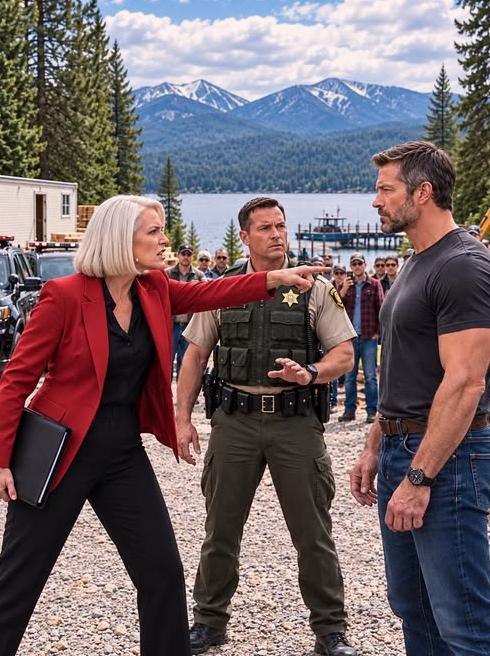
Four sheriff’s SUVs surrounded my ranch gate at nine twelve in the morning, and the woman who had ordered them pointed at me as if I were a dangerous animal.
“There he is,” Paige Whitmore said. “That’s the trespasser.”
I stood beside my mud-streaked pickup with a clipboard tucked beneath my arm. Behind me, the construction trailer where I had slept for eight months leaned slightly toward Lake Pend Oreille, its aluminum steps slick with rain. A brass compass clipped to the clipboard knocked against the metal every time my hand tightened.
Deputy Mark Ellison got out first. His boots sank into the wet gravel.
“Sir, I need identification.”
I handed him my license, then a yellow county parcel card.
“Before anyone touches that trailer,” I said, “call the assessor’s office.”
Paige laughed. Her red blazer looked absurdly clean against the gray morning.
“He’s been saying that for weeks. He’s unstable, Deputy.”
“Am I under arrest?” I asked.
“Not at this moment.”
“Then I’m staying right here.”
Paige stepped closer. Her perfume smelled like expensive cedar and something bitter.
“You have seventy-two hours to vacate association property,” she said. “You were warned.”
“This is Mercer land.”
“We have our own map.”
“Your map doesn’t own dirt.”
Her smile hardened. She handed Mark a packet thick with photographs, violation notices, and a picture of me measuring a fence line.
“Unauthorized camping. Storage. Visual nuisance. Trespassing.”
She lowered her voice so only I could hear.
“A real property owner wouldn’t sleep in a construction trailer.”
The sentence hit harder than it should have. My father had died eight months earlier, and the wildfire had gutted half of his lodge. I had come home to rebuild it, not to defend my name to a woman who had never asked why I was there.
At ten thirty that night, I found the photograph Paige had posted in Cedar Harbor’s private group. Under my face, she had written: DANGEROUS HOMELESS MAN NEAR LAKE ACCESS.
I nearly threw my phone into the sink.
Then I noticed the background.
A fresh gravel road cut through the timber behind my trailer. It led toward the shoreline, past a new pavilion with black steel beams. I grabbed my flashlight and went out.
At six forty the next morning, I followed the road through dripping fir trees. The compass on my clipboard swung wildly whenever I crossed the old boundary line my father had taught me to recognize.
At the end stood a manicured lawn, an irrigation system, and a private dock stretching into the lake. Every post was new. Every structure sat beyond the faded survey marker bearing the Mercer name.
I photographed everything and recorded the coordinates.
At noon, I called Clare Benton, our family trust attorney.
She came to the lodge at three, carrying a leather case and a look that made my stomach tighten. She spread my father’s easement across the burned dining table.
“Twelve years,” she said. “Foot traffic only. No construction. No vehicles. No permanent structures.”
“It expired nineteen months ago.”
“Yes.”
“Then why are they building?”
Clare looked at the photographs, then at me.
“Because somebody believes your family won’t fight.”
She searched county filings until dusk. Outside, the lake slapped against the pilings of the dock that should never have existed.
Finally, Clare stopped scrolling.
“Caleb,” she said carefully, “there’s a transfer document here.”
“What kind?”
“It grants Cedar Harbor expanded development rights over the shoreline.”
“That’s impossible.”
“It carries your father’s signature.”
My throat closed.
H. Mercer.
The letters looked almost exactly like the ones on the old deeds stacked beside us. But the filing date sat in the corner of the screen, cold and unmistakable.
Five months after my father’s death.
Clare touched the brass compass clipped to my board.
“Don’t confront Paige,” she said. “Not yet.”
“Why?”
“Anyone willing to use a dead man’s signature may be willing to make other evidence disappear.”
The next morning, I found a new notice nailed to my trailer door. At the bottom, Paige had written one sentence by hand: Leave before the county sees what you’ve done.
At that exact moment, headlights appeared beyond my gate. More than one vehicle. Someone was walking toward me with a thick folder tucked beneath an arm, and when the person reached for the clasp, I heard Paige say…
PART 2
“Open it,” Paige ordered.
The voice came from behind me. I turned and saw her standing beside Deputy Ellison, one hand resting on the gate as if she owned that too. Behind them waited two Cedar Harbor board members and a county code officer whose boots were still clean.
The folder opened with a wet snap.
“These are sworn complaints,” Paige said. “Residents report threats, illegal occupation, and damage to association property.”
“What association property?” I asked.
She pointed toward the gravel road.
“Everything beyond this gate.”
Clare stepped between us.
“Then show us the recorded instrument giving Cedar Harbor title.”
Paige’s eyes flicked to her.
“You’re the trust lawyer.”
“I am.”
“Your client’s father authorized our access.”
“Access is not ownership.”
The code officer cleared his throat. “We’re here to inspect the trailer.”
“No,” I said. “You’re here because Paige sent edited photographs and a false complaint.”
His face reddened. “Sir, cooperate.”
My hand found the brass compass. Its lid had a tiny dent from the wildfire, and I rubbed it with my thumb to keep my voice steady.
“Deputy, ask the county what parcel this trailer sits on.”
Mark studied the yellow card. “I already called.”
Paige’s smile vanished for half a second.
“And?” I asked.
“The assessor is sending someone.”
“Then nobody enters.”
At two fifteen that afternoon, Clare and I drove to the county records building in Sandpoint. The fluorescent lights hummed above us while a clerk placed three folders on the counter.
The first contained the expired easement. The second contained a development agreement naming Lake Glass Landing as a luxury shoreline project. The third held the disputed transfer.
The project value was printed on the cover.
Twenty-six point five million dollars.
I felt the floor tilt beneath my boots.
“They promised investors land they didn’t own,” I said.
“More precisely,” Clare replied, “they promised investors the right to build on land they hoped nobody would claim.”
A name appeared on the agreement: Nolan Voss, managing partner of Voss Meridian Resorts.
Paige’s signature sat beneath his.
At four forty, Ruth Donnelly met us in the records room. She wore a green wool coat with a brass thimble pinned to the collar, a habit from the years she had repaired board minutes by hand.
“I was Cedar Harbor’s secretary for six years,” she said. “Paige removed me last winter.”
“Why?” Clare asked.
“Because I refused to backdate the easement.”
Ruth placed a bundle of original minutes on the table. The pages smelled of dust and carbon paper.
“One meeting says the residents voted to extend the shoreline rights,” she continued. “But the original attendance sheet shows only four directors were present, and one of them had resigned two weeks earlier.”
“Do you have proof Paige knew?” I asked.
Ruth looked directly at me.
“I kept the draft correspondence.”
She handed Clare a printed email. The subject line read: Heir activity.
The message said Cedar Harbor should behave as though the shoreline were association-controlled until residents accepted that as established fact. It called me an unexpected heir and warned that my presence could threaten investor confidence.
My fingers went cold.
“She knew,” I whispered.
“She knew before you arrived,” Ruth said.
At six, Clare found another filing. It was an application for a construction loan against the entire development footprint, including the lodge, my trailer, and the county road.
“What happens if the bank learns this is forged?” I asked.
“Funding stops. Permits stop. Investors panic.”
“And Paige?”
“She may still claim the signature is genuine.”
That night, my water tank was cut loose from the trailer. The hose lay in the mud like a severed vein. Taped to the hitch was a card bearing only one sentence: Come to the clubhouse tomorrow at noon, or the county will hear the story first.
The Cedar Harbor clubhouse stood on the very ground my father had owned. When I arrived, Paige was waiting beneath the chandelier with Nolan Voss beside her. He held a document in a clear sleeve.
“Your father signed this,” Nolan said. “Deny it publicly, and every investor hears that you’re trying to destroy a legitimate resort.”
Clare moved beside me.
“Where did you get the original?”
Nolan’s expression shifted.
“From the man who witnessed it.”
The clubhouse doors opened behind him. An elderly groundskeeper entered, trembling so badly he had to grip the frame. He looked at the signature, then at me, and said…
PART 3
“I never witnessed that signature.”
The words seemed to drain the warmth from the clubhouse.
Paige turned sharply. “Elias, you’re confused.”
Elias Boone shook his head. His work jacket was patched at both elbows, and lake water darkened the cuffs of his trousers.
“I was told to sign as witness,” he said. “I refused.”
Nolan grabbed his arm. “You’re making a serious mistake.”
Clare stepped forward. “Let him go.”
He did, but not before Elias’s shoulder struck the brass fire extinguisher mounted beside the door.
I looked at the document in Nolan’s sleeve.
“Tell them what happened,” I said.
Elias swallowed. “Paige brought me into the maintenance office last October. The document already had Harlon Mercer’s signature. She said the family had approved the expansion and needed my witness mark.”
“Did you see my father sign it?” Clare asked.
“No.”
“Did you sign it?”
“No. I wrote on the bottom that I had not witnessed the signature.”
Paige’s face tightened. “That note isn’t there.”
“It was when I left.”
Ruth opened her bundle and removed a narrow envelope marked with a date. “Because Paige removed it from the board file,” she said. “I found it in the shred bin before she changed the locks.”
Inside was a photocopy of the transfer, including Elias’s handwritten refusal. Beneath it sat a second sheet: a typed instruction from Paige to Nolan’s office requesting a clean replacement.
Nolan’s mouth parted.
“You forged the witness block,” he said.
Paige stared at him. “You told me to fix the paperwork.”
“I told you to obtain authorization.”
“You said the deal had to close.”
The words landed harder than any confession Clare could have produced.
Everyone heard them.
The board members backed away from Paige. One knocked over a glass pitcher, and water ran across the polished table toward the disputed document.
I looked at the signature again. My father had signed thousands of papers, but his final stroke always lifted sharply at the end. The mark on Nolan’s copy dragged downward, as if someone had copied it from a scan.
Clare pointed to the bottom margin.
“Your father died on May third,” she said. “This document was filed October ninth. The state notary recorded it on October eleventh.”
Nolan’s face had gone pale.
Paige whispered, “The county accepted it.”
“The county recorded a paper,” Clare replied. “It did not bless the fraud inside it.”
At three thirty, the survey crew arrived at the shoreline. Mayor Thomas Avery stood beside the county engineer while Mark Ellison watched Paige from the road. A prism on a tripod flashed red against the water.
The engineer drove a metal pin into the earth beneath the pavilion.
“This corner is Mercer Ridge Trust land,” he announced. “So is the road, the dock, the irrigation field, and approximately forty feet of the clubhouse foundation.”
A resident named Maribel Hart covered her mouth.
“You told us the association owned this,” she said to Paige.
Paige looked at me. “You manipulated this.”
“With what?” I asked. “My father’s death certificate?”
Nobody answered.
Then Clare’s phone rang. She listened, her expression changing from anger to alarm.
“What is it?” I asked.
She handed me the phone.
The caller was the lender financing Lake Glass Landing. They had received an emergency notice from the county engineer and were freezing the project pending title verification.
That should have ended Paige’s leverage.
Instead, Clare looked toward the lake.
“Caleb,” she said, “the lender didn’t send the notice.”
“Who did?”
“The state water office. Someone filed an application claiming Mercer Ridge authorized the irrigation system. If they approve it, Cedar Harbor can argue the water works were established before your claim.”
A second document had been submitted that morning.
It carried my name.
And attached to it was a scanned copy of the brass compass my father had left me, photographed beside a signature page I had never seen…
The last document carried Caleb’s name…
I thought the survey had exposed everything. I was wrong. The final discovery forced me to choose what happened to the land—and to the people living on it.
“Your boundary ends here.”
Her fingers tightened around the ruined paper.
👇 The final chapter is already open






