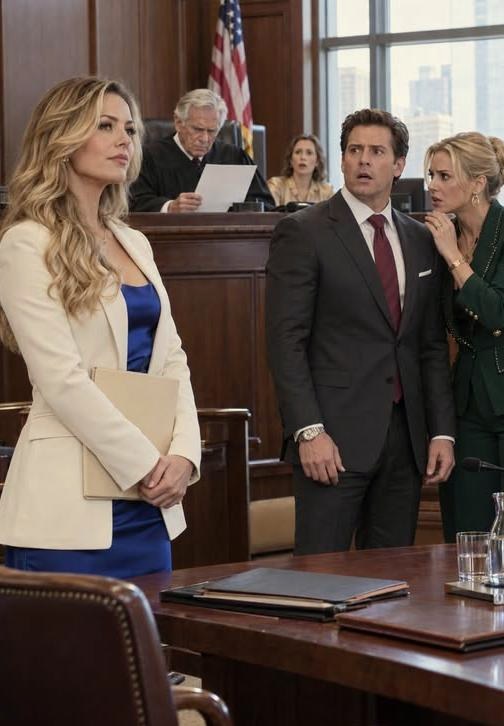
The first thing Grant did that morning was smile at the bruise beneath my sleeve, as if he had personally signed it.
“Without a lawyer, you’re finished,” he whispered across the courthouse bench. “By lunch, you won’t even own your name.”
Rain crawled down the tall windows of Franklin County Domestic Relations Court. The clock above the judge’s bench showed 9:08 a.m., and the fluorescent lights made everyone look sickly except Grant. He looked polished, rested, and expensive in a navy suit tailored in Chicago.
His silver cuff links flashed whenever he moved his hands. They had belonged to my father. Grant had taken them from the bedroom drawer after my father died and had never returned them.
Beside him sat Malcolm Voss, the divorce attorney whose billboards along Interstate 71 promised, DIVORCE IS WAR. Malcolm had six black binders, three yellow legal pads, and the relaxed expression of a man who expected to win before anyone spoke.
My table held a blue folder, a grocery-store legal pad, and a paper cup of water.
Grant wanted the contrast noticed.
Judge Rebecca Holloway adjusted her glasses. She was sixty-something, close-cropped gray hair, steady eyes, and nineteen years of published decisions I had read during the sleepless weeks after Grant emptied our accounts.
“Mrs. Whitmore,” she said, “you are appearing without counsel today?”
“Yes, Your Honor.”
“Your attorney withdrew two days ago.”
“He did.”
“Mr. Voss opposed your request for a continuance.”
Malcolm rose. “This case has been pending for eleven months. Mrs. Whitmore has delayed repeatedly and now chooses to proceed alone.”
Chosen.
The word settled over me like dust.
Judge Holloway looked at me. “Did you choose to terminate your attorney?”
“No, Your Honor.”
Grant’s mouth barely curved.
“My former attorney emailed me at 2:13 Monday morning,” I said. “He wrote that continuing to represent me created an unacceptable risk to his firm.”
Malcolm gave a patient sigh. “That language confirms the breakdown was caused by Mrs. Whitmore’s conduct.”
“What conduct?” the judge asked.
He glanced at me. “Paranoia. Unreasonable accusations. Refusal to cooperate with discovery.”
I could feel Elaine Whitmore, Grant’s mother, watching from the second row. Her cream suit was immaculate, and one gloved hand rested on the pearl necklace she wore to funerals and court proceedings. Beside her, Grant’s sister Paige held her phone low near her purse.
Probably recording me.
Waiting for me to crack.
Grant had already told our friends I had developed a gambling problem. He told my sister I was unstable after my mother’s death. He told Lydia, my closest friend, that I had threatened to burn our house down with both of us inside it.
By the time people understood he was building a story, they had already begun repeating it.
I looked down at the bruise beneath my sleeve. Grant had created it three nights earlier when I refused to sign a property settlement transferring our house to his mother. He had called it an accident. He always did.
Judge Holloway leaned forward. “Mrs. Whitmore, do you have evidence supporting your objections?”
“I have one exhibit.”
Malcolm laughed softly. “One page?”
“One page,” I said.
Grant’s right foot turned inward beneath the table.
For fourteen years, I had worked as a forensic accountant. I found missing numbers for people who believed numbers could be buried. A dry swallow, a rubbing thumb, a shoe suddenly angled toward the exit—money taught me to notice what fear did to the body.
The $84,000 transfer to Halcyon Strategic Consulting had made Grant’s foot turn inward three months ago. So had the email from my attorney. So did Malcolm’s glance toward the courthouse hallway now.
Judge Holloway held out her hand. “Bring me the exhibit.”
I lifted the blue folder. My fingers were cold, but my voice stayed level.
Grant leaned closer.
“Claire,” he murmured, “think very carefully.”
I placed the folder on the clerk’s desk. The judge opened it, drew out the single page, and began reading. Her eyes moved across the first line. Then the second. Malcolm stopped arranging his papers.
Judge Holloway’s hand reached for the courtroom telephone, and the bailiff stepped toward the doors as if he had just received an order no one else could hear…
PART 2
The bailiff’s hand closed around the brass door handle before Judge Holloway spoke.
“Lock both entrances,” she said. “No one leaves this courtroom.”
The click of the deadbolt sounded louder than the rain.
Grant shot to his feet. “Your Honor, this is outrageous.”
“Sit down, Mr. Whitmore.”
“I have a right to—”
“You have a right to sit down.”
He sat, but his face had changed. The expensive calm was gone. A vein pulsed beside his temple, and one of my father’s cuff links had twisted sideways against his wrist.
Judge Holloway continued reading the page. It was only one sheet, printed on both sides, with a bank verification stamp in the lower corner and a handwritten notation beside a signature.
Malcolm reached for it. “Your Honor, I object to the admission of an unauthenticated document.”
“You have not seen the reverse.”
“I don’t need to. It was not produced during discovery.”
“That is precisely what concerns me.”
Elaine rose behind Grant. “This woman is sick. She has been stalking my son’s accounts for months.”
Judge Holloway looked over her glasses. “Mrs. Whitmore, remain seated.”
Elaine lowered herself slowly, pearls clicking against one another like tiny teeth.
I kept my hands folded over the grocery-store legal pad. My nails had crescent marks from where I had pressed them into my palms.
“Mrs. Whitmore,” the judge said, “what is Halcyon Strategic Consulting?”
“A company registered to a mailbox in Delaware. It received eighty-four thousand dollars from our joint account, then paid twenty thousand to Whitmore Holdings and sixty-four thousand to a trust controlled by Elaine Whitmore.”
Grant turned toward me. “You’re inventing this.”
“Am I?”
“You had access to the accounts.”
“I had access until you changed every password.”
Malcolm stood again. “Your Honor, my client’s wife is presenting financial allegations without foundation. I request that the document be stricken.”
Judge Holloway held up the page. “The document bears a certification from First Franklin Bank’s internal fraud department.”
Malcolm’s expression tightened. “That does not make it admissible.”
“No,” the judge said. “But it makes your objection premature.”
The courtroom door rattled once. Someone outside tried the handle. The bailiff did not move.
Grant leaned toward Malcolm and whispered, “You said she had nothing.”
It was quiet, but not quiet enough.
Malcolm’s head snapped toward him. “Not here.”
The judge’s eyes moved between them. “What did you say, Mr. Whitmore?”
“Nothing.”
My pulse struck hard against my throat. Three months earlier, I had found the first transfer while reconciling an old joint account. The second had led to a storage unit. The storage unit had led to a banker named Nora Bell, who refused to talk until I showed her a subpoena from a different matter and promised her I would not expose her name without consent.
Nora had not given me a dramatic confession. She had given me something more dangerous: a copy of a payment instruction, stamped and signed.
Grant had signed the first page.
Malcolm had signed the authorization below it.
The signature on my name had been imitated so carefully that only the pressure pattern gave it away. I had made thousands of signature comparisons in my career. Whoever forged mine wrote the final letter too slowly.
Judge Holloway turned the page over.
“Mr. Voss,” she said, “why does this document include your firm’s trust-account number?”
Malcolm did not answer immediately.
Grant’s mother stood. “Because my son paid his attorney. That is not illegal.”
“Not from a concealed marital account,” I said.
Grant’s hand slammed against the table. The paper cup beside me tipped, and water spread across the legal pad.
“You think one page makes you clever?” he hissed. “You have no idea what you’re accusing me of.”
“No,” I said. “I know exactly what I’m accusing you of.”
Judge Holloway pressed the courtroom telephone. “Clerk, bring Ms. Bell inside.”
Malcolm went pale.
Grant stared at him. “Who is Ms. Bell?”
The door remained locked. Footsteps approached from the corridor, slow and uneven, then stopped directly outside.
A woman knocked twice.
Judge Holloway looked at the bailiff. “Let her in.”
The lock turned, and the door opened just wide enough for Nora Bell to enter, clutching a red bank folder against her chest. She looked at Grant, then at Malcolm, and said, “I was told if I came here, someone would make sure I never worked in banking again…”
PART 3
“Who told you that?” Judge Holloway asked.
Nora Bell shut the door behind her. She was a small woman in a damp brown coat, with rain shining on her glasses and a red folder pressed so tightly to her chest that its corners had bent.
“Mr. Voss,” she said.
Malcolm pushed back from the table. “That is absurd.”
Nora looked at him. “You called me yesterday at six seventeen in the evening. You said my position at First Franklin depended on whether I cooperated with Mrs. Whitmore.”
“I never threatened you.”
“You said the word disloyal three times.”
Judge Holloway pointed to the witness chair. “Sit down, Ms. Bell.”
Nora did. The leather creaked beneath her, and a drop of rain slid from her sleeve onto the wooden armrest.
“Tell me what you know,” the judge said.
Nora opened the red folder. “In April, Mr. Whitmore submitted a transfer request for eighty-four thousand dollars from the joint account held by him and Claire Whitmore. The destination was Halcyon Strategic Consulting.”
Grant shook his head. “I never—”
Nora raised one finger. “The request carried Mrs. Whitmore’s electronic authorization. It also carried a handwritten confirmation from Mr. Whitmore.”
“I said I never signed anything.”
Nora removed a photocopy. “You signed this.”
Judge Holloway studied it. “And the authorization beneath it?”
“That came from Mr. Voss’s office.”
Malcolm’s chair scraped the floor. “This is a disgruntled employee making accusations to avoid discipline.”
Nora’s voice trembled, but she did not lower it. “Your assistant emailed the instruction from a private address. The email included the phrase, ‘Use Claire’s usual approval format.’ I flagged it because the approval came from a device that had been disconnected two months earlier.”
The judge turned to me. “How did you obtain this copy?”
“I asked the bank to preserve the records after my former attorney refused to file an emergency motion.”
“Why did he refuse?”
I looked at Malcolm. “Because he was not only Grant’s lawyer.”
Grant’s head turned sharply. “What does that mean?”
I placed the one-page exhibit beneath the judge’s hand. “Halcyon Strategic Consulting paid Malcolm Voss’s firm fifty thousand dollars before he entered his appearance in our divorce. The remaining thirty-four thousand went to the trust Elaine used to purchase the lake house.”
Elaine’s pearls stopped moving.
Malcolm’s face hardened. “That is a mischaracterization of a legal fee.”
“Your invoice says ‘consulting services.’ Your trust ledger says ‘Whitmore marital asset protection.’”
Judge Holloway looked at Grant. “Did you create Halcyon?”
Grant opened his mouth, then looked at Malcolm.
That glance answered before he did.
“You promised me the house,” Grant said to Malcolm. “You said the signature would hold.”
Malcolm turned white. “Be quiet.”
Grant realized what he had said only after the words were already in the room.
Elaine rose with a gasp. “Grant, you told me the house was a gift.”
“You wanted security.”
“I wanted to protect you.”
“You wanted the deed.”
Judge Holloway’s voice cut through them. “Enough.”
She read the final lines of my page aloud: “The transfer, the forged authorization, the concealed payment to counsel, and the pending deed conveyance are connected through the same trust account.”
Grant stared at me. “You planned this.”
“I documented it.”
The judge ordered the accounts frozen, halted the noon deed recording, and directed the clerk to send the financial records to the appropriate authorities. Malcolm was removed from the case immediately. Elaine began crying behind her glove.
Then my phone vibrated.
The message came from the county recorder’s office. The deed had already been accepted electronically at 8:41 a.m.—before court began.
A second line followed: “The receiving party is not Elaine Whitmore.”
I looked at Grant.
He was already staring at his phone, and whatever he saw made his face collapse…
The name on Grant’s phone changed everything…
I thought the page had exposed his plan. I was wrong about what he had placed in my name.
“Please don’t let them read the last page.”
I placed the silver cuff link on the document.
👇 The final part of the story is open.






