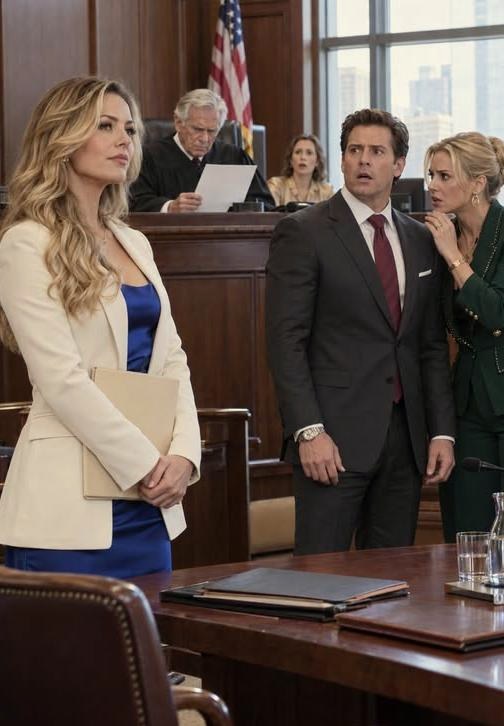
PART 4
The name on Grant’s phone was not Elaine Whitmore’s.
It was mine.
For three seconds, nobody moved.
Then Grant shoved his chair backward so hard it struck the wall.
“That’s impossible.”
Judge Holloway held out her hand. “Mr. Whitmore, give me the phone.”
He clutched it against his chest. “Someone is trying to frame me.”
“Give me the phone.”
Grant looked at Malcolm, but Malcolm was no longer looking at him. The attorney had turned toward the locked doors, calculating distance, witnesses, and the price of every mistake he had made in the last eleven months.
I understood the message before anyone explained it.
The deed had been recorded into a company registered under my maiden name: Claire Anne Mercer Holdings.
A company I had never created.
A company Grant had created for me.
Judge Holloway read the message again. “Mr. Whitmore, why was the marital residence conveyed to a corporation bearing your wife’s name?”
“I don’t know.”
“You signed the conveyance?”
“No.”
“Your wife did?”
“No.”
“Then who did?”
Grant looked at me as if I had become a trap hidden beneath the carpet.
I stood. My knees were shaking, but they held.
“I know who filed it,” I said. “The question is whether Grant knows who owns the signature.”
Malcolm turned sharply. “Claire, stop talking.”
That was the answer I needed.
Judge Holloway noticed it too. “Mr. Voss, sit down.”
The bailiff moved between Malcolm and the door.
Nora Bell opened the red folder again. “There is another problem, Your Honor.”
Grant’s shoulders tightened.
“First Franklin received a second instruction at 8:36 this morning,” Nora said. “The instruction directed the remaining funds from the Whitmore joint account into Claire Anne Mercer Holdings.”
Grant stared at her. “No.”
“It was signed with a digital certificate.”
“Whose certificate?” I asked.
Nora looked at me. “Yours.”
Elaine began sobbing. “Grant, what did you do?”
He swung toward her. “I did what you told me to do.”
Her glove flew to her mouth.
“I told you to make Claire disappear from the accounts,” she whispered. “I never told you to put everything in her name.”
Grant’s face twisted. “Because the bank would flag a transfer to yours.”
Malcolm closed his eyes.
The room seemed to tilt, not from surprise but from the sudden rearrangement of every piece. Grant had not transferred the house to Elaine as the final destination. He had moved it into a shell company bearing my name, intending to sell it later and claim I had hidden the proceeds. The forged signature would make me look like the architect of my own theft.
He had built the trap so carefully that he had forgotten one thing: ownership was not the same as possession.
Judge Holloway asked, “Mrs. Whitmore, how did you learn about the company?”
“I found it six weeks ago,” I said. “I did not know why he had used my maiden name, so I waited.”
Grant laughed once, harshly. “You waited?”
“I needed you to move the house and the money into the same place.”
His face drained.
I opened my blue folder and removed a bank letter. “I filed a beneficial-ownership notice with First Franklin yesterday. The notice instructed them to reject any transfer into that company unless I personally verified it in person.”
Nora nodded. “That is why the second instruction triggered an alert.”
“Then why does the recorder show the deed as accepted?” Judge Holloway asked.
“Accepted for review,” Nora said. “Not legally effective. The recording system timestamps submissions before examination.”
Grant’s knees seemed to lose their strength.
The house was not gone.
The money was not gone.
But the evidence of what he had tried to do now sat in the center of the courtroom, connected by signatures, account numbers, and his own furious words.
Judge Holloway ordered the recorder to reject the deed, froze every account connected to Halcyon, and voided the emergency settlement Grant had prepared. She also barred him from entering the marital house or contacting the bank without written permission. No dramatic handcuffs followed. There was something more fitting: Grant had to remain seated while every institution he had manipulated received the truth in writing.
Malcolm was required to withdraw immediately. His firm’s trust account was placed under review, and Nora’s testimony was entered into the record. Elaine’s claim that the lake house belonged to her collapsed when the trust ledger showed she had received the money as part of the concealment plan.
She turned to Grant after the judge finished.
“You told me Claire was dangerous.”
Grant stared at the table.
“You said she would destroy us.”
“I was protecting you.”
“No,” Elaine said. “You were protecting the house.”
It was the only honest sentence she had spoken all morning.
Grant finally looked at me. The cuff link on his right wrist had come loose. My father’s initials were engraved inside it, small enough that no one noticed unless they knew where to look.
“You could have destroyed me,” he said.
“I could have.”
“Why didn’t you?”
“Because I wanted the truth to survive you.”
His mouth trembled. “Claire, I never meant for it to go this far.”
“You prepared a deed at 8:41 in the morning.”
“I was desperate.”
“You hired Malcolm to make me look incompetent.”
“I thought you would sign the settlement.”
“You bruised me when I refused.”
He looked toward the judge. “That was an accident.”
Judge Holloway’s expression did not change. “Mr. Whitmore, accidents do not explain forged authorizations, concealed payments, or coordinated transfers.”
Grant lowered his eyes.
I reached across the table and took the loose cuff link from his sleeve.
He flinched.
“My father gave these to me when I graduated,” I said. “You wore them into court because you wanted everyone to see what you believed belonged to you.”
Grant looked at the silver piece in my palm. “Keep them.”
“I am.”
The judge directed the clerk to prepare the orders. The bailiff unlocked the doors only after every account number and every name had been read aloud into the record.
Outside, Nora stopped beside me in the corridor.
“I’m sorry I waited,” she said.
“You came.”
“I was afraid.”
“So was I.”
She looked at the folded one-page exhibit in my hand. “How did you fit all of that on one page?”
“I didn’t,” I said. “I only put the part they thought no one would understand.”
Behind us, Grant emerged between two courthouse deputies assigned to escort him to the records office, not to a cell. He had to sign a release acknowledging that the house, the accounts, and the forged company were no longer under his control.
At the records counter, the clerk placed the rejected deed beneath a red stamp.
Grant stared at it. “Claire, please.”
I did not answer.
The clerk slid the document toward me. I pressed my father’s silver cuff link onto the corner to keep the damp paper flat while she stamped it.
The metal clicked once against the counter.
Inside the cuff link, beneath the initials Grant had worn like a trophy, my father’s tiny engraving caught the light.
C.A.M.
Claire Anne Mercer.
The name Grant had tried to use as a weapon was the name that remained on every page he could no longer alter.
The clerk lifted the stamp.
“Rejected,” she said, and the silver cuff link held the paper down.
Missed the beginning?






