PART 4
The smoke poured from the office windows before anyone could reach the roof.
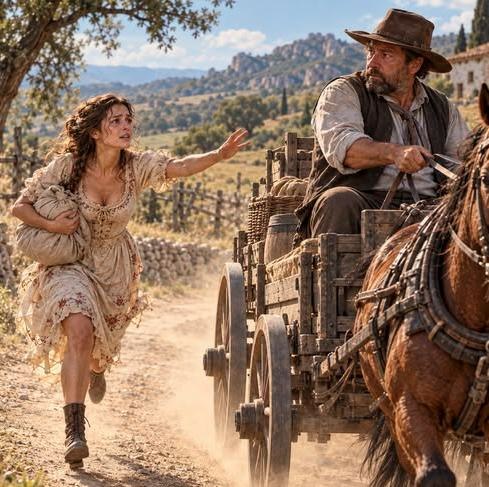
Tomás struck the alarm bell with his cane. Workers ran for buckets, but the old bell’s harsh ringing did something more important than summon water: it brought every farmer in the yard to the gate.
They had been waiting outside with carts, sacks, and questions. Rogelio’s threats had made them cautious. The sound of fire made them brave.
I stood with the telegram in my hand.
My name was written at the bottom.
The signature looked like mine.
It was not mine.
Lucía was staring at the office door, where orange light crawled beneath the frame.
“Your name is on the deed,” she repeated, almost to herself.
Rogelio appeared through the smoke, coughing, one sleeve blackened. He carried a metal cash box against his chest.
“You should have listened to me,” he said.
I stepped toward him.
“What did you transfer?”
“The ranch. The crop. Everything you owe.”
“I don’t owe you anything.”
“You signed the delivery agreement.”
“I signed a receipt for beans.”
“You signed twelve pages.”
Lucía’s expression changed.
“The pages he made me copy,” she said. “He attached them to every farmer’s receipt.”
Rogelio’s eyes snapped toward her.
“You helped him do it.”
“I thought I was copying inventory.”
“You knew enough to steal the ledger.”
“I knew enough to stop you from using my name.”
The fire cracked behind him. A beam collapsed inside the office, sending sparks through the doorway.
Rogelio hugged the cash box tighter.
“Move,” he ordered.
No one moved.
A farmer named Esteban stepped from the crowd. His hat was patched at the crown, and his hands were stained with black soil.
“Open that box,” he said.
Rogelio laughed bitterly.
“You think you can command me?”
Esteban pointed to the tags scattered around the scale.
“My son sold you six hundred kilos last spring. You paid for five hundred and twenty. Then your men came to my house when I demanded the difference.”
Another farmer stepped forward.
“You did the same to me.”
“And me.”
“And my brother.”
Rogelio looked at the crowd as if numbers had suddenly become more dangerous than weapons.
I took the telegram to Lucía.
“Who forged this?”
She scanned the page.
“The notary’s seal is real. The signature is not.”
“How do you know?”
She touched the ink with one finger.
“Because the last stroke on your real signature curls upward. This one stops halfway. He copied your name from the receipt book.”
Tomás nodded slowly.
“Rogelio kept a drawer of signatures. Farmers, drivers, suppliers. He practiced them at night.”
Rogelio’s face hardened.
“You old rat.”
Tomás lifted his chin.
“I weighed your lies for seven years. I know exactly how heavy they are.”
The workers had nearly smothered the fire by then. When they dragged the office door open, black smoke rolled over the yard. The private room was scorched, but the floorboards near the desk had not burned.
Lucía ran inside.
“Wait!” I shouted.
She dropped to her knees beside the desk and used the brass key on a narrow lock hidden in the baseboard. The floorboard lifted with a groan.
Inside was a tin case wrapped in oilcloth.
Rogelio tried to reach her.
I caught him by the shoulder.
“Let her take it.”
He looked at me with an expression I had never seen on his face before—not anger, not pride, but panic stripped bare.
“That case belongs to me.”
“No,” Lucía said. “It belongs to everyone whose name you used.”
She carried it outside and placed it on the weighing platform.
The lid held a stack of signed receipts, copies of contracts, and a small account book. The final pages listed payments to three men who had threatened farmers. Beside each payment was a date and a name.
One of the names belonged to Rogelio’s younger brother, Andrés.
Rogelio froze.
“He did this alone,” he said quickly. “Andrés handled the collections.”
Lucía turned a page.
“The money went into your private account.”
“He stole from me.”
“Then why did you send him away two days ago?”
The crowd shifted.
Rogelio’s gaze darted toward the road.
I understood the final piece. His brother had not disappeared because he was guilty. He had disappeared because Rogelio had sent him away with the only ledger that could connect the payments to the bank transfers.
But Lucía reached into the cloth bundle and removed something I had not seen before: a narrow strip of paper sewn into the hem of her dress.
“I found this under my mother’s mattress,” she said. “Andrés left it there the night he came to apologize.”
“What does it say?” I asked.
She handed it to Tomás.
He read it, then looked toward the gate.
“Your brother is at the freight station,” he said. “He has asked for protection from the railway manager.”
Rogelio staggered backward.
“He wouldn’t.”
“He already did,” Lucía replied.
The boy who had brought my telegram stepped forward again.
“There’s another message,” he said. “It came with the first one.”
He handed it to me.
The paper was addressed to Lucía.
I gave it to her. She read the first line, and all the color left her face.
“What is it?” Elena asked, who had arrived in our second cart with a blanket over one arm and terror in her eyes.
Lucía folded the paper against her chest.
“Andrés says my mother left a second letter with him. He says it explains why she let Father believe she had signed the transfer.”
Rogelio took one step forward.
“No.”
Lucía looked at him.
“You knew she hadn’t signed. You knew she was trying to protect me.”
He shook his head.
“She betrayed me.”
“She protected me from you.”
For a moment, the yard held only the hiss of wet ash.
Then Rogelio opened the cash box.
Everyone expected money. Instead, he pulled out a photograph, bent and stained at the corners. It showed a younger Rogelio, María, and Lucía as a child in front of the warehouse. María was smiling. Rogelio’s hand rested on her shoulder.
“I built this for her,” he said. “Every sack, every road, every peso. When she got sick, she told me the business was rotten. She wanted to sell it.”
Lucía’s voice softened despite herself.
“Then why didn’t you?”
“Because I was afraid.”
It was the first honest thing he had said.
He looked at the warehouse, the farmers, the scorched office.
“I thought if I kept earning, I could pay for her treatment. Then the debts grew. I took a little from each delivery. Only a little. I told myself I would replace it.”
“And when you couldn’t?” I asked.
“I took more.”
No one spoke.
Rogelio’s confession did not erase what he had done. But it explained the shape of the trap: greed had begun as fear, and fear had learned to wear a clean shirt.
Lucía unfolded the message from Andrés.
“Mother knew,” she said. “She wrote that she wanted me to leave before Father made me responsible for the warehouse. She told Andrés to keep the second letter until I was safe.”
Rogelio pressed both hands to his face.
“I loved her.”
“You loved what you were willing to destroy for her,” Lucía said.
That sentence struck him harder than any accusation.
By noon, every farmer had copied the figures from the tin case. The railway manager agreed to hold the records in a locked office until the regional agricultural board could examine them. Rogelio’s bank was notified that the transfer of my ranch was disputed, and the notary who had stamped the deed came to the warehouse himself, sweating through his collar, after discovering that his office ledger contained a payment from Rogelio.
No one needed a dramatic arrest to understand what was happening. Rogelio lost the buyers, the bank, the farmers, and the polished respect he had purchased with stolen weight.
But I still had a decision to make.
The agricultural board offered to return my ranch once the fraudulent deed was canceled. They also offered Lucía a clerk’s position reviewing grain records.
She turned to me that evening beside the scale.
“I can’t go back to the ranch as a servant.”
“You won’t.”
“I don’t know how to live there as family either.”
Elena came closer and held out the small brass button Lucía had left on the kitchen table days before. She had polished the cut edge and sewn it to a strip of cloth.
“You can start by stopping work whenever you’re tired,” Elena said.
Lucía gave a fragile laugh.
“That sounds difficult.”
“It is,” Elena replied. “We’ll teach you.”
Rogelio remained near the burned office, waiting for someone to decide what would become of him. He had lost the warehouse before the roof fully collapsed. Andrés returned from the freight station and gave the second letter to Lucía, then refused to speak to his brother.
Before we left, Rogelio called my name.
“Mateo.”
I turned.
“If the ranch deed is canceled, you’ll still lose the next harvest. The fire destroyed the contracts and half your seed stock.”
“I know.”
“I can repay you.”
Lucía looked at him sharply.
“With what?”
He glanced at the cash box.
“Sell the warehouse.”
The farmers stared.
Rogelio swallowed.
“Sell it and divide what remains according to the true weights. Every person in that yard gets the difference before I receive anything.”
It was not forgiveness. It was not enough. But it was the first decision he had made that cost him something without trying to buy silence.
I left with Lucía and Elena in the cart. The tin case rested beneath the seat, heavy with names. Lucía held her mother’s letter inside her dress, close to her heart.
At the edge of the road, she asked me to stop.
She climbed down, walked to the old weighing tag bearing my name, and placed it in my palm.
“Keep it,” she said.
“Why?”
“So you remember the honest weight of what you almost lost.”
I looked at the brass disk, warm from her hand.
Behind us, the warehouse bell rang once, and the farmers began reading the true numbers aloud.
Lucía climbed back into the cart beside Elena.
Then she touched the repaired button at her waist and said, “Take me home, Mateo—but let me decide what work comes next.”
Missed the beginning?






