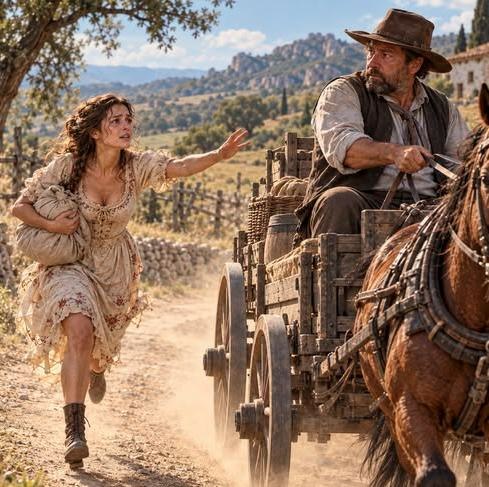
The girl dropped to her knees in the middle of the dirt road and begged me not to let the men from San Jerónimo catch her.
I had already passed her by several yards when I heard the cry behind me. The sun was sinking over the fields outside Tepatitlán, turning the dust orange, and my chestnut mare was pulling the empty cart toward home. I tightened the reins.
“Please! Take me with you!”
She ran badly, one hand gripping a small bundle wrapped in a faded kitchen towel, the other pressed against her ribs. Her wine-colored dress was torn near the ankle. Dirt covered her sandals.
I looked down the road. No one followed her, but the way she kept glancing over her shoulder made my stomach tighten.
“Where are you going?” I asked.
“Anywhere that isn’t San Jerónimo.”
“That isn’t a place I can write on a map.”
“It’s the only answer I have.”
She was young, perhaps twenty-two. Her face was thin with exhaustion, but her eyes were sharp enough to make me uneasy.
“What’s your name?”
She hesitated just long enough for me to notice.
“Lucía Prado.”
I should have refused. A strange woman, a strange story, and a road empty enough for trouble to hide in every ditch. But darkness was coming, and the next village was almost two hours away.
“I’m going to my ranch,” I said. “I can give you food and a place to sleep. I’m not promising a job.”
“I’ll work for every tortilla.”
“You can decide that after you eat.”
She climbed into the cart before I could change my mind.
At my ranch, Elena met us beside the brick house. She was carrying a copper pot, and steam curled around her face. She looked at Lucía, then at the bundle, then at me.
“Who is she?” Elena asked.
“Someone who needed a ride.”
“That explains the cart. Not the girl.”
Lucía lowered her eyes.
Elena sighed and stepped aside.
“Let her eat first.”
She served beans, rice, squash, and strips of dried beef. Lucía ate as if someone might snatch the plate away. When she finished, Elena filled it again without asking.
That night, we gave her a mattress in the storage room. Before I went to bed, I saw her sitting beneath the single lamp, pressing the wrapped bundle against her chest.
“What’s inside?” I asked.
“Clothes.”
“Nothing else?”
Her fingers tightened around the towel.
“It’s almost everything I have.”
For the next few days, she worked harder than any hired hand I had ever known. She swept the yard, fed the hens, washed pots, pulled weeds, and sorted beans until the skin around her nails cracked. Every time Elena told her to rest, Lucía answered the same way.
“I said I’d earn my food.”
“You said that while starving,” Elena replied. “It doesn’t become a law.”
One afternoon, I sat at the kitchen table with two receipts from Rogelio Quezada’s warehouse, the largest grain buyer in the region. The numbers for thirty-four sacks of beans refused to make sense.
Lucía passed behind me with a pitcher.
“How much did he deduct for moisture?” she asked.
I looked up.
“You understand these receipts?”
She took one from my hand. Her eyes moved across the columns quickly.
“This deduction is wrong.”
“Show me.”
I pushed over a pencil. She calculated on the back of an old seed invoice, her handwriting neat and trained.
“He charged you for nearly half a sack more than the actual loss.”
I checked the figures twice. She was right.
“Where did you learn that?”
She placed the pencil on the table.
“Working.”
Then she left the kitchen.
Two days later, she examined older receipts and found different transport charges, unexplained spoilage deductions, and percentages that changed depending on the harvest. When I mentioned Rogelio’s name, she froze.
“You know him?”
“I know that kind of business.”
“Did you work in a warehouse?”
Her face closed like a latched gate.
“Yes.”
The next week, I decided to sell only half my crop and insist that every sack be weighed in front of me. Lucía asked to come along. The night before we left, Elena found her sitting by the chicken coop, twisting a brass button from her torn dress between her fingers.
“You’re afraid,” Elena said.
Lucía stared toward the dark road.
“If he sees me, he’ll know I took something.”
“What did you take?”
Lucía looked toward the storage room.
“Something he cannot be allowed to destroy.”
At sunrise, she climbed into my cart. Two hours later, we entered Rogelio’s warehouse yard. An employee holding a ledger saw Lucía and dropped his pen.
“No,” he whispered. “That can’t be…”
He turned toward the office.
“Don Rogelio! Come outside!”
Rogelio appeared in a spotless white shirt and polished hat. The moment he saw Lucía, the color drained from his face.
“Lucía.”
She gripped the edge of the cart.
Rogelio descended the steps slowly.
“Where have you been, daughter?”
I turned toward her.
“Daughter?”
Rogelio’s gaze fell on the sacks of beans, then returned to Lucía.
“And if she came here with you,” he said, “I suppose she has already told you what she found in my accounts.”
Lucía shut her eyes. I felt the ground shift beneath my boots.
Rogelio held out his hand.
“Bring me the ledger, girl.”
Lucía’s bundle was still under her arm. She began to unwrap it, and every man in the yard moved toward her at once…
PART 2
…I stepped between Lucía and the men before anyone could touch her.
“Back away,” I said.
Rogelio stopped at the bottom of the stairs. Behind him, three warehouse workers stood frozen beside the weighing platform. The brass scale creaked in the morning heat, its empty tray swinging like a warning bell.
“That woman stole company property,” Rogelio said. “You have no idea what you’ve brought here.”
Lucía’s bundle trembled against her ribs.
“You told me she was your daughter,” I answered.
“She is. That makes her betrayal worse.”
Lucía finally looked at him.
“Betrayal?”
Her voice was quiet, but it carried across the yard.
“You made me sign the grain reports.”
Rogelio’s jaw tightened.
“You were my clerk.”
“I was your daughter.”
“And I gave you work when no one else would.”
“You gave me numbers already written and told me to copy them.”
One of the workers lowered his eyes. I recognized him from the road, the thin man who had called Rogelio outside.
“What is in that bundle?” I asked.
Lucía stared at the cloth.
“The original tally sheets.”
A murmur moved through the yard.
Rogelio laughed, but it sounded forced.
“Originals? She stole scraps from a waste bin and invented a story because she wanted money.”
“If they are scraps,” I said, “why are you shaking?”
His polished hat tilted as he took one step toward me.
“You are a farmer, Salgado. You sell beans. You do not understand contracts, inventory, or business.”
“I understand when thirty-four sacks become thirty-three on paper.”
“And you believe a runaway girl over me?”
“I believe the figures she corrected.”
The air smelled of burlap and hot metal. Lucía’s thumb rubbed the brass button she had carried from the ranch. I noticed a dark mark on its edge, as if she had held it so tightly that the metal had cut her skin.
“Mateo,” she whispered, “we need to leave.”
Rogelio turned sharply.
“You are not leaving with anything that belongs to me.”
“I didn’t take your money.”
“You took records.”
“Records that prove what you did.”
His expression hardened.
“Careful.”
Elena’s warning came back to me: Lucía had not been running from a bad harvest or an argument. She had been running from a man who knew exactly what she carried.
I raised my voice.
“Bring out the weighing book.”
The thin worker flinched.
Rogelio snapped, “No.”
“Why not?”
“Because I said so.”
“Then we leave and sell elsewhere.”
Rogelio’s smile returned, colder than before.
“You won’t sell anywhere. Every buyer within fifty miles uses my routes. If I tell them your crop is contaminated, you’ll feed it to your chickens.”
For months, I had accepted his deductions because I thought there was no alternative. Now I understood the real price of his friendship.
Lucía untied the cloth. Inside were folded sheets, a small iron key, and a narrow notebook with a cracked red cover. She did not hand them to me. Instead, she opened the notebook and pointed to a page.
“These are the actual weights,” she said. “The date, the farmer’s name, and the amount removed before the official entry.”
“Where did you get it?”
“From my father’s locked desk.”
Rogelio’s face changed.
“You broke into my office?”
“I used the key you gave me when you sent me to fetch your papers.”
“You were stealing from me.”
“I was trying to understand why people came to our house crying.”
His eyes flashed.
“Your mother was ill. The business kept this family alive.”
Lucía’s breath caught.
“Don’t use her to excuse yourself.”
A truck rumbled beyond the gate. The sound made everyone turn. An elderly man climbed down from the cab, carrying a wooden box against his chest. He wore a faded blue vest and walked with a cane.
Rogelio went rigid.
“Why is he here?”
The old man looked at Lucía first, then at me.
“I came because she asked me to tell the truth.”
Rogelio’s voice dropped.
“Tomás, think carefully.”
“I have thought for seven years.”
Tomás placed the wooden box on the weighing platform. Inside it, wrapped in wax paper, were dozens of small brass tags, each stamped with a farmer’s name and a weight.
“I kept these when Rogelio ordered me to reset the scale after every delivery,” he said. “I kept them because I knew one day someone would ask.”
Rogelio grabbed his arm.
“You old fool.”
Tomás pulled free, and the box tipped. Brass tags scattered across the concrete like hard little teeth.
Lucía knelt to gather them. Her hands shook.
I picked up one bearing my own name.
The weight stamped on it was four hundred and twelve kilos. The receipt in my pocket claimed three hundred and eighty.
Rogelio saw it in my hand.
“That proves nothing,” he said.
Then he made the mistake that turned suspicion into something far more dangerous.
He pointed at Lucía’s bundle and shouted, “She signed every false sheet herself!”
The yard went still.
Lucía’s face went white.
“You told them I signed because you needed someone to blame.”
Rogelio realized what he had admitted, but the words were already hanging between us.
Tomás opened the wooden box again and drew out a folded document sealed with red wax.
“This is not a weighing tag,” he said. “It is the paper Rogelio made Lucía sign the night her mother died. And it says…”
PART 3
…Tomás broke the seal with the edge of his cane.
The paper crackled in the hot yard. Rogelio lunged forward, but I caught his wrist. His cuff smelled of starch and expensive cologne. Beneath it, his pulse hammered.
“Let him read,” I said.
“You have no right,” Rogelio snarled.
Tomás unfolded the document and held it toward the light.
“This is a transfer agreement,” he said. “It says Lucía accepted responsibility for all warehouse discrepancies and personal debts incurred by Quezada Grains.”
Lucía stared at the page.
“I never saw that.”
“You signed the last sheet,” Tomás replied. “The pages were changed afterward.”
Rogelio pulled against my hand.
“She was an employee. She knew what she signed.”
“Read the witness line,” Tomás said.
Lucía moved closer. Her lips parted.
“María Prado.”
Her mother’s name.
Rogelio’s expression shifted from anger to fear.
“Your mother witnessed it,” he said quickly.
“My mother could not hold a pen that night.”
“You were grieving. You don’t remember.”
“I remember her coughing blood into a cloth. I remember you locking the office door. I remember you telling me that if I didn’t sign, the bank would take the house.”
A worker made the sign of the cross. Another stepped away from Rogelio as if the man had become contagious.
Tomás reached into the box again and brought out a folded letter.
“María wrote this before she died,” he said. “She gave it to me because she knew Rogelio would search her room.”
Lucía took it with both hands. The paper was yellowed, but the handwriting was unmistakably careful.
She read silently. Then she pressed the letter to her mouth.
“What does it say?” I asked gently.
Her eyes lifted to Rogelio.
“My mother says she never signed the transfer. She says my father was hiding losses by weighing every farmer’s crop short. She says he planned to put the debts in my name.”
Rogelio shook his head.
“She was confused from the medicine.”
Tomás pointed to the bottom of the letter.
“Her physician signed the date. She was clear enough to ask me to protect her daughter.”
Lucía looked at the red-sealed agreement again. In the witness section, the name María Prado had been written in a hand too smooth and steady to belong to a dying woman.
I removed the receipt from my pocket and placed it beside the document.
“The same ink,” I said. “The same handwriting.”
Rogelio looked from the papers to the people around him.
“You think this is a trial?”
“No,” I answered. “It’s a reckoning.”
He turned on Lucía.
“I fed you. I paid for your schooling. I kept this business alive after your mother became useless.”
Lucía flinched as though he had struck her.
“You called her useless?”
“She left me with debts and a daughter who knew nothing.”
“I knew enough to find the second ledger.”
The words landed harder than the document.
Rogelio’s face emptied.
“What second ledger?”
Lucía opened the cracked red notebook. Between its pages was a small brass key.
“The one hidden beneath the floorboard in your private office,” she said. “The one listing payments you made to the men who threatened farmers when they complained.”
Tomás closed his eyes.
“So that is why they came to my house,” he whispered.
Lucía nodded.
“They were not debt collectors. They were being paid to frighten you.”
I felt anger rise through me, but beneath it was something heavier: shame. I had called myself cautious, yet I had sold my harvest to a man who had been stealing from neighbors for years.
Rogelio looked toward the office.
“Where is the ledger?”
Lucía did not answer.
He suddenly shoved past me and ran up the steps. The office door slammed. A moment later, smoke curled from beneath it.
“He’s burning it,” Tomás cried.
I reached for the handle, but Lucía caught my sleeve.
“Don’t go in. The key I took wasn’t for the ledger.”
“Then what was it for?”
She turned the brass key over in her palm. A number had been scratched into the metal.
“Locker seventeen at the freight station.”
Before we could move, a boy came racing through the gate, breathless, clutching a telegram.
“Señor Salgado,” he gasped. “This came for you. The bank says your ranch has been transferred to a buyer in Guadalajara. The signature is yours.”
I stared at the paper.
Rogelio had not only stolen from me. He had used the papers Lucía carried to make sure I could never afford to expose him.
And at that moment, from inside the burning office, Rogelio shouted one sentence that made Lucía’s knees give way…
“Your name is already on the deed!”
The last paper made Rogelio lose his color…
I thought the truth had already destroyed his carefully built world. I was wrong. The final document forced all of us to choose what justice would actually cost.
“Every stolen weight is written here.”
Rogelio’s hand tightened around the burned ledger.
👇 The final part of the story is already open.






