PART 4
I answered the second call.
“Lena?” a woman said.
Her voice was calm. Too calm.
“Who are you?”
“You know who I am. I am standing in your kitchen.”
I looked at Pavel. Rэм lifted his head from my knee.
“Leave my apartment,” I said.
“I would gladly leave,” Irina replied, “if your husband had not given me the keys and accepted my money.”
“Did he tell you I signed the sale?”
“He told me many things.”
There was a pause. Then I heard the clink of a spoon against ceramic. My spoon. The one with the chipped handle from our first year together.
“Irina,” I said, “where is Egor?”
“Not here. He ran when I showed him the original contract.”
“What original contract?”
“The one he signed with me. The one in which he promised to deliver the apartment empty, with no wife, no baby, and no dog.”
The words struck harder than Pavel’s discovery.
I closed my eyes.
Egor had not simply wanted the dog gone. He had planned to erase all three of us from the place where he had promised we would grow old.
Pavel leaned toward the phone. “Irina, do you have the contract in front of you?”
“Yes.”
“Do you have the payment receipt?”
“Yes.”
“Then do not give either document to Egor.”
Irina gave a short, bitter laugh. “I learned that much already.”
I gathered the baby and Rэм. The dog leaned against my leg, still limping. Pavel insisted on driving us back to town in the ranger truck. The road jolted beneath us, and every bump made Rэм whine softly from the rear seat.
“Why did you help him?” I asked Irina when we reached the apartment building.
She was standing in our hallway wearing a red wool scarf and holding a leather folder. She looked older than I had imagined, with tired eyes and a pale line around her left wrist where a watch had been removed.
“Because my son needed surgery,” she said. “Your husband found me at the market. He knew I had inherited money from my mother. He told me he owned this apartment and needed a fast sale.”
“He said I agreed?”
“He showed me your forged signature.”
“Why did you call me?”
Irina looked toward the stairwell. “Because I saw him leave the dog. He told me the animal would be collected by a shelter. When I realized he had lied about that, I looked at the rest of his papers.”
She opened the leather folder.
Inside was a bank receipt, the signed agreement, and a small folded page covered in Egor’s handwriting. It contained a list of everything he intended to take from the apartment: television, tools, baby furniture, even my grandmother’s copper baking pan.
At the bottom he had written one sentence: Leave Lena with nothing. She will come back when she is afraid.
I stared at it until the letters blurred.
Irina touched my sleeve. “I am sorry.”
“I am not going back to him.”
“I did not ask you to.”
She handed me the papers. “I am going to cancel the sale. I will not keep money obtained through a lie.”
“Your son needs surgery.”
“Yes.”
Pavel said, “There may be another way.”
The ranger station had a small emergency fund for injured working animals, and Irina had already sold her car to raise part of the money. I had no savings. But I had a skill Egor had always treated like a hobby.
I called the bakery where I had once worked before pregnancy.
The owner remembered my cinnamon rolls. She offered me the empty counter near the front window and paid me in advance for the first month. It was not enough for Irina’s entire problem, but it was a beginning. Then Pavel brought a photograph of Rэм standing beside a rescue volunteer’s truck, his bandaged paw lifted like a solemn salute. The picture spread through the neighborhood by evening.
People came for cinnamon rolls and left envelopes marked for Irina’s son.
Egor came three days later.
He stood outside the bakery while I was arranging pastries beneath the glass. Rэм was lying near the ovens, warm and watchful. Our son slept in a carrier behind me.
Egor looked thinner. His coat was stained with plaster, and his eyes kept moving between the dog and the cash register.
“Can we talk?” he asked.
“No.”
“I made a mistake.”
“You made a plan.”
His face tightened. “I was desperate.”
“You sold our home to pay a debt and forged my name. You left Rэм in a forest because you thought I would be too frightened to resist.”
“I thought I was protecting the baby.”
Rэм rose behind me.
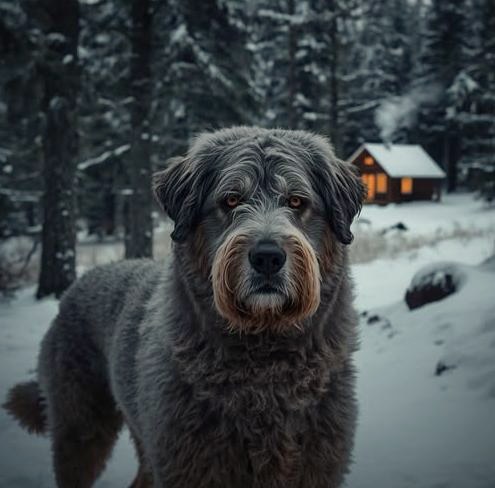
Egor took one step forward, then stopped. The dog did not bark. He simply stood between us, broad-chested and silent, his amber eyes fixed on the man who had driven away.
Egor swallowed. “He still remembers me.”
“He remembers everything,” I said.
A delivery truck rattled past outside. Cinnamon and warm sugar filled the bakery.
Egor looked at the sleeping baby. “Please let me see my son.”
“You may see him when you can explain the truth without asking him to carry it for you.”
His gaze dropped to the floor.
“I don’t know how to fix this.”
“Start by returning every key.”
He placed two keys on the counter. The apartment keys. Then he pulled a third from his pocket, the key to his workshop.
“I sold the tools,” he said.
“All of them?”
“To Irina. I used the money to repay what remained.”
Irina had not told me that. She had bought the tools back from the creditor and was storing them until the matter was settled. Egor had nothing left to bargain with.
Except the truth.
He reached into his coat and placed a signed statement beside the keys. It admitted the forged signature, the false promise, and the abandonment of Rэм. His hand shook as he pushed it toward me.
“I gave a copy to Irina,” he said. “And to the bank. I want the sale canceled properly. I want the debt in my name.”
I read the first line. Then I folded the paper.
“Why?”
“Because I kept trying to make you afraid enough to stay.”
The answer hurt because it was the first honest thing he had given me in months.
I did not forgive him that day.
I did not take him back.
But I gave him an address and a time when he could see our son with Pavel present. Consequences were not the same as cruelty. And Rэм deserved to know that leaving him had never been his fault.
A week later, Irina’s son received the operation he needed. The payment came partly from her sale of the car, partly from the bakery, and partly from neighbors who had never met us before the forest story traveled through town.
The apartment sale was canceled. Irina kept the forged contract and returned the money she could. The rest became a debt Egor was forced to repay by working at a construction yard under his own name, without my signature, my income, or my silence.
I moved into a smaller place above the bakery. Rэм’s bowl stood near the oven, where he could watch me knead dough. Our son slept in a crib beside the wall, and the knitted yellow blanket with the red sailboat stayed tucked around him.
One afternoon, Egor came for his visit. He carried no gifts. He brought only a paper bag of dog biscuits and a leash with a new brass tag.
Rэм sniffed it, then looked at me.
I nodded.
The tag read: Rэм. Found, loved, and home.
Rэм took it gently from Egor’s hand and carried it to the baby’s crib.
Egor sat on the floor, his back against the wall.
“I thought he would hate me,” he said.
“He may,” I answered. “He may also remember the years before the clearing. Both can be true.”
Rэм placed the tag beneath the crib and rested his chin beside the baby’s tiny foot.
Egor covered his face.
I watched the dog guard the child who had once been used as an excuse to abandon him, and the little brass tag caught the bakery light like a small, stubborn promise: Rэм was not waiting by the forest road anymore.
Missed the beginning?






