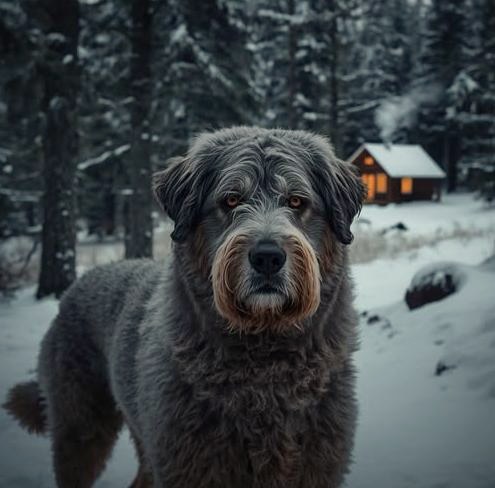
The moment my husband drove away from the forest, our dog ran after the car with the baby’s blanket still caught under his paw. I stood beside the open rear door, holding our three-month-old son, while the taillights shrank between the pines.
“Egor,” I whispered. “Stop the car.”
He did not stop.
Rэм—our enormous shepherd mix with amber eyes and a white mark across his chest—kept running. His claws struck the gravel. His tongue hung from his mouth, and every few seconds he turned his head toward us, expecting the game to end.
Egor gripped the steering wheel so tightly that the veins stood out on his hands.
“Don’t make this harder,” he said.
“You said we were going for a walk.”
“We are going for a walk. He is going for a longer one.”
Our son stirred in the carrier behind us and made a thin, hungry sound. I looked at the road, then at the dog disappearing around the bend. Something inside my chest seemed to split open.
For three years, Rэм had slept against our feet in the old two-room apartment on the edge of town. Mornings smelled of Egor’s paint, fresh coffee, and the cinnamon rolls I baked before work. Rэм carried my slippers from room to room, stole crusts from the table, and smiled by stretching his black lips over his teeth.
When I became pregnant, he placed his heavy head on my knees and listened to my stomach as if the baby might answer him. After we brought our son home, Rэм crept to the crib, licked one tiny heel, and lay down beside it. He became the silent shadow of a person who could not yet speak.
Then came the sleepless nights.
At two in the morning, our son cried until his face turned red. Egor came home covered in plaster dust, found water spilled across the new floor, and stared at Rэм as though the dog had personally ruined his life.
“Choose,” he said that night. “The dog goes, or I do.”
“He has nowhere to go.”
“Then find somewhere.”
I knew what he meant by somewhere. A roadside. A shelter that would refuse a dog his size. A stranger’s yard. I cried until dawn with the baby against my shoulder, while Rэм pressed his nose into my palm.
A week later, Egor packed charcoal, meat, and a folding grill into the trunk. He acted cheerful. Rэм jumped in circles when he heard the word forest. Our son slept beneath a knitted yellow blanket, one corner embroidered with a tiny red sailboat.
Three hours later, the road became dirt. The trees closed around us.
At the clearing, Egor opened the door.
“Run, Rэмbo,” he murmured, scratching behind the dog’s ear. “We’ll be right back.”
Rэм believed him. He bounded toward a fallen pine, sniffed the moss, and barked happily.
I stepped out, clutching the baby. Egor was already back behind the wheel.
“Get in,” he said.
“I’m not leaving him.”
His face hardened. “You are not choosing a dog over your child.”
The engine roared. Rэм turned, confused, and raced toward us. I grabbed the door handle, but Egor pressed the accelerator. Gravel struck the underside of the car like thrown stones.
Rэм followed until the road bent. Then he vanished.
I spun toward Egor. “Turn around!”
He locked the doors.
“Egor!”
“Not here.”
The baby began to cry. My hands shook so badly that I could barely unfold the yellow blanket. Then I noticed something beneath it: a narrow brown folder wedged beside the carrier, its corner marked with a fresh smear of green paint.
Egor reached for it before I could pick it up…
PART 2
Egor’s hand stopped inches above the folder.
For one second, neither of us moved. The baby cried between us, his small fists opening and closing beneath the yellow blanket.
“What is that?” I asked.
“Nothing.”
“Then let me see it.”
“Lena, I said it’s nothing.”
He snatched the folder from the seat and shoved it beneath his jacket. The motion was too quick, too practiced. My stomach tightened.
“Pull over.”
“We are almost home.”
“Pull over, or I will climb out while you’re moving.”
His jaw flexed. He glanced at our son in the mirror, then at me.
“You’re exhausted. You don’t know what you’re saying.”
“I know exactly what I’m saying. Turn around.”
The car continued through the trees.
At the bend, I saw the place where Rэм had disappeared. There were deep paw marks in the dust, one claw-shaped line cutting across the tire tracks. I pressed my palm to the window.
“Stop.”
“He’ll find another road.”
“He thinks we’re coming back.”
Egor said nothing.
That silence was worse than shouting.
When we reached the highway, a sign pointed toward town. I waited until the car slowed near a roadside café, then grabbed the folder from beneath his jacket. He caught my wrist.
“Don’t touch my things.”
“Your things? You hid them next to our baby.”
The folder fell open across the dashboard. Inside were printed pages, a map with a red circle around the forest clearing, and a short handwritten note. I saw only three words before Egor tore the page away.
“Move-out inspection.”
The world tilted.
“What inspection?”
He crumpled the note in his fist. “The apartment needs repairs.”
“Why would there be an inspection?”
“Because I’m selling it.”
The café lights flashed across his face. I remembered the evenings he had come home smelling of gasoline instead of paint. The calls he took on the stairwell. The way he had started counting money twice before buying diapers.
“You can’t sell our home without telling me.”
“I can if we have debts.”
“What debts?”
He struck the steering wheel. Our son screamed.
“Enough! I am trying to keep us from being buried alive.”
I looked at the folder again. A corner of a stamped page showed through his fingers. There was a date, a price, and a line with my name printed beneath it.
My name.
“Why is my name there?”
Egor shoved the folder under the driver’s seat and started the car.
That night, while he showered, I searched the apartment. The crib stood beside the wall, surrounded by folded clothes and unopened packages of diapers. Rэм’s metal bowl still sat near the kitchen radiator. A single strand of his fur clung to the rim.
I found no papers in the desk. No envelope in the wardrobe. But inside Egor’s paint box, beneath a roll of masking tape, I found a brass luggage tag. It belonged to Rэм’s collar. His name was engraved on one side. On the other was our old address and my phone number.
Egor had removed it before we left.
My fingers went cold.
At 1:17 in the morning, my phone rang. The number was unknown.
“Is this Lena?” a man asked.
“Who is this?”
“I’m calling from the forest access road. I found your dog.”
I gripped the kitchen counter. “Is he alive?”
“He is hurt, frightened, and standing beside a child’s blanket. But he is alive.”
Behind me, the bathroom door opened. Egor stepped into the hallway, drying his hair.
The man continued, “There is something else you need to know. Your husband wasn’t alone when he left the dog…”
PART 3
The line went quiet for half a breath.
“Who was with him?” I asked.
“A woman in a red scarf,” the man said. “She was waiting near the road. Your husband gave her a set of keys.”
Egor crossed the hallway in three steps and reached for my phone.
“Hang up.”
I pulled away. “Where is my dog?”
“Bring the baby and come to the ranger station. I have water and a blanket for him. My name is Pavel.”
Egor seized my arm. “You are not going anywhere.”
Pavel heard him.
“Lena,” he said, “I saw the car’s plate. I also saw the papers your husband carried. Bring them if you have them.”
Egor ripped the phone from my hand and ended the call.
For a moment, the apartment held only the hum of the refrigerator and our son’s soft breathing.
Then I slapped Egor.
The sound cracked through the hallway.
“You left him there,” I said.
His cheek reddened. “I was trying to save us.”
“From what?”
He laughed once, without humor. “From the bank. From collectors. From you pretending cinnamon rolls can fix everything.”
“What did you sign?”
His eyes shifted toward the paint box.
I moved first. I grabbed the brass luggage tag and the box, then ran for the stairs. Egor followed, but the baby’s crying stopped him. I heard him curse behind me as I reached the street.
Pavel met me at the ranger station just before dawn. The building smelled of wet wool and wood smoke. Rэм lay on a woven mat near the stove, one front paw scraped raw. When he saw me, he tried to stand.
“Rэм,” I whispered.
He crossed the room on trembling legs and pushed his head into my stomach.
I fell around his neck.
“I’m sorry,” I sobbed. “I’m so sorry.”
He licked my wrist. His breath smelled of pine needles and dust.
Pavel set a metal thermos on the table. “I found him near the bend. He kept returning to the tire tracks.”
“Why did you say my husband had papers?”
Pavel opened a logbook. “Because I wrote down the license plate. And because your husband asked me yesterday if the property beyond the clearing was private land.”
He turned the book toward me. Beneath the time and plate number was Egor’s signature.
“He claimed he was leaving an aggressive dog,” Pavel continued. “I told him the forest was not a shelter. He said the dog was no longer his problem.”
My throat burned.
Pavel then placed a second sheet beside the logbook. It was a property transfer agreement, folded and creased from being hidden beneath a car seat. The buyer’s name was Irina Volkova—the woman in the red scarf. The price was far below the apartment’s value. The document stated that the sale would be completed after the occupants vacated.
My signature appeared at the bottom.
But it was not mine.
I knew because my signature always ended with a small upward hook. This one ended sharply, like a knife cut.
“He forged it,” I said.
Pavel nodded. “And he told Irina the apartment would be empty by Monday.”
My phone began ringing.
Egor.
I answered on speaker.
“Where are you?” he demanded.
“With Rэм.”
A pause.
“You took the dog back.”
“He was never yours to abandon.”
“You don’t understand what happens if that sale fails.”
“Then tell me the truth.”
His breathing grew rough. “Irina paid the debt. I promised her the apartment. I promised her you would sign.”
Pavel looked at me. Rэм rested his head on my knee.
Egor whispered, “If she learns the papers are forged, she will come for both of us.”
Before I could answer, a second call pushed through. The name on the screen made Pavel’s face change.
It was Irina Volkova, and she was calling from our apartment…
Then the woman in the red scarf showed me everything…
I thought the forest was the worst thing my family would face. I was wrong. The truth waiting at our apartment changed every choice that followed.
“I want the debt in my name.”
Rэм watched him without moving.
👇 The final part of the story is open.






