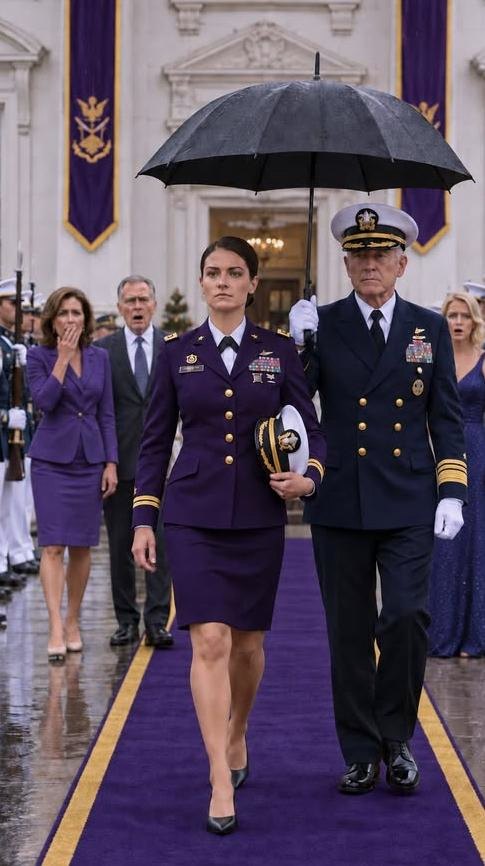
My father shoved me down the academy steps in the rain, then walked inside wearing the invitation meant for me.
The stone beneath my boots was slick with ice, and the sharp edge of the third step cut through my palm. I barely noticed. I was staring at the bronze doors closing behind Richard Reed, my stepmother Elaine, and Brianna, who was holding my cream-colored invitation between two manicured fingers.
The academy seal glinted on it like an accusation.
“Do not embarrass us,” my father had said moments earlier. “Brianna knows how to speak to important people. You are only graduating.”
Only graduating.
The words followed me into the freezing rain.
Twenty-two hours earlier, I had been standing watch in a communications room beneath the north training range. My uniform smelled of dust, metal, and burnt coffee. When I finally reached my father’s house at six in the morning, my knees trembled from exhaustion.
I had not even set my pack down before Elaine called from the kitchen.
“Natalie, the dishes are still in the sink. Brianna has a photographer coming tomorrow.”
“I just finished a twenty-two-hour shift.”
“And Brianna has a very important day ahead of her.”
Richard sat beneath the television’s blue light, scrolling through messages on his tablet. I pulled the invitation from my pack and placed it on the table.
“Dad, my graduation is Friday,” I said. “They gave me one family invitation. I thought maybe you could come.”
He looked at the envelope for less than a second.
Then he took it.
“Richard,” I said.
He handed it to Brianna without even turning toward me.
She came in wearing a white silk blouse and holding a phone with a ring light clipped to its case. “Is this the VIP one?”
“It is now,” he said.
My throat tightened. “That invitation has my name on the guest list.”
“Names can be changed,” Richard replied. “Brianna is meeting generals and senior officers. This could help her career.”
“What career?”
Her smile sharpened. “Public relations. You would not understand.”
I looked at my father. I wanted him to say he was joking. I wanted one sentence that proved four years of discipline, sleepless examinations, field exercises, and classified research had meant something to him.
Instead, he folded his arms.
“You are one young service member among hundreds, Natalie. Do not act as if the whole academy is waiting for you.”
I said nothing.
They had always believed I was ordinary because I had stopped correcting them. I never told them that I ranked first in my class. I never mentioned the national military research award, or the commission waiting for my signature, or the hours I spent designing a field-communication system that could keep isolated units alive when every tower failed.
Explaining yourself to people committed to misunderstanding you became exhausting.
So I let them think I was small.
On Friday morning, the academy courtyard was crowded with families beneath umbrellas. Brass instruments warmed up beneath the awning. Medals flashed on dress uniforms. The rain clicked against the stone like thousands of impatient fingers.
A black luxury car stopped beside the VIP entrance.
Richard stepped out first. Elaine followed. Brianna emerged last, lifting my invitation toward the cameras.
“This is going to look incredible online,” she said. “Everyone will think I know the commandant personally.”
I approached the main gate with my academy identification visible at my collar.
I did not need the invitation.
Before I reached the guard, Richard seized my arm.
“What are you doing?”
“Going inside.”
He glanced at my soaked uniform, then at Brianna’s spotless blouse.
“Not beside her. You will ruin the photographs.”
His fingers dug into my arm. Then he pushed.
My boot slid. My shoulder struck the iron railing, and the brass pin bearing my unit number snapped loose and skittered across the steps.
Richard did not look back.
Neither did Brianna.
I remained there while the cold rain ran down my face. Four years of work passed through my mind in flashes: midnight drills, burned fingertips, exam papers covered in red ink, and every difficult decision I had made when the easier choice would have been to quit.
Then someone stepped beside me, and the rain stopped touching my shoulders.
A black umbrella had opened above my head.
General Marcus Ellison, commandant of the academy, stood there in full dress uniform. His eyes moved from my injured hand to the bronze doors.
“Captain Reed?” he asked. “Why are you standing outside?”
I could not answer.
“We have been looking for you for twenty minutes,” he said. “The ceremony cannot begin without you.”
He glanced toward the entrance.
“Your father went in with your guest.”
“Yes, sir.”
The general studied my face. “Do you know what today is?”
“My graduation.”
“No.” His voice softened. “Today is the academy’s first Command Leadership Convocation. You are this year’s distinguished graduate. You are delivering the address, receiving the leadership medal, and accepting the national research citation.”
My heartbeat changed.
Behind the doors, the orchestra struck the opening note, then stopped.
General Ellison turned toward the entrance.
“Come with me, Captain.”
I bent to retrieve my broken brass pin. Before I could stand, the general reached for the handle of the bronze door, and someone on the other side began pulling it open…
PART 2
The bronze door opened inward, revealing a corridor crowded with officers, faculty members, and confused guests. Every conversation died at once.
General Ellison stepped through first.
“Clear the aisle,” he ordered.
I followed him, still clutching the broken brass pin in my wet palm. Water dripped from my sleeves onto the polished floor. The smell of rain and wool followed me inside.
At the end of the corridor, a lieutenant hurried toward us.
“Sir, the orchestra is waiting. The board is seated.”
“Then tell them Captain Reed has arrived.”
The lieutenant’s eyes widened when he saw me. “Captain?”
I had grown used to people looking twice when they learned my rank. My family had never bothered to look once.
General Ellison lowered his voice. “Are you hurt?”
“My shoulder is bruised.”
“That was not my question.”
I looked at the crowded hall beyond him. “I am embarrassed.”
“Your family caused that. Do not carry their work for them.”
Across the foyer, Richard had turned around. His expression changed so quickly it looked almost painful. He had expected me to disappear through the public entrance. Instead, I was standing beside the commandant while two officers moved to make room for me.
Brianna still held my invitation.
“What is happening?” she demanded.
General Ellison looked at her credential. “Miss Reed, please give that to Captain Reed.”
“She gave it to me,” Brianna said.
“No,” I answered. “My father took it from me.”
Richard came forward. “This is a family misunderstanding. Natalie is upset because she was not given the attention she wanted.”
The general’s face hardened. “The academy does not delay a national ceremony for family misunderstandings.”
Elaine touched Richard’s sleeve. “You said she was not important.”
He shot her a warning glance.
I heard it. So did Brianna.
For the first time, Brianna’s smile disappeared entirely.
A staff officer approached with a folder pressed against his chest. Its corners were protected by a strip of red sealing tape. I recognized the folder immediately. It held the citations for the national research project, the one I had never discussed at home.
“Captain, the board needs your signature before the presentation,” he said.
Richard reached for it. “I can handle that.”
The officer pulled it away. “Only Captain Reed can sign.”
My father’s face tightened. “She is under my roof.”
“Not under my command,” General Ellison said.
The words landed harder than the shove outside.
At nine fifteen, I stood behind the curtain while the orchestra began again. Through a gap in the fabric, I saw Richard seated in the VIP section. Brianna sat beside him, still wearing my invitation on a white lanyard. Elaine kept glancing between them and the stage.
The master of ceremonies announced the graduates.
My name came last.
“Captain Natalie Reed, distinguished graduate, recipient of the National Field Communications Citation, and designer of the adaptive relay protocol adopted by three regional commands.”
The applause began before I stepped out.
It rose like thunder.
My legs felt unsteady. I had imagined this moment in empty barracks rooms, but never with my father sitting beneath my name as if he had known all along.
General Ellison met me at the center of the stage. “Ready?”
“No, sir.”
“Good. Ready people rarely remember what matters.”
He pinned the leadership medal to my jacket. The metal was warm from his hand.
When I approached the lectern, Richard stood halfway up.
“Natalie,” he called sharply. “This is enough.”
The audience turned.
I looked at him through the bright stage lights. “Enough of what?”
“Making private family matters public.”
“I did not make anything public.”
“You are humiliating us.”
General Ellison stepped toward the microphone. “Mr. Reed, sit down.”
Richard did not.
The academy’s chief legal officer, Colonel Miriam Vale, came through the side aisle carrying a second folder. Unlike the first, this one had no seal. It was thin, worn, and marked with a handwritten date from four years earlier.
She stopped beside the stage and looked at me.
“Captain Reed,” she said, “before you begin, there is a matter the board has decided you must hear in front of the person who brought it here.”
My stomach turned.
Richard’s hand gripped the arm of his chair.
Colonel Vale opened the folder but did not read from it.
“Your father has submitted a formal claim concerning the origin of your research.”
A murmur passed through the hall.
I stared at Richard. “What claim?”
He rose at last. “This is absurd.”
“Then you should have no difficulty answering,” Colonel Vale said. “Why does your company possess Captain Reed’s original research files, and why was the project presented to the defense procurement board under another name?”
Brianna turned toward her father.
“What does she mean?”
Richard’s lips parted.
The orchestra members stopped moving. Somewhere behind me, a medal chain tapped softly against the lectern.
Colonel Vale placed one hand on the folder.
“We have the transfer record,” she said. “But the person who signed it is not the person you think it was…”
PART 3
The hall became so quiet that I could hear rain ticking against the high windows.
Colonel Vale turned the folder toward Richard.
“On March fourteenth, four years ago, a research package created by Cadet Natalie Reed was transferred from the academy archive to Reed Tactical Systems,” she said. “The request claimed the cadet had authorized commercial review.”
“That is a clerical matter,” Richard snapped.
“Then you will recognize the signature.”
She lifted a page.
I saw my name at the bottom. The signature looked like mine from a distance: the same long first stroke, the same narrow loop beneath my surname. But I had never signed it.
“I was in field training that week,” I said.
“You were,” Colonel Vale replied. “Your attendance records place you at Fort Danner from March twelfth through March seventeenth.”
Richard’s jaw tightened. “She gave me permission verbally.”
“Did she?” General Ellison asked.
“I am her father.”
“That is not permission.”
Brianna stood. “Dad, what did you do?”
“Sit down, Brianna.”
“No. You told me the relay system was mine.”
The room shifted. Heads turned toward her.
I looked at her. “What did you just say?”
Her face had lost its color. “He said the company wanted me to present a youth innovation project. He told me the academy research belonged to the family because he paid for your education.”
Richard pointed toward me. “She would never have completed it without this family.”
“I completed it after you refused to drive me to the laboratory,” I said. My voice shook, but it did not break. “You told me military technology was a hobby for people who could not succeed in business.”
Colonel Vale removed another sheet from the folder.
“The commercial patent application lists Brianna Reed as the primary developer. It also lists Richard Reed as the supervising consultant.”
Brianna stared at the page.
“You used my name?” she whispered.
Richard reached for her. “I was protecting your future.”
“By stealing hers?”
The question struck him harder than any accusation from the stage.
I remembered the night the system had finally worked. I had been alone in a basement laboratory, listening to three disconnected radios find one another through a storm simulation. I had called home afterward. Richard had answered on the fourth ring.
“Can this wait?” he had said. “Brianna has a fitting.”
I had said yes.
Now I understood why my father had fought so hard to place Brianna in the VIP section. She was supposed to meet the procurement delegation that morning. He had planned to introduce her as the brilliant young mind behind the project and use her photographs, her charm, and his company’s connections to secure a national contract.
The invitation had never been about a ceremony.
It had been a doorway into money.
Richard stepped toward the stage. “This is a private dispute. The academy has no right to interfere with my company.”
“The academy has every right,” General Ellison said. “The research was created here, under academy supervision, and the transfer was unauthorized.”
Colonel Vale looked at me. “There is one more document.”
She unfolded a handwritten statement.
An elderly woman in a navy staff uniform rose from the third row. I recognized her after a moment: Mrs. Alvarez, the laboratory supervisor who had retired the year after my project began. She had been quiet during the investigation, almost invisible among the officials.
She walked to the stage carrying a small metal key on a cord around her neck.
“I kept the original archive ledger,” she said. “Mr. Reed came to my office himself. He told me Natalie was unstable, that she had abandoned the project, and that the family needed the files before she destroyed them.”
My chest tightened.
“He did not come alone,” Mrs. Alvarez continued. “Brianna was with him. She was wearing a yellow scarf and carrying a box of pastries. She asked me where Natalie kept the final design notes.”
Brianna covered her mouth.
“I did not know,” she whispered. “He said he needed them for her scholarship.”
Mrs. Alvarez placed the ledger on the lectern. “I refused to release the final archive. That is why the copy they took was incomplete.”
Richard’s eyes flashed. “You are an old employee trying to settle a grudge.”
Mrs. Alvarez opened the ledger and pointed to a line. “I wrote down the serial number of the drive they carried away. I also wrote the name of the officer who later returned it.”
Colonel Vale took the ledger. “The returned drive contained the missing development notes and a draft patent application.”
I felt cold despite the heat of the stage lights.
Richard had not merely taken credit. He had taken the work, altered the records, and planned to sell a system he could not fully understand.
General Ellison addressed the room. “The procurement delegation will not meet with Reed Tactical Systems today. The academy will assume control of the technology until Captain Reed chooses its future.”
Richard looked at me, not as a daughter, but as an obstacle.
“You will regret this,” he said.
“I already regretted trusting you,” I replied.
His hand trembled against the back of the chair.
Then a signal officer hurried onto the stage and handed Colonel Vale a sealed message. She read it once. Her expression changed.
“What is it?” I asked.
She looked at Richard, then at me.
“The board has received a second filing from Reed Tactical Systems,” she said. “It was submitted this morning, less than an hour ago.”
Richard’s face turned gray.
Colonel Vale lowered the page.
“It claims the academy’s entire research program belongs to your father’s company—and it names you as the employee who allegedly approved the transfer…”
Then the invitation dropped something onto the floor…
I thought the stolen invitation was the deepest betrayal. I was wrong. The final discovery forced everyone to choose a side.
“I want to give a statement.”
Richard finally understood who had left him.
👇 The final part of the story is already open.






