PART 4
“That filing is a lie,” I said.
Colonel Vale did not answer immediately.
She handed the page to General Ellison, who read it beneath the stage lights while the audience watched every movement of his eyes.
Richard stood rigidly below us.
Brianna was still staring at him as if she had never seen his face before.
“Your company filed this at eight forty-seven,” Colonel Vale said. “It includes a digital authorization bearing Captain Reed’s credentials.”
“I never authorized anything,” I replied.
“I know.”
She reached into the folder and removed a small plastic card sealed inside a transparent evidence sleeve. It was an academy access card, cracked across the corner.
My breath caught.
I knew that card.
It had disappeared four years earlier, during the week I was at Fort Danner. I had assumed I had dropped it during training. Richard had found it in the kitchen drawer when I returned, then told me he had thrown it away.
He had not thrown it away.
“You used my access card,” I said.
Richard’s eyes shifted toward the exit.
Colonel Vale continued. “The second filing was generated from an account linked to this card. But the authentication was incomplete. Whoever submitted it used an outdated security certificate.”
General Ellison looked at the communications officer. “Can we identify the terminal?”
“Yes, sir. The filing came through the guest network in this building.”
Every face in the hall turned toward Richard.
His voice rose. “I came here as a guest. That proves nothing.”
“It proves you had access to the network,” Colonel Vale said. “It does not prove you submitted the filing.”
Richard seized on that sentence. “Exactly. You have no case.”
Brianna flinched.
I watched him carefully. He was not frightened by the accusation. He was measuring the gaps between facts, searching for the place where he could slip away.
Then his gaze landed on the lanyard around Brianna’s neck.
“Give me the invitation,” he ordered.
She did not move.
“Brianna.”
“You said it was mine.”
“It is a piece of paper.”
“It has her name on it.”
Richard crossed the aisle and grabbed for it. Brianna stepped backward, and the lanyard snapped. The invitation fell between them.
A small brass key slipped from the fold of the envelope.
It struck the floor with a bright metallic click.
I recognized it at once.
The old laboratory archive key.
I had kept a duplicate in my academy locker because the supervisor’s office was often closed during night shifts. I had not seen the original since my last week at home before field training.
Richard saw me looking at it.
His expression changed.
Not guilt.
Calculation.
“You took that from my desk,” I said.
“I was trying to help you.”
“You had my access card, my archive key, and my research files.”
“I invested in you.”
“You erased me.”
For a moment, the entire hall seemed to tilt around those words.
Richard’s shoulders rose and fell.
“You think the military will make you special?” he said. “You think a medal changes what you are? You were always too quiet, too difficult, too determined to be grateful. Brianna understands people. She understands how the world works.”
Brianna stared at him.
“No,” she said softly. “She understands the work. I only understood what you told me.”
Richard turned on her. “You would have nothing without me.”
She bent and picked up the invitation.
“I have nothing because of you.”
The sentence left him unsteady.
Colonel Vale took the invitation from Brianna and examined the brass key. A tiny red mark had been painted near its teeth.
Mrs. Alvarez noticed it.
“That was my archive mark,” she said. “Every duplicate key had one. Richard would not have known what it meant unless someone explained it to him.”
Brianna slowly looked at her father.
“You brought me there,” she said. “You told me to ask where the final notes were kept.”
Richard’s mouth opened.
“You said Natalie was going to fail and that I had to rescue the project,” Brianna continued. “You told me the key was for the scholarship packet.”
“It was not like that.”
“Then tell me what it was like.”
He had no answer ready.
That was the moment his plan broke—not because the documents were perfect, and not because the academy had cornered him, but because the person he had used as a shield finally stepped away from him.
Brianna walked to the stage.
She removed the white lanyard from her neck and placed it beside the archive key.
“I want to give a statement,” she said.
Richard grabbed her wrist.
General Ellison moved between them before I could descend the steps.
“Release her.”
Richard did.
Brianna rubbed the red marks on her skin. “He brought me to the laboratory the night before Natalie left for field training. He told me to photograph the project boards. He said the company needed proof that I had developed the system.”
A collective breath moved through the hall.
“I did not know he planned to file a patent,” she said. “But I knew he was taking something that was not mine.”
She looked at me.
“I am sorry.”
The apology was small. It did not repair four years. It did not give me back the nights when I had doubted my own worth. But she was standing in front of everyone, without the invitation, without her polished smile, without the protection of Richard’s name.
That mattered.
Colonel Vale turned to the communications officer. “Preserve the filing and lock the guest network logs.”
The officer nodded.
General Ellison faced the audience. “The ceremony will continue. The procurement meeting will be suspended. Captain Reed’s research remains under academy protection, and no commercial claim will proceed without her written consent.”
Richard laughed once, harshly. “You are throwing away a contract worth millions because of a family argument.”
“No,” I said. “You threw away the contract when you decided my name was an inconvenience.”
He looked at me.
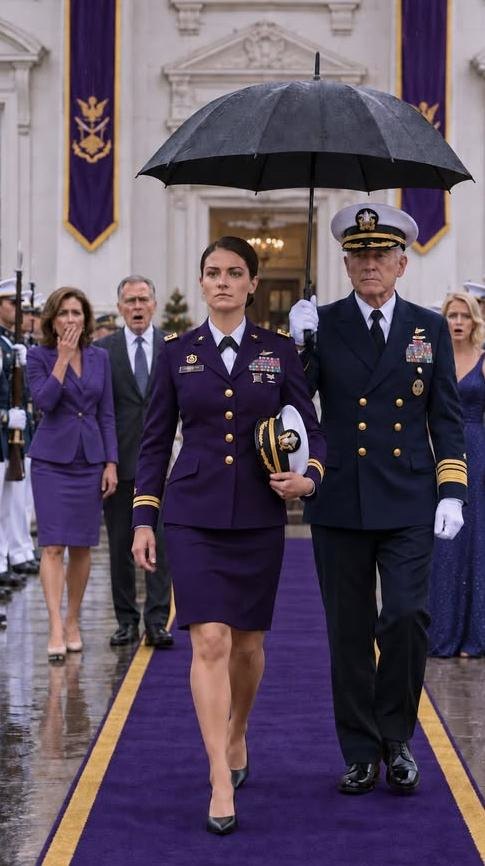
I had spent years waiting for him to be proud. Standing there with rain still darkening the shoulders of my uniform, I understood that I had been asking the wrong person to confirm what I already knew.
Colonel Vale offered me the original citation folder.
“Captain Reed, the academy would like you to decide how the research is released.”
I looked toward the rows of cadets, toward the officers who had trained me, and toward the families who had come to celebrate people they actually knew.
“Not through Reed Tactical Systems,” I said. “The protocol should remain open to every regional command that needs it. The academy can license the manufacturing, but no one family should own a system designed to keep soldiers alive.”
General Ellison gave a slow nod.
“That is a decision worthy of the medal.”
Richard’s face tightened. “You are giving away everything I built.”
“No,” I said. “I am keeping you from selling what you stole.”
He was escorted from the hall by academy security, not in handcuffs, not beneath flashing lights, but under the gaze of every officer he had tried to impress. The company board would remove him before the afternoon ended. The procurement delegation would demand the original archive. His public claim would collapse when the authentication records, Mrs. Alvarez’s ledger, and Brianna’s statement were attached to it.
Brianna did not follow him.
She remained beside the stage, holding the broken lanyard in both hands.
“Do you hate me?” she asked.
I considered lying. I had done enough of that for one family.
“I hate what you helped him do,” I said. “I do not know yet what I feel about you.”
She nodded, accepting the answer without asking for comfort.
“What can I do?”
“Tell the truth when they ask.”
“I will.”
“And return anything with my name on it.”
She reached into her purse and removed a small silver flash drive. “This was in Dad’s office. I took it yesterday because I was scared. It has the presentation he prepared for the procurement meeting.”
I accepted it.
The label on the drive read: BRIANNA REED FIELD RELAY SYSTEM.
I turned it over. Beneath the printed label, someone had scratched a second name into the metal with a key.
NATALIE.
Brianna had not made that mark for the cameras. She must have done it alone, after realizing whose work she was carrying.
“Thank you,” I said.
She swallowed. “You still have to give the speech.”
I looked at the lectern.
“No,” I said. “I have to give my speech.”
The distinction steadied me.
I walked to the microphone while General Ellison returned to his seat. The orchestra lifted its instruments again. This time, no one stopped them.
I spoke about the first night the relay system worked. I spoke about soldiers separated by mountains, about signals lost in storms, and about the people who kept trying after every screen went dark.
I did not mention my father.
I did not need to.
When I finished, the applause came from the cadets first. Then the faculty. Then the families.
Brianna was the only person in the VIP section who stood before everyone else.
Afterward, in the laboratory beneath the academy, I placed the cracked access card and the brass archive key inside the evidence cabinet. The broken card would remain with the investigation. The key would return to Mrs. Alvarez, who said she had carried enough secrets for one lifetime.
The silver drive stayed in my hand.
General Ellison stood beside the workbench. “What will you call the open version?”
I looked at the scratched name beneath Brianna’s label.
“Keep the original designation,” I said. “The one in the archive.”
He smiled. “And that is?”
I pressed the drive into the laboratory console. Across the dark screen, the first line of my own research appeared.
A signal is not lost merely because someone refuses to carry it.
I touched the scratched letters with my thumb and answered, “The Reed Relay Protocol.”
Missed the beginning?






