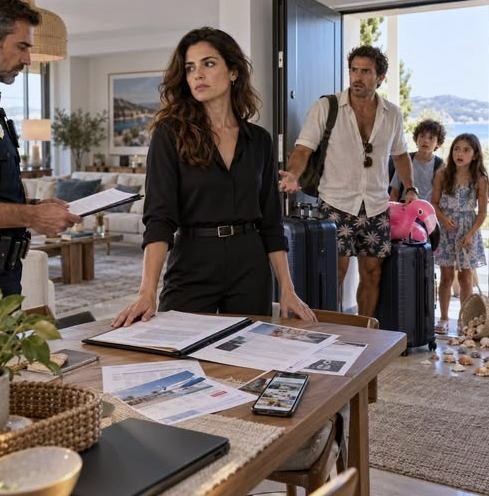
The cashier called me while I was standing beside my mother’s fresh grave, and her first sentence made the earth seem to tilt beneath my shoes.
“Please don’t panic,” the woman said. “Your son is here with me. We’ve called the police.”
I stared at the damp black ribbon around the funeral flowers in Morelia. Two days earlier, we had lowered my mother into the ground. I was still surrounded by her boxes, her folded blouses, and the bitter smell of coffee that clung to every room of her apartment.
“My son?” I whispered.
“He says his name is Mateo. He’s eight. He’s been alone for several hours.”
My knees struck the edge of a cardboard box.
Mateo was supposed to be in Monterrey with my husband, Javier. Eating dinner. Sleeping safely. Surrounded by family.
“Put him on the phone.”
A cash register chimed in the background. Then a small voice said, “Mom?”
I pressed my palm to the wall.
“Mateo, are you hurt?”
“No.”
“Where’s Javier?”
“He’s in Cancun.”
The air left my lungs.
“With Bruno and Valeria?”
“Yes.”
“How long have you been alone?”
There was a pause. “I think six days.”
Six days.
Bruno was eleven. Valeria was nine. They were Javier’s children from his first marriage. Mateo was mine, born before I met Javier, and his father had died when he was two. Javier had been my husband for five years.
“Who has been taking care of you?”
“No one.”
The grocery store manager came back on the line. She told me Mateo had arrived around four that afternoon, bought bread with crumpled bills, and sat outside beneath the buzzing sign. At nine, when the evening air turned cold, she asked whether someone was coming for him.
“No,” Mateo had answered.
He had walked there alone because the frozen food was gone, the soup was gone, and the cans were too high for him to reach safely.
“Why didn’t you call me?” I asked.
“Javier said not to bother you. He said Grandma died and you had more important things.”
Something inside me went still.
“Listen to me,” I said. “You are never a bother. Not when I’m grieving. Not when I’m asleep. Not ever.”
My aunt Nora lived thirty-five minutes from our apartment. When I called her, she answered over the sound of a running car.
“Javier told me Mateo was in Cancun with you,” she said.
“What?”
“He sent a picture from the airport. Bruno and Valeria were in it. I assumed Mateo was outside the frame.”
“Go to the store. Please.”
“I’m already going.”
By midnight, Mateo was safe at Nora’s house, wearing borrowed pajamas and holding a mug of hot chocolate. Before my morning flight, I called him again.
“Are you angry that I left the apartment?” he asked.
“No. I’m proud you found help.”
“Javier said Aunt Nora was away with her church.”
I looked toward the woman standing two feet from me.
“She was never away,” I said.
The next morning, when I reached Nora’s house, Mateo ran into my arms so hard he nearly knocked me over. He smelled like apple shampoo.
“Sorry, Mom,” he whispered.
“Never apologize for surviving.”
Nora’s eyes were swollen.
“There’s something else,” she said. “Javier told me all five of you had gone to the beach together.”
But my phone was full of his messages: Mateo ate dinner. Mateo is playing games. Mateo is asleep.
Three messages had supposedly come from my son.
I love you, Mom.
Everything is fine.
I miss you.
Mateo stared at the screen.
“I didn’t write those.”
That afternoon, I returned to the apartment with an officer and a child-protection worker. The place was spotless, which made it worse. On the refrigerator, held beneath a wooden magnet shaped like a lemon, was a note addressed to Mateo.
“Do not bother Mom under any circumstances. She is going through something very difficult.”
At the bottom of the trash bin, I found frozen-meal wrappers. In the kitchen, a chair had been dragged beneath the highest shelf.
Then, inside Javier’s desk, I found the original family reservation. It had been booked for five people.
Me. Javier. Mateo. Bruno. Valeria.
Two days after I flew to Morelia, my ticket had been canceled. So had Mateo’s.
The refund had paid for Javier’s larger ocean suite and a private boat excursion for three.
He hadn’t forgotten my son.
He had removed him.
Lucia, my attorney, told me not to change the locks. “Let him come home,” she said. “I want him to answer every question in front of witnesses.”
At 7:11 the following evening, keys scraped against the apartment door. Valeria entered first, sunburned and carrying souvenirs. Bruno followed with a bright beach ball. Javier came last, pulling two enormous suitcases.
“Well,” he laughed, “the survivors of paradise are home.”
Then he saw the officer near the sofa.
His smile vanished.
I pointed to the chair across from the table.
“Sit down, Javier.”
He looked at the note on the refrigerator. “Elena, what did you do?”
I slid the note toward him.
“No. The question is what you did to my son.”
Before he could answer, Valeria reached for the paper and began reading it aloud. Her finger stopped halfway down the page, and her face changed as she whispered the last line…
PART 2
Her finger remained pressed to the paper.
“Do not bother Mom under any circumstances,” Valeria read. “She is going through something very difficult.”
The apartment seemed to shrink around us. Somewhere in the kitchen, the refrigerator clicked and started humming.
Javier’s hand tightened around the handle of his suitcase.
“That note was meant to help,” he said.
“Help whom?” I asked.
He glanced at the children. “Mateo had food. He had money. He had a phone.”
“None of those things is an adult.”
The officer beside the sofa wrote something on his pad. Bruno’s beach ball rolled from the hallway and tapped against Javier’s shoe.
Valeria looked up. “Where was Mateo?”
Javier swallowed. “He chose to stay home.”
“He was eight,” I said.
“He said he was nervous about the trip.”
“That is not what you told me.”
His eyes flicked toward my phone. “You were grieving. I didn’t want to burden you with details.”
“You sent me messages from Mateo’s phone.”
“I checked on him.”
“You wrote, ‘I love you, Mom.’”
Javier’s jaw moved. “I was trying to keep you calm.”
I placed the printed messages on the table. Beside them lay the canceled ticket, the five-person reservation, the receipt for the ocean suite, and the police report from the store.
Bruno stepped closer. “Dad, you said Mateo was with Aunt Nora.”
“I never said that.”
“You did in the car.”
Valeria’s lips parted. “You said he was staying with Grandma.”
Their faces were no longer sunlit and excited. They looked like children who had discovered that an adult’s story could have holes in it.
Javier turned to me. “You’re making this dramatic.”
I felt the old instinct rise in me, the one that had made me soften his words for years. Then I remembered Mateo sitting outside a grocery store under a buzzing sign, afraid to climb onto a chair for soup.
“No,” I said. “You made it dangerous.”
At 8:03, we met at Nora’s house because Mateo said he could not return to the apartment while Javier was there. Nora placed a plate of cinnamon toast on the table, then switched off the television. The tiny seashell in Mateo’s palm clicked against the wood whenever his fingers trembled.
Lucia arrived with a folder. Javier came with his lawyer. Marcela, the children’s mother, brought Bruno and Valeria after they insisted on hearing the truth.
Javier tried to smile at Mateo.
“Hi, champion.”
Mateo did not answer.
“I made a terrible mistake,” Javier began. “I thought you were responsible enough to manage for a few days.”
Mateo looked at him. “Am I more responsible than Bruno?”
“No.”
“Then why was I alone?”
Javier glanced at his lawyer.
“Because I was wrong,” he said.
“Because I’m not really your son?”
Valeria lowered her head. Bruno stared at the floor.
“That isn’t true,” Javier said.
“But you said I was my mother’s problem.”
“I was angry.”
“Were you angry when you canceled my ticket?”
Javier’s face tightened. “I thought the trip would be difficult for you.”
“Then why didn’t you ask me?”
No one answered.
Mateo touched the shell to his ear. “I called you twice.”
“I know.”
“You saw it?”
“Yes.”
“And you didn’t answer?”
Javier looked down. “No.”
Mateo placed the shell on the table.
“Okay.”
He moved to the sofa. Valeria immediately made room beside her.
Bruno faced his father. “You told us Mateo didn’t want to come.”
“I made mistakes.”
“That was a lie, not a mistake.”
Marcela put a hand on Bruno’s shoulder. “You don’t have to fix this.”
“I know,” he said. “But someone should stop Dad from changing it.”
On the porch, Javier followed me beneath the flickering yellow light.
“Elena, I can repair this,” he said.
“How?”
“Counseling. Family therapy. Anything.”
I took Lucia’s envelope from my bag and handed it to him.
His eyes dropped to the papers inside.
“Divorce?”
“Yes.”
“After one mistake?”
I looked through the screen door at Mateo, who was showing Valeria the shell.
“It wasn’t one mistake. It was six days, three false messages, two canceled tickets, and a child you taught to stay silent.”
Javier’s face hardened. “You’re destroying this family.”
“No,” I said. “You built a family where one child was excluded and expected everyone else to call it normal.”
He crumpled the envelope, then carefully smoothed it again.
The weeks that followed filled with interviews, forms, and meetings with child-protection officials. Javier called almost every day.
“Tell them Mateo had food.”
“I already did.”
“Tell them he had cash.”
“I did.”
“Then explain that it wasn’t abandonment.”
“That is not my decision.”
The divorce became another battlefield. Javier argued over furniture, savings, and even a four-year-old television. Lucia called it control. I called it exhaustion.
Then one Thursday, Lucia phoned me from her office.
“Elena, Javier’s attorney submitted a new statement.”
“What kind?”
“He claims Nora checked on Mateo every day, and that you knew about the arrangement.”
My stomach dropped.
“Nora has his messages.”
“Send me everything.”
I opened the conversation. There it was: Javier’s message from the beach, saying he had taken all three children and that Mateo was happily enjoying the hotel.
Nora had replied, “Give him a hug from me.”
Javier answered, “I will.”
Mateo had been alone in Monterrey.
Lucia wrote back: “Nora must testify tomorrow. Bring the original reservation, the cancellation records, and the phone that received the false messages.”
I looked at Mateo doing homework at the kitchen table. The pencil in his hand had stopped moving.
Lucia sent one more message.
“They also want to know who actually wrote the messages sent from Mateo’s phone…”
PART 3
The next morning, at nine, we gathered in a small conference room at the child-protection office. A ceiling fan clicked above us with every rotation. Mateo sat beside Nora, his fingers wrapped around the little seashell. I sat across from Javier, Lucia beside me, while his attorney arranged papers into a neat pile.
Javier looked exhausted, but not ashamed. He wore the same expensive watch he had worn on the beach.
His attorney began. “Mr. Ortega maintains that Mrs. Herrera was aware a trusted relative was checking on the child.”
Nora leaned forward. “That is false.”
The attorney raised one eyebrow. “You were not checking on Mateo?”
“No. I didn’t know he was alone until the store called Elena.”
Javier shook his head. “Nora, you told Elena you understood the arrangement.”
Nora opened her handbag and removed her phone. Its cracked corner caught the fluorescent light.
“I understood the arrangement you described to me,” she said. “You told me all five of you were at the beach.”
She handed the phone to Lucia. The message thread was printed beside the timestamps.
Lucia read aloud. “All three children are with me in Cancun. Elena needs the break after losing her mother.”
The room went silent.
Javier’s attorney reached for the papers. “That wording could be interpreted—”
Nora interrupted him. “There is more.”
She turned to Javier. “I asked you to send Mateo my love. You said you would. But he was home alone, wasn’t he?”
Javier’s mouth tightened.
“Answer her,” the caseworker said.
“Yes,” he said.
Mateo’s fingers stopped moving.
I felt his shoulder press against mine.
Lucia placed the canceled ticket on the table. “The original booking included Mateo. The cancellation occurred two days after Elena left for the funeral. The refund paid for a suite upgrade and a private boat trip for three. Why was the child’s ticket canceled?”
Javier looked at Mateo.
“I thought he would feel out of place.”
Mateo lifted his head. “You didn’t ask me.”
“I thought I knew what was best.”
“You knew I was alone.”
Javier’s attorney touched his arm. “Do not speculate.”
But Javier had already crossed the line. “I knew he could manage.”
The caseworker’s pen stopped above the page.
I placed the final evidence on the table: the grocery receipt, the police report, and the note from the refrigerator. Then I showed the phone records proving Mateo had called Javier twice.
“Why did you tell him not to contact his mother?” I asked.
Javier rubbed his forehead. “She was grieving.”
“No,” I said. “You wanted him quiet.”
His eyes flashed. “I wanted one peaceful trip with my children.”
There it was.
Not an accident. Not confusion. Not a misunderstanding.
He had wanted a family photograph without the child who reminded him that I had a life before him.
Bruno, waiting outside with Marcela, had overheard enough. He entered the room without permission.
“Dad,” he said, “you told us Mateo didn’t want to come.”
Javier turned pale. “Bruno—”
“You made him disappear and told us it was his choice.”
Valeria stood behind him, crying silently.
The caseworker asked Javier whether he had written the messages from Mateo’s phone.
He stared at the table.
“I sent them,” he said.
Mateo’s face crumpled, but he did not cry. That hurt more than tears.
The meeting ended with temporary restrictions on Javier’s contact and a formal investigation into the abandonment. Outside, under the courthouse-like stone steps, Lucia hugged the folder to her chest.
“We can prove he lied,” she told me.
I looked at Mateo, who was walking between Nora and Marcela.
“Will proving it make him understand what he did?”
“No,” Lucia said. “But it will stop him from rewriting it.”
That evening, I thought the worst part was over. Then Lucia called again at 7:42.
“Elena, there’s a second issue.”
“What now?”
“The defense says the messages were sent with your consent because your phone had access to the family account.”
“That’s absurd.”
“I know. But they also claim the refrigerator note was a care plan, not evidence of abandonment.”
I stared at Mateo’s worksheet. He was drawing a map of the solar system, carefully coloring each planet inside the lines.
“Can they do that?”
“They can try.”
A new email appeared in my inbox while we were speaking. It came from the hotel in Cancun.
The subject line contained the reservation number.
Lucia opened the attachment from her office. Her breathing changed.
“Elena,” she said, “the hotel has a signed guest form.”
“Signed by whom?”
She did not answer immediately.
Then she whispered, “By someone who was never supposed to know Mateo was alone…”
The hotel form revealed what Javier never expected…
I thought the refrigerator note was the worst proof. I was wrong. The final document forced everyone to face the choice behind it.
“Did you ever worry that I would die?”
Javier’s face broke before he could answer.
👇 The final part of the story is now open.






