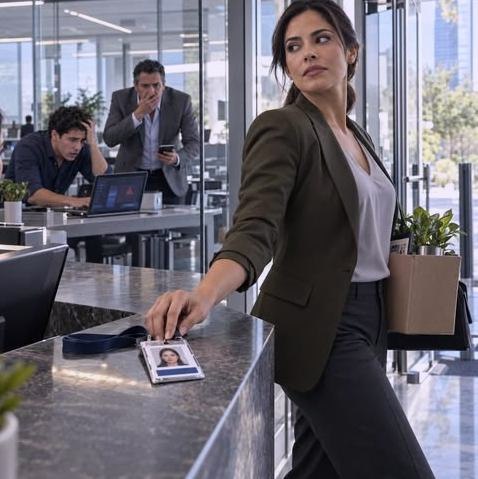
At 10:02 on my last morning at Nexora, the company’s million-peso demonstration froze in front of the investors who were supposed to save it.
Santiago Lara clicked the remote again. The screen remained white, except for a small spinning circle that seemed to mock everyone in the room.
“Try the backup environment,” Rodrigo Salcedo ordered.
Our technical director, Esteban Cruz, stared at his laptop. A thin red cable trembled beside his coffee cup.
“There isn’t an independent backup,” he said.
Rodrigo’s smile vanished. “What do you mean, there isn’t one?”
I was already outside the glass conference room, walking past the reception desk with my company badge in my hand. Through the glass, I watched Santiago turn toward the investors while Rodrigo leaned over Esteban’s shoulder. My stomach tightened, but I didn’t stop.
Six months earlier, I had warned them this exact moment could happen.
Four years before that, Nexora had been twelve people in a cramped office in Santa Fe. I had designed the payment infrastructure that allowed thousands of small businesses to process transactions. When a midnight failure threatened to stop merchants from getting paid, I was the person everyone called.
“Valeria, please tell me you’re awake,” Rodrigo had said during one emergency.
“I’m looking at the logs.”
“Can you fix it?”
“I already did.”
Back then, he called me indispensable.
Then the investors arrived, the offices grew, and Santiago appeared with polished shoes, perfect presentations, and no experience with the systems he described so confidently.
“Vale, can you explain the capacity model again?” he would ask beside the printer.
“Of course.”
“Could you review my strategy deck too?”
I trusted him because I remembered what it felt like to be new.
That trust ended on a Monday morning when I entered a planning meeting and saw my three-month technology strategy projected on the wall under Santiago’s name. The objectives were identical. The deadlines were identical. Even the typo in the security section was identical.
“That document is mine,” I said.
Rodrigo folded his arms. “We’re not here to fight over credit. We’re a team.”
Santiago kept presenting while people applauded.
That afternoon, my administrative access disappeared. I could no longer approve changes to systems I had built, yet every outage still brought my phone to life.
I stopped arguing. I started saving everything.
Emails. Incident reports. Change requests. Messages warning that Nexora had no independent recovery environment. I kept copies in a small brass document case my father had given me, its latch shaped like a tiny compass. Every warning went in chronological order.
No one answered them.
When Horizonte Capital scheduled the decisive demonstration, my name was missing from the invitation. Rodrigo was attending. Santiago was presenting. Marketing was attending. Even an intern had a seat.
I requested the engineering director position that afternoon.
Rodrigo didn’t read my proposal.
“We don’t negotiate with employees,” he said. “If you dislike your role, there are hundreds waiting outside.”
I closed my folder. “Understood.”
That evening, I submitted my resignation. My final day would be the morning of the demonstration.
At 8:36, I left my badge and company laptop on my desk. Santiago arrived with a doughnut in one hand.
“Thanks for the documents, Vale. I think I have everything under control.”
I looked at the folder beneath his arm.
“I hope you do.”
Now, outside the conference room, I heard Rodrigo shout.
“Esteban, restore the environment!”
“I can’t restore something that was never maintained.”
A chair scraped violently across the floor. Then the conference-room door opened, and an investor’s assistant stepped into the hallway holding a black binder with both hands. She looked directly at me.
“Are you Valeria Montes?”
I stopped.
She reached toward the first page, her finger lifting the corner of a sealed tab…
PART 2
She reached toward the first page, her finger lifting the corner of a sealed tab…
“Yes,” I said. “Why?”
The assistant glanced through the glass. Rodrigo was arguing with Esteban, while Santiago stood frozen beside the dead screen.
“Mr. Hale wants to speak with you privately.”
I knew the name. Daniel Hale was Horizonte Capital’s managing partner, the person whose signature could turn Nexora from an ambitious company into a national payment platform. I followed her into a smaller meeting room where the blinds were half closed and the air smelled of burnt coffee.
Daniel placed the binder on the table.
“This was delivered to our office three weeks ago,” he said.
I recognized the first page before he turned it around. It was one of my architecture warnings, stamped with the internal document number I had used for every formal risk report.
“Who sent this?” I asked.
“It arrived without a name. Only a note saying we should read it before committing funds.”
My fingertips went cold. “There were several warnings.”
“There were thirty-two.”
He opened the binder. Each report had my signature, the date, the affected system, and the person who had received it. Behind every page was a delivery confirmation from Nexora’s document server.
Daniel tapped one of the forms. “You warned them about the missing failover system in April.”
“Yes.”
“And again in May.”
“Yes.”
“And in June, you wrote that the demonstration environment depended on one administrator’s credentials.”
I swallowed. “That was Santiago’s account by then.”
Daniel studied me. “Why didn’t you tell us directly?”
“Because I wasn’t invited to the meeting. And because every time I raised the issue, Rodrigo said the company needed confidence, not technical hesitation.”
Before Daniel could respond, Rodrigo burst through the door.
“Valeria, what are you doing here?”
“Answering questions your team should have answered months ago.”
His face hardened. “You resigned. You have no authority to interfere.”
Daniel turned toward him. “Your demonstration has been down for eleven minutes.”
“We’re handling it.”
“You told us the system had a redundant recovery environment.”
Rodrigo’s jaw tightened. “There is a temporary configuration issue.”
I looked at him. “It isn’t temporary.”
His eyes flashed. “You don’t get to sabotage us because you’re angry.”
The accusation landed harder than I expected. My hand closed around the edge of the brass document case in my bag.
“I didn’t sabotage anything,” I said. “I documented the risk. You removed my access, assigned the rollout to Santiago, and ignored every escalation.”
Santiago appeared behind Rodrigo, pale and sweating.
“Rodrigo,” he said quietly, “the deployment credentials aren’t working.”
Rodrigo spun around. “Then use Valeria’s credentials.”
“They were revoked this morning.”
For a moment, nobody moved.
Daniel closed the binder. “Valeria, can you restore the demonstration?”
“I can stabilize the payment core,” I said. “But I can’t repair months of decisions in ten minutes.”
Rodrigo stepped toward me. “You will not touch our systems.”
Daniel’s voice became very calm. “You invited us to invest hundreds of millions in a platform she built. If she is the only person who can explain it, she is already involved.”
Rodrigo looked from him to me. His confidence had begun to fracture.
I returned to the conference room. Esteban moved aside without a word. The monitor showed a string of failed requests. I recognized the pattern immediately: the main environment was alive, but its recovery keys had been redirected to a private storage account.
“Who changed the key destination?” I asked.
Santiago stared at the floor.
“I don’t know,” he whispered.
“You approved the deployment.”
“Rodrigo told me it was part of the new security model.”
Rodrigo’s voice cut across the room. “Enough. Fix it, Valeria.”
I opened the incident console. A locked notice appeared beneath the failed requests, one I had never seen before.
RECOVERY PACKAGE HELD FOR OWNERSHIP VERIFICATION.
Daniel leaned closer. “What does that mean?”
“It means someone changed the legal owner of the recovery package.”
“Can you access it?”
I entered the old emergency command. The system asked for a second authorization, followed by a physical verification code.
My code.
The one printed on the brass case I had carried out of Nexora.
Rodrigo saw my expression and stepped closer.
“What did you take from this company?” he demanded.
I looked at the locked screen, then at the investors gathered behind him.
“I didn’t take anything,” I said. “But someone may have forgotten what they signed…”
PART 3
Rodrigo waited for my answer, but the conference room door opened before I could say more. Mara Villanueva, Nexora’s operations manager, stood there clutching a stack of printed forms. Her hair was loose on one side, and there was a smudge of printer ink across her thumb.
“I remember,” she said.
Rodrigo turned sharply. “Mara, go back to operations.”
“No.” Her voice shook, but she stepped inside. “Not this time.”
She placed the papers on the table in front of Daniel.
“These are the approval records for the recovery migration.”
Rodrigo’s face changed. “Those are internal documents.”
“So are the warnings you ignored,” Mara replied.
Daniel lifted the first form. “This says the independent backup was disabled on July fourteenth.”
“That was the day Rodrigo ordered us to move everything into the presentation environment,” Mara said. “He said the investors wanted a cleaner architecture diagram.”
Santiago stared at him. “You said it was temporary.”
“It was supposed to be temporary,” Rodrigo snapped.
Mara placed another page over the first. “This one says the recovery package was transferred to a private storage account under Santiago’s employee credentials. I refused to approve it because it violated the continuity policy.”
Daniel looked at Santiago. “Did you create that account?”
Santiago’s lips parted. “Rodrigo gave me the access request.”
“Did you sign it?”
His eyes moved to the document. His signature sat at the bottom, uneven and hurried.
“Yes,” he whispered.
Rodrigo slammed his palm on the table. “Everyone signed operational changes. Don’t pretend this is some conspiracy.”
Mara pulled out the final page.
“This is the authorization override,” she said. “It transferred ownership of the recovery package away from Nexora’s corporate account and into an account controlled by Santiago. The request required an executive approval.”
Daniel read the line beneath the signature.
Rodrigo Salcedo.
The room seemed to contract around us. I could hear the soft clicking of the frozen presentation computer and the sharp hiss of the air conditioner.
Rodrigo pointed at me. “She engineered this. She kept a private key so she could hold the company hostage after resigning.”
I reached into my bag and took out the brass case. The tiny compass-shaped latch caught the overhead light.
“I kept the emergency verification code because the continuity policy required two custodians,” I said. “One code belonged to the company. The other belonged to the senior engineer responsible for recovery design. When you removed me, you were supposed to appoint a replacement and record the transfer.”
Esteban looked at the forms. “There was never a replacement.”
“Exactly.”
Daniel turned to Rodrigo. “You represented to us that Santiago was the head of engineering.”
Rodrigo’s mouth tightened. “He was leading the project.”
“Those are not the same thing.”
Santiago looked sick. “You told me Valeria had approved the migration.”
“I told you to do your job.”
“You told me to put my name on her strategy.”
Nobody spoke.
The truth had not come from a recording or a hidden confession. It was sitting in ink, dated, signed, and impossible to blame on a software failure.
Daniel pushed the papers toward Rodrigo. “Horizonte is suspending the investment.”
Rodrigo’s chair scraped backward. “You can’t do that over a technical incident.”
“We can do it over a concealed operational risk and a false representation of leadership.”
He turned to me. “Can you restore the payment core without giving Nexora access to the private recovery account?”
“Yes. But it will take a controlled handover, and I will not do it under Rodrigo’s authority.”
Rodrigo laughed once, harshly. “You think they’ll hire you because you caused this spectacle?”
Daniel’s phone rang. He listened for five seconds, then looked at me.
“What is it?” I asked.
“Your emergency package has been accessed from outside Nexora’s network.”
Mara’s face went white. “Who accessed it?”
Daniel checked the alert.
“It wasn’t Rodrigo. It wasn’t Santiago.”
A second notification appeared beneath it: OUTBOUND TRANSFER INITIATED.
Then a message arrived from the bank handling Nexora’s merchant settlement account, and Daniel read it aloud.
“Funds are being routed to an account that was created under Valeria Montes’s name…”
The emergency account carried Valeria’s name—but not for the reason they thought…
I thought the collapse was about stolen credit. I was wrong. The final discovery revealed who Nexora had really endangered—and what I had to choose.
“Take it, and sign the recovery order.”
I looked at the brass case between us.
👇 The complete finale is already open.






