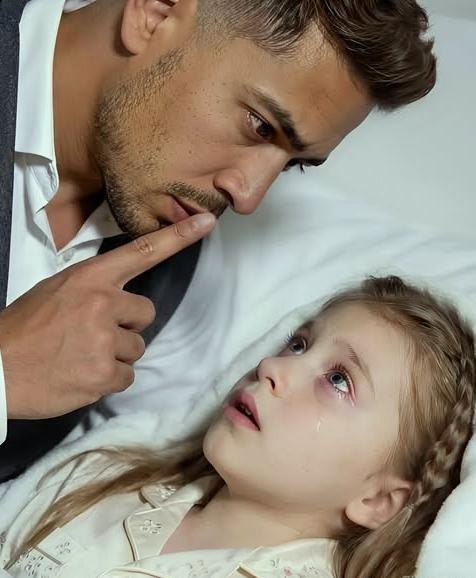
My eight-year-old daughter was hiding behind her bedroom door when she whispered that her back hurt so badly she could not sleep, and that her mother had warned her not to tell me.
I had been home for fifteen minutes. My suitcase still stood beside the entryway, and the brass luggage tag I had bought in Florence tapped softly against its handle whenever the heating came on. Usually, Emma would have raced toward me before I could take off my coat. That evening, the house was silent.
“Daddy?” she called from the hallway.
I found her in pink pajamas, one hand gripping the doorframe. Her face looked smaller than I remembered from the morning, when she had waved at me from the taxi window.
“Come here, sweetheart.”
She shook her head.
“Please don’t be angry.”
The words stopped me cold. I set my suitcase down and knelt several feet away so I would not frighten her.
“Angry about what?”
“Mummy said things would get worse if I told you.”
My heart began pounding so hard that I could feel it in my throat.
“Where does it hurt?”
Emma pressed both hands against her lower back. Her fingers were white from squeezing the fabric of her pajama top.
“Everywhere. I couldn’t sleep last night.”
“Did you fall?”
“Mummy said it was an accident.”
“What accident?”
She looked toward the living room. The hallway light flickered above us, making the shadows seem to move.
“She got angry.”
I reached toward her shoulder, but Emma flinched so violently that I pulled my hand back at once.
“Don’t touch me, Daddy. It hurts.”
Inside, panic rose like a fire behind a locked door. Outside, I forced my voice to stay gentle.
“Did you tell your mother?”
Emma nodded.
“She said I was exaggerating.”
That sentence hurt more than anything else she had said.
“Can you show me your back?”
She hesitated, then slowly turned away and lifted the top of her pajamas. I saw a dark purple mark spreading across the right side of her spine. Above it were three narrow red lines, almost perfectly parallel, as if something with ridges had struck her.
For one second, I could not breathe.
Then the front door opened.
My wife, Laura, stepped inside carrying grocery bags. She saw Emma, saw me kneeling behind her, and froze with one hand still on the brass handle.
“What happened?” I asked.
Her eyes dropped to the bruise.
“It was an accident,” she said quickly. “She fell in the laundry room.”
“Why didn’t you call me?”
“You were working.”
“I was on a plane, Laura. I was not dead.”
She put the bags down too carefully. A bottle rolled out and struck the wall.
Emma began trembling.
Laura noticed and stepped forward. “Sweetheart, tell your father what happened.”
My daughter stared at the floor.
“Emma,” I said, “you can tell me the truth.”
Laura’s voice sharpened. “Daniel, don’t turn this into something it isn’t.”
I stood between them.
“What did you do?”
Her face changed—not into anger, but into something quicker and harder to name. Fear. Guilt. Calculation.
“I told you,” she whispered. “She fell.”
Emma’s small hand closed around mine. Her palm was icy.
Then someone knocked three times on the front door.
Laura turned toward the sound, and the color drained from her face. I reached for the lock, but she caught my wrist.
“Do not open that door,” she said.
Behind her, Emma whispered, “It’s the lady who saw me…”
The knock came again, louder. I pulled my wrist free and reached for the handle…
PART 2
The door opened before Laura could stop me.
A woman stood on the porch beneath the yellow light. She was in her sixties, with silver hair pinned behind one ear and a canvas shopping bag pressed against her chest. I recognized her from the apartment across the courtyard, though we had never spoken more than a greeting.
“My name is Miriam Bell,” she said. “I need to speak with Daniel.”
Laura moved into the doorway.
“Not tonight.”
Miriam looked past her at Emma. Her eyes dropped to the child’s rigid posture, then returned to Laura.
“Tonight is exactly when I need to speak.”
I stepped outside and closed the door behind me.
“What did you see?”
Miriam’s fingers tightened around the canvas bag. “Yesterday afternoon, at four twenty-three. I was carrying laundry upstairs when I heard a crash from your back entrance. Then I heard Emma crying.”
Laura opened the door a few inches.
“That is not what happened.”
Miriam did not look at her. “I saw Laura pull the girl away from the radiator.”
The courtyard seemed to tilt beneath my feet.
“Why didn’t you call me?” I asked.
“Because Laura came outside afterward. She told me Emma had fallen and begged me not to interfere. She said you had a violent temper and would hurt someone if I made trouble.”
A bitter laugh escaped Laura.
“You believe that?”
“I believed the child’s face,” Miriam said. “And I believed what I heard.”
Laura slammed the door.
Inside, Emma had moved to the sofa. She was curled around a cushion, her back held stiffly away from the fabric. I crouched in front of her.
“Did Mummy push you against the radiator?”
Emma’s lips trembled.
“She grabbed me because I took the blue folder.”
“What folder?”
Laura answered from behind me. “She is confused.”
I turned. “Then explain it.”
“There is nothing to explain.”
“Why was Emma holding a folder?”
Laura crossed her arms. The silver watch on her wrist clicked against its metal clasp.
“Go upstairs,” she told Emma.
“No,” I said.
Her eyes flashed. “You have been home for less than half an hour, Daniel. You are frightening her.”
“I am asking questions.”
“You are accusing me.”
Emma suddenly spoke. “The folder had papers from school.”
Laura went still.
“What papers?” I asked.
“The ones Mummy hid in the kitchen drawer. The nurse wrote that I was hurt before.”
Laura’s expression collapsed for half a second, then hardened again.
“There was no nurse.”
Emma looked at me. “There was. She asked me why I had a bruise on my arm last month.”
I remembered that bruise. Laura had said Emma had caught herself on the garden fence. I had been away at a conference and accepted the explanation because I wanted to believe our house was safe.
I called the pediatric clinic. The receptionist recognized my name and asked me to bring Emma in immediately. Laura snatched the phone from my hand.
“You will not take her anywhere,” she said.
“Give me the phone.”
“She needs rest.”
“She needs a doctor.”
For several seconds, neither of us moved. Then Laura lowered her voice.
“If you walk out with her, Daniel, you will destroy this family.”
I looked at Emma’s hunched shoulders.
“You did that yourself.”
At the clinic, the examination room smelled of disinfectant and warm plastic. Dr. Shah lifted Emma’s shirt only after asking permission. She examined the bruise, then the older yellow mark near her ribs.
“How many times has this happened?” she asked softly.
Emma stared at the paper covering the examination table.
“Mummy says I bruise easily.”
Dr. Shah looked at me. “That is not an answer.”
A nurse entered carrying a thin green file. Her hands were shaking.
“Doctor,” she said, “I found the report Laura signed.”
Laura, who had been waiting outside, heard her name and pushed into the room.
“What report?”
The nurse placed the file on the counter. Laura lunged for it, but I caught her arm.
“Don’t,” I said.
She stared at my hand, then at the file.
The nurse opened the cover and turned to the final page. At the bottom, beneath a paragraph I could not yet read, was a signature that looked unmistakably like Laura’s.
Dr. Shah’s eyes moved across the page.
Then she asked Emma one question that made my wife step backward toward the wall…
PART 3
“Emma,” Dr. Shah said, “who told you to say that you fell?”
My daughter’s face crumpled. Laura pressed one hand against the wall, and the metal clasp of her watch scraped the paint.
“Answer her, sweetheart,” I said.
Emma looked at her mother.
Laura shook her head once. It was not a plea. It was a warning.
“Mummy did,” Emma whispered.
The room became unbearably small.
Laura turned on me. “She is frightened. She does not understand what she is saying.”
Dr. Shah opened the green file. “This report is dated six weeks ago. It records bruising on Emma’s upper arm, a complaint of pain when sitting, and her statement that someone at home had grabbed her.”
“That was a misunderstanding,” Laura said.
“Then why did you sign here?” the nurse asked.
Laura’s mouth opened, but nothing came out.
I looked at the signature. It was written in blue ink, with the same looping capital L Laura used on birthday cards. Beneath it, she had written: I will make sure this does not happen again.
“Did you write this?” I asked.
She lowered her eyes.
“Yes.”
Emma began crying silently.
I turned back to Dr. Shah. “What happened six weeks ago?”
The nurse answered. “Emma told me her mother had grabbed her during an argument. I asked Laura to come in. She said she was overwhelmed, accepted responsibility, and promised to seek help.”
Laura grabbed the edge of the counter.
“I did seek help.”
“Where?” I asked.
“At the community center.”
“You went once,” the nurse said. “Then you canceled every appointment.”
Laura’s eyes filled with tears, but her voice remained defensive. “Because they wanted to label me. They wanted to take my child.”
Dr. Shah stood between Laura and Emma.
“No one is taking Emma because you asked for help. They become concerned when a child is injured repeatedly and the adult hides it.”
The truth finally came out in pieces. Laura had been struggling with severe panic attacks and sleeplessness since losing her job. She had started drinking in secret. When Emma disobeyed her, Laura grabbed her. Six weeks earlier, she had shoved Emma into a chair. Yesterday, when Emma found the green file in the kitchen drawer and said she would show it to me, Laura had seized her by the shoulders and pushed her backward. Emma’s spine struck the cast-iron radiator.
“I never meant to hurt her that badly,” Laura said.
“But you did,” I replied.
She looked at Emma. “I am sorry.”
My daughter pressed herself against the examination table.
Dr. Shah gently touched my elbow. “Daniel, Emma cannot go home with Laura tonight.”
Laura’s face went white. “You cannot do this.”
“I am not the one who made that decision,” I said. “You did, every time you told her to lie.”
A social worker entered with a folder and a tired expression. She explained that Emma could stay with me under a temporary safety arrangement while Laura entered an emergency treatment program. There was no shouting, no dramatic order, only forms, signatures, and the quiet sound of Emma’s breathing.
Then Laura pulled a folded paper from her purse.
“I signed something else,” she said.
I stared at her.
She handed it to the social worker. “A week ago, I arranged for Emma to go to my sister in another city. I thought if Daniel found out, he would take her away forever. I forged his approval.”
The social worker read the page and looked up sharply.
“That transfer is scheduled for tomorrow morning.”
Laura’s shoulders shook.
I thought the worst thing she had done was hurting our daughter. Then the social worker checked the attached travel authorization and whispered that someone had already collected Emma’s school records from the office…
The name on the travel form changed everything…
I thought the truth had already come out. I was wrong. The final part revealed who else had been pulled into Laura’s lie—and what Emma chose to do with the one thing that had guided her through it.
“Tell her the truth, even if it costs you everything.”
I watched my daughter decide whether to step closer.
👇 The final part is now open.






