PART 4
The security officer reached for the handle, but I raised my hand.
—Do not open it.
Ethan knocked once.
—Emily, I know you are frightened. Let me explain.
Emily’s fingers dug into the blanket.
—Do not let him inside.
The officer moved the lock into place. Ruth stepped behind the medical cart, as if a thin metal tray could protect her from the family that had threatened her son.
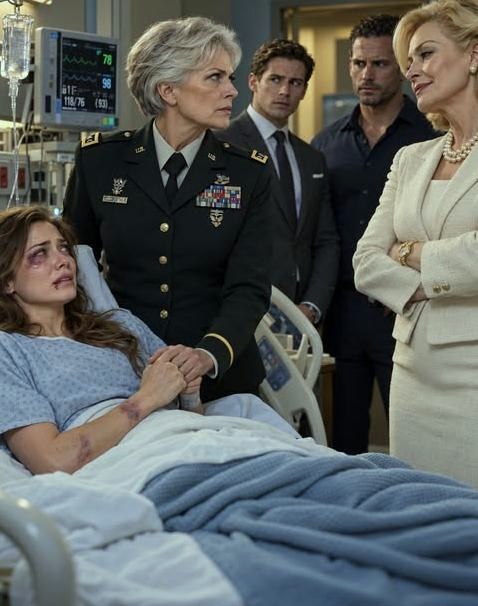
Julia stood beside the bed, pale and rigid.
—You cannot keep me here, Ethan called. —I am her husband.
—You are not her guardian, I answered. —And you are not entering this room.
—You have no idea what you are doing, he shouted.
That was the sentence Margaret had used. Julia had used a version of it too.
The Prescotts had mistaken certainty for authority. They believed that whoever spoke most confidently controlled the room.
I turned to the foundation director on the phone.
—Send every transfer record to the bank, the auditors, and the nonprofit board. Do not send them to Julia. Do not send them to anyone in the Prescott office.
—Victoria, the largest transfer carries your electronic approval.
—It was not mine. Ruth has the original records.
Ruth stepped forward, still clutching her taped bag.
—I have invoices, delivery logs, and the rejected signatures. I also have the appointment calendar from Julia’s office.
Julia looked at her.
—You kept my calendar?
—You told me to keep copies of everything in case the bank asked questions.
For the first time, Julia looked less like an attorney and more like a woman who had walked to the edge of a cliff and discovered the ground behind her had vanished.
The foundation director asked Ruth to read the dates aloud. She did.
Every transfer had been followed by a Prescott board meeting. Every false delivery had been approved by Brandon. Every authorization had passed through Julia’s office.
And every page carrying my name had been created after I retired.
The four million dollars had not gone into construction.
It had paid old debts, private loans, luxury vehicles, and a settlement Margaret had hidden from her investors. The veterans’ housing project had been used because donors trusted my name.
My name was the curtain.
Emily was the body they intended to leave behind it.
The door shook under Ethan’s fist.
—Mom, please! he yelled. —You are destroying my family!
Emily flinched. Then she sat up, wincing as the movement pulled at her ribs.
—No, she said. —You destroyed it when you watched them hurt me.
Ethan went quiet outside.
I looked at my daughter.
—You do not have to speak to him.
—Yes, I do.
She swung her feet carefully to the floor. The hospital bracelet around her wrist clicked against the bed rail.
—But I want you beside me.
I stood at her shoulder.
—Always.
The officer opened the door only wide enough for Ethan to be seen. He wore the same charcoal suit from the family dinner, but his collar was damp with sweat. Behind him stood Brandon, Margaret, and a private investigator holding a leather case.
—You brought a witness? I asked.
—We brought counsel, Brandon said.
—Then let him explain why he is standing in a hospital corridor instead of answering the bank’s fraud department.
Brandon’s mouth tightened.
Margaret looked past me at Emily.
—Sweetheart, you do not understand the consequences. If the foundation collapses, people will lose their homes.
Emily’s bruised face remained still.
—You used homes to hide money.
—We borrowed temporarily.
—You locked me in a guesthouse.
Margaret’s eyes flickered.
—That was a misunderstanding.
Ruth stepped into view.
—No, it was not.
Margaret stared at her as if she had become visible for the first time.
—You ungrateful little woman.
Ruth’s hands shook, but she did not retreat.
—You told Brandon to take Emily’s phone. You told him to make her sign. I heard you from the service hall.
Brandon moved toward her.
The officer blocked him.
—Take one more step and you will be removed from hospital property.
Brandon stopped. His expensive watch flashed beneath the corridor lights.
Julia finally spoke.
—Victoria, I can explain the four million.
—You already did.
—No. The first nine hundred thousand was my decision. The four million was not.
I turned toward her.
—Who ordered it?
Julia reached into her portfolio and removed a narrow receipt printed on pale yellow paper. The corner was burned, as if someone had tried to destroy it with a lighter.
—Margaret opened a second account using a power of attorney. It carried your name, but the witness signature belongs to my father.
Margaret’s face changed.
—Your father has been dead for eight years, I said.
—Exactly, Julia replied.
That was the twist none of us had seen coming. Margaret had not merely recruited Julia. She had used a dead witness’s name to activate an old military charitable account, one I had created with Julia’s help before her father died.
The account contained emergency funds for veterans facing eviction. Margaret had emptied it in three transfers, then used the fake guarantee to make the missing money look like a business loan.
Emily covered her mouth.
—How many families?
The director answered from my phone.
—Thirty-seven households were waiting for those funds.
Margaret’s polished expression cracked.
—The money would have been replaced.
—With what? I asked. —The company you were preparing to steal from my daughter?
She said nothing.
I handed Ruth’s folder to the foundation director through the secure transfer link. Then I sent the original guarantee to the bank’s fraud counsel and the state auditor. I also sent the hospital’s social worker a written statement from Emily describing the assault while the nurse and security officer remained present.
There was no dramatic raid. No shouting television cameras. Just a series of practical consequences that began moving faster than the Prescotts could buy them away.
The bank locked every Prescott-controlled account tied to the project.
The foundation board suspended Margaret’s authority.
Brandon’s construction company lost access to its credit line before sunrise.
The hospital documented Ethan’s attempt to force his way into Emily’s room, and the family’s private investigator was escorted from the building.
Julia remained in the chair by the wall.
—What will happen to me? she asked.
I looked at her silver glasses, the same pair she had worn when she helped me sign my retirement papers. I remembered trusting her with my address, my accounts, my daughter’s wedding contract, and the stories I never told anyone else.
—You will tell the truth without bargaining for a smaller truth.
Her eyes filled.
—My son will lose everything.
—Ruth’s son nearly lost his future because you protected yours.
Julia nodded, and the movement seemed to cost her more than any argument could have.
She gave the auditors the passwords, the office ledger, and the name of the notary who had stamped the false documents. She did not ask me to forgive her.
That mattered.
Ethan remained outside until Emily agreed to one conversation. We met in a small consultation room at 2:40 in the morning. A paper cup of untouched coffee sat beneath the harsh lamp, its cardboard sleeve slowly loosening from the steam.
Ethan sat across from us.
—Mom, I never wanted her hurt.
Emily watched him.
—You wanted me quiet.
—I thought if you signed, we could fix everything.
—You knew the money was gone.
His eyes moved toward me.
—My mother said it was temporary.
—And when Emily refused?
He rubbed his palms together.
—I thought Brandon would frighten her. I did not think he would hit her.
Emily’s voice was almost calm.
—You watched him.
Ethan lowered his head.
—Yes.
The word hung between us, stripped of excuses.
He had not planned every blow. He had simply decided that his comfort mattered more than her safety.
That was enough.
Emily removed her wedding band. It was a narrow gold ring, scratched along the inside from years of being twisted whenever she felt anxious.
She placed it on the table.
—Take this back to your mother.
Ethan stared at it.
—Emily—
—Do not call me sweetheart. Do not call me your wife. You stood there while they made me choose between my signature and my life.
He reached toward the ring.
Emily pulled it away.
—You do not get to keep even the symbol of a promise you sold.
She gave it to the social worker for safekeeping, along with the written request for separation and protection. The decision was not loud. It was heavier than shouting.
By dawn, the hospital had moved Emily to a protected floor. Ruth was given a private room because she had agreed to provide the records. The foundation board appointed an independent trustee, and the bank agreed to release emergency money directly to the thirty-seven families once the auditors verified their claims.
Emily’s design company was not saved in full. The Prescott loan had damaged its credit and frightened away two clients. She would have to rebuild it without the brand name she had spent six years creating.
When I told her, she touched the bruise beneath her eye.
—Then I will rebuild the part that was mine.
I nodded.
—And the foundation?
—You will not run it while your name is being repaired, I said. —Ruth will help the auditors. I will testify to every legitimate project and resign from the board until the records are clean.
Emily looked at me carefully.
—You are giving up the thing you made after the Army.
—No. I am giving up control of it long enough to prove it was never built around one person’s name.
Outside the consultation room, the director called to say the first displaced family had received emergency assistance. The news did not erase the bruises. It did not restore Emily’s trust in her husband or my trust in Julia.
But it placed one real thing back where a lie had been.
Ruth arrived with the final ledger at 7:05 that morning. The cover was marked with a strip of silver duct tape, exactly like the strap of her grocery bag. She laid it on the table between Emily and me.
On the last page, beneath Margaret’s handwritten initials, was a note addressed to Julia: “After the daughter signs, remove the mother from the account.”
Emily read it twice.
Then she looked at me.
—They planned to erase you too.
I folded the page and placed it inside the hospital file.
—They failed.
Emily reached for my hand. Her fingers were still bruised, but they no longer trembled.
At noon, as the foundation’s emergency team prepared checks for the families, Ruth asked Emily whether she wanted her company’s name removed from the project records.
Emily considered the question.
—No, she said. —Leave it there. Let people see exactly whose name they tried to use.
She picked up a red pen from the table and signed the release form beneath the list of legitimate vendors. Her signature was smaller than usual, but it was unmistakably hers.
Then she handed the pen to me.
—Your turn, Mom.
I signed below her, not as a guarantor, not as a shield, and not as the name wealthy people borrowed when they wanted the world to trust a lie.
Just Victoria Hart.
Ruth closed the ledger, and the strip of silver tape caught the morning light.
Emily placed her injured hand over my signature and said, “This time, they will have to build with what we actually gave them.”
Missed the beginning?






