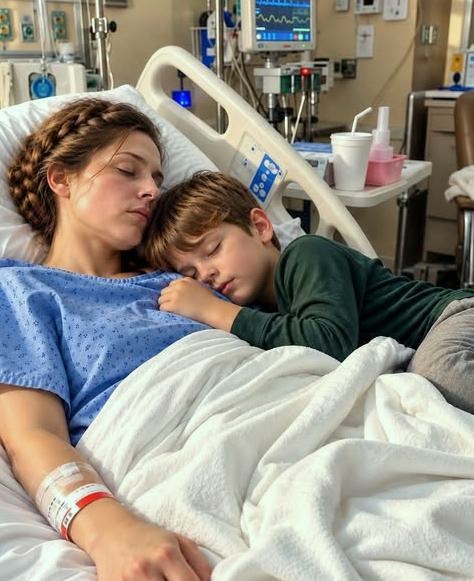
On the sixty-first day of my wife’s coma, my seven-year-old son accused me of being afraid of her hospital room.
He said it so quietly that I almost pretended I had misheard him.
The room smelled of antiseptic and warm plastic. A monitor blinked beside Elena’s bed, each green pulse cutting through the Saturday evening like a tiny metronome. Maxim sat with his knees tucked beneath him, one hand wrapped around his mother’s fingers and the other holding a comic book with a torn red cover.
“Your grandmother is waiting downstairs,” I told him. “We should go home tonight.”
He did not look at me.
“Not tonight.”
“Maxim, you need sleep.”
“Not on Saturdays.”
I glanced at the calendar taped to the wall. The date was circled in blue ink, though I could not remember who had marked it.
“Why does Saturday matter?”
My son slowly closed the comic book. Elena’s fingers lay motionless against the white sheet, a thin hospital bracelet resting above her wrist.
“Because that’s when Mom talks to me.”
My throat tightened.
“She can’t talk right now, buddy.”
“She does. You just don’t stay long enough.”
The words struck harder than they should have. For two months, I had visited every day, but I had also answered work calls in the hallway, argued with insurance representatives, and found reasons to leave before the silence became unbearable.
“You’re tired,” I said. “You may be imagining things.”
Maxim’s face changed. He was not angry. That would have been easier. He looked disappointed.
“Then why are you scared to stay with me?”
The monitor continued its steady beeping.
I had no answer.
Two months earlier, I had been standing outside a conference room in another city when my mother called. I remembered the brass handle beneath my palm and the way my coffee had gone cold while she spoke.
“Andrew, come home immediately.”
“What happened?”
“It’s Elena. She’s in the hospital. She isn’t waking up.”
I had left before the meeting ended. On the flight home, I kept staring at the message I had sent my wife before boarding: We’ll talk when I’m back. I love you.
It was the last message she had received from me.
Since then, Maxim had come to the hospital after school every day. He did his homework beside her bed, read her stories, and reported every minor event as if she were simply resting between conversations. I had called it bravery because I did not know what else to call it.
Now he reached beneath the pillow and pulled out a small paper star folded from a yellow medication wrapper.
“I made this for her,” he said. “She squeezed my hand when I put it there.”
“Maxim—”
“Three times.”
I stared at him.
“Three squeezes means she hears me.”
A nurse entered with a tray, and the wheels squeaked against the polished floor. Her name badge read Mara. She glanced at Maxim, then at Elena’s hand, and quickly lowered her eyes.
“Is something wrong?” I asked.
“No,” Mara said too quickly. “Everything is normal.”
Maxim tightened his grip on my hand.
“Dad, tell her what you said before the trip.”
The old argument rose between us—the mortgage, my endless work, Elena’s tired face beneath the kitchen light.
I pulled a chair beside the bed.
“What did I say?” I whispered.
Maxim leaned toward his mother.
“Tell her the part you keep running away from.”
My fingers trembled as I reached for Elena’s hand. Beneath the blanket, something moved. So faintly I almost dismissed it as the tremor of the mattress.
Then the door opened, and Mara stepped back to let a man in with a black folder pressed against his chest.
He looked at me, then at Elena’s chart.
“Mr. Petrov,” he said, “we need to discuss tomorrow morning.”
Maxim’s hand locked around mine as the man placed the folder on the bed table and opened it to the first page…
PART 2
The man’s name was Dr. Adrian Vale, the hospital’s neurological consultant. I had seen him once before, on the day Elena arrived, but I had been too numb to remember his face.
He pulled a chair beneath the humming air conditioner.
“What happens tomorrow morning?” I asked.
Dr. Vale did not answer immediately. He turned a page in the folder, and the paper made a dry, delicate sound in the room.
“Your wife’s care plan is being reviewed.”
“By whom?”
“By the neurological team and the hospital board.”
Maxim climbed down from his chair.
“Why?”
Dr. Vale looked at him, then at me.
“Because Elena has shown no reliable response to commands.”
“That isn’t true,” Maxim said.
His voice was small, but it did not shake.
Dr. Vale softened. “I know you believe she responds to you.”
“She does.”
“Maxim,” I said, “let the doctor explain.”
My son turned toward me. “You always say that when you don’t want to listen.”
The accusation landed in the space between us. Mara stood near the sink, her fingers wrapped around a metal tray so tightly that her knuckles had gone white.
I looked at Elena. Her lashes rested against her cheeks. A thin strand of hair had escaped from the braid the nurses made each morning and lay across her temple.
“I want the truth,” I said. “What exactly are you planning?”
Dr. Vale folded his hands.
“Your wife’s condition will be reclassified if tomorrow’s assessment confirms the previous findings. That could affect the level of long-term support available to her.”
“Could?”
“Mr. Petrov, I am not saying anyone is abandoning Elena. I am saying the documentation must match the clinical evidence.”
Maxim climbed back onto the chair and touched his mother’s wrist.
“Mom hears me every Saturday.”
“Why Saturday?” I asked.
He stared at Elena.
“Because that’s when I read the book she gave me.”
“What book?”
He pointed to the drawer. I opened it and found a small cloth-bound astronomy book, its corners worn smooth. Inside the cover Elena had written: For Maxim, so you always remember that distant things can still send light.
“I read the star pages,” he said. “Then I say, ‘Find the North Star.’ She squeezes my hand three times.”
Dr. Vale leaned forward.
“Has she done this in front of anyone else?”
“Mara saw it,” Maxim said.
The nurse flinched.
I turned to her. “You saw Elena respond?”
Mara swallowed. “Once. Maybe twice.”
“Why didn’t you tell me?”
“I did.”
“When?”
“Three weeks ago. You were speaking to the insurance office in the corridor. I told you Elena’s fingers moved when Maxim read to her.”
I remembered the corridor, the terrible music in the receiver, the way I had nodded without hearing anything.
Dr. Vale opened another section of the folder.
“There is a note here,” he said. “A nursing observation dated October fourteenth.”
Mara’s expression tightened.
“That note was removed from the active chart,” she said.
The room seemed to shrink around us.
“Removed by whom?” I asked.
She looked at Dr. Vale. He gave a slight nod.
“By the attending physician,” Mara said. “He considered the movement reflexive.”
“Did he test it?”
“No.”
My chair scraped backward. Elena’s monitor quickened, and the yellow star on the table slipped onto the floor.
Dr. Vale picked it up and held it between two fingers.
“Tomorrow’s assessment will be different,” he said. “I want to examine her response while Maxim gives the command.”
“Why tomorrow?”
“Because the review begins at eight.”
Maxim looked from the doctor to me.
“Dad, don’t let them take Mom somewhere else.”
The sentence made no sense until Dr. Vale closed the folder.
“If Elena is not classified as responsive,” he said, “the hospital may transfer her to a long-term facility by Monday.”
“Can they do that without my permission?”
“Not immediately.”
“But they can try.”
“Yes.”
The monitor beeped faster. I leaned over Elena, suddenly aware of every machine, every tube, every sealed packet on the bedside table.
“Then we test her tonight,” I said.
Dr. Vale shook his head. “We need controlled conditions.”
Maxim lifted his mother’s hand and whispered, “Mom, Dad is staying.”
Elena’s thumb moved.
Not a tremor this time. It pressed once against Maxim’s palm, then twice more.
Dr. Vale stood so abruptly that his chair struck the wall.
“Do it again,” he said.
Maxim looked at me.
“Dad, ask her the question only she knows.”
I bent over my wife, my lips inches from her ear, while Dr. Vale reached for the examination light.
“What question?” I whispered.
Maxim’s face went pale.
“The question she asked you before you left for the trip…”
PART 3
The question came back to me with painful clarity.
It had been 5:40 on a Thursday morning. Elena stood in the kitchen wearing her green wool cardigan, the one with a loose thread near the cuff. My suitcase lay beside the table, and rain tapped against the balcony glass.
“Andrew,” she had said, “if something happens while you’re gone, will you listen to Maxim before you listen to everyone else?”
I had been checking the time.
“Nothing is going to happen.”
“That isn’t an answer.”
I kissed her forehead, promised we would talk when I returned, and walked out.
Now I repeated her question beside a hospital bed.
“Elena, if something happens while I’m gone, who should I listen to first?”
For several seconds, nothing changed. The machines breathed and blinked. Maxim’s palm rested beneath his mother’s fingers.
Then Elena squeezed once.
Dr. Vale raised one finger.
“Again.”
Maxim whispered, “Mom, who should Dad listen to?”
Elena squeezed twice.
The doctor checked the chart, then looked at me.
“Is there a person associated with two?”
I thought of our family. Elena’s mother was one. My mother was two. My brother Daniel was three.
“My mother,” I said.
Elena’s fingers squeezed once, then stopped.
Maxim shook his head. “No. That means no.”
Dr. Vale turned to him. “How do you know?”
“Because she taught me.”
He lifted a hand. “All right. Elena, squeeze once for yes, twice for no. Can you hear us?”
One squeeze.
The room changed.
Mara covered her mouth. I felt the blood drain from my face.
“Can you understand what we say?” Dr. Vale asked.
One squeeze.
“Can you move your body?”
Two squeezes.
“Can you open your eyes?”
Two squeezes.
My knees weakened. I gripped the bed rail.
“Why didn’t you tell us?” I asked.
Her fingers remained still.
Dr. Vale placed a letter board on the table, then pointed to groups of letters. It took nearly twenty minutes to form a sentence. Maxim never released her hand.
When the final letter was confirmed, Dr. Vale read it aloud.
“Saturday. Only Saturday. The night nurse listens.”
Mara began to cry.
“I knew she was trying,” she said. “But I was told not to encourage family fantasies.”
“Who told you?” I asked.
“Dr. Harlan.”
Harlan was Elena’s attending physician, the man who had told me three weeks earlier that hope could become cruel if I let it control me.
Dr. Vale opened the black folder and removed a signed assessment.
“This says Elena has demonstrated no purposeful response since admission.”
Mara pointed at the bottom of the page.
“That signature is not mine, but the observation attached to it is mine.”
I looked closer. The wording had been changed. The original note described three deliberate squeezes during Maxim’s reading. The current chart called them spontaneous muscle contractions.
Dr. Vale’s jaw tightened.
“Someone altered the record.”
Elena squeezed once.
I bent close. “Was it Dr. Harlan?”
Two squeezes.
“No?”
One squeeze.
I did not understand until Maxim touched the yellow paper star.
“Ask her about the star,” he said.
I held it near her hand. “Did Dr. Harlan change your record?”
Two squeezes.
“Did someone else?”
One squeeze.
Dr. Vale looked toward the door. “Who?”
Elena’s finger moved against the sheet, not enough to squeeze. A faint line appeared in the fabric as she traced one letter with the tip of her thumb.
M.
Mara whispered, “Mercer.”
The hospital administrator, Thomas Mercer, had signed the transfer recommendation. He also controlled the rehabilitation contract with the facility waiting to receive Elena.
Before I could speak, Dr. Vale’s phone rang. He answered, listened, and his expression hardened.
“What happened?” I demanded.
He lowered the phone.
“The review has been moved to tonight. Mercer is already bringing the board to this floor.”
A shadow crossed the glass panel in the door.
Maxim clutched Elena’s hand.
Dr. Vale looked at me.
“If we cannot prove this response before they arrive, they can remove her from our care before morning.”
The handle began to turn, and from the corridor came Thomas Mercer’s calm voice.
“Mr. Petrov, we need to have a very serious conversation…”
Mercer entered the room carrying one decision too many…
I thought the danger was hidden inside Elena’s diagnosis. I was wrong. The final discovery forced every person in that room to choose a side.
“Dad, you still owe me a Saturday.”
Maxim began to cry.
👇 The final part of the story is open.






