PART 4
The hospital call ended before I could ask another question.
The minister lowered the receiver and stared at me.
“Who was demanding Jack’s belongings?” I asked.
“A man who said he was authorized to collect them.”
Thea’s father raised his chin. “I am his family.”
Daniel moved closer to him. “You are not Jack’s family.”
The man’s eyes flicked toward the red tin. “You have no idea what that boy hid.”
Mrs. Alvarez tightened her arms around the box.
“I know what he trusted me with,” she said.
Thea looked at me, frightened and exhausted.
“Mom,” she whispered.
The word broke something open inside me.
She had never called me that before. Not once. She had called me Mrs. Harris for eleven years, even while sleeping in our guest room and stealing the cinnamon rolls I kept behind the flour tin.
I took her face gently between my hands.
“You can call me whatever feels safe,” I said. “But you are not going with him.”
Her father scoffed. “You cannot simply take responsibility for an adult.”
“No,” I answered. “But I can stand beside one.”
Daniel turned to the minister. “We are going to the hospital.”
Thea’s father stepped into the aisle.
“You will give me that box.”
Mrs. Alvarez opened the tin fully and removed a small brass key taped beneath the lid.
The man’s anger vanished.
For the first time, I saw fear on his face.
Thea noticed it too.
“What does the key open?” she asked.
He said nothing.
Daniel’s gaze sharpened. “You know exactly what it opens.”
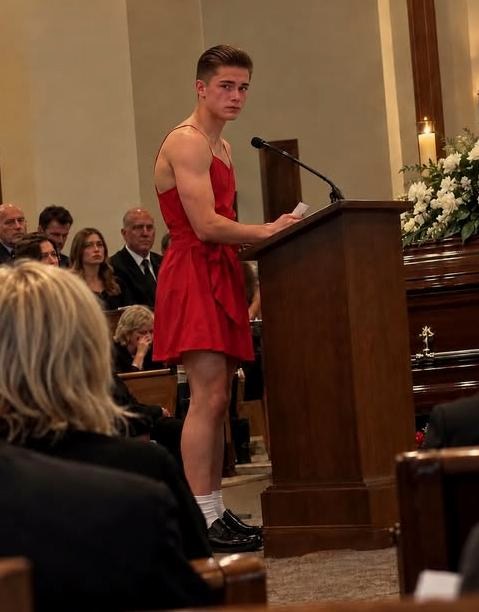
Thea’s father reached for her. She recoiled so violently that the microphone stand rocked behind her.
“Don’t touch her,” I said.
The minister called the building manager, and Daniel guided Thea toward the side corridor. Nobody tried to stop us. The mourners who had stared at the red dress were now standing around us like a wall.
At the chapel entrance, Thea turned back.
“Mrs. Alvarez,” she said, “bring the tin.”
The counselor nodded. “I will.”
Her father remained between the pews, alone beneath the flower arrangements he had not brought and could not claim.
The hospital had placed Jack’s belongings in a small consultation room near the oncology wing. We arrived just before noon. The corridor smelled of disinfectant and burnt coffee. A nurse waited beside a canvas storage bag with Jack’s name written across the tag.
“I’m sorry,” she said. “This was found behind the false panel of his bedside cabinet.”
She handed me a narrow wooden case.
I knew it immediately. Jack had built it in shop class when he was fifteen. One corner was painted yellow, and the lid carried a crooked red star.
Thea touched the paint.
“He told me he lost this,” she said.
“He told me many things were lost,” I replied.
Inside the case was a second envelope, several photographs, and a bank folder. There was also a letter from a charity that helped young people leave unsafe homes. Jack had made monthly payments from his savings account. Every payment was addressed to Thea under her chosen name.
Thea covered her mouth.
“He was saving for me.”
Daniel opened the bank folder. “He had enough for your first year of school and housing.”
Her father appeared in the doorway.
“You stole from me,” he said.
Thea turned around. “You never gave me anything.”
“I paid for your life.”
“You paid for a version of me you could control.”
His face tightened. “You are coming home.”
Daniel stepped forward, but I lifted a hand. This was not a fight I could have for her.
Thea walked toward her father.
“Why did you want Jack’s box?” she asked.
He glanced at the folder.
“Because he was interfering.”
“With what?”
He looked at the nurse, the counselor, Daniel, and me. His confidence began to fracture.
Thea’s voice grew steadier. “Tell me.”
He pointed at the documents. “Your mother left money for you. Money you were supposed to receive when you turned eighteen. Your grandfather put it in a trust. I managed it until then.”
Thea stared at him. “What money?”
Mrs. Alvarez opened the red tin and pulled out a copy of the trust agreement. “Your father withdrew from it for years,” she said. “Jack found the statements in your journal’s envelope. He sent copies to me before he got too sick.”
Daniel read the figures. His mouth tightened.
Thea’s father shook his head. “I used it for the household.”
“You used it to pay debts,” Mrs. Alvarez said. “The account is nearly empty.”
Thea looked at the wooden case, then at the man who had come to her funeral wearing authority like armor.
“Did Jack know?” she asked.
Her father’s silence answered first.
Then he said, “He threatened to expose me.”
The room went still.
“He was dying,” the man continued, trying to recover his anger. “He had no right to destroy this family.”
Thea’s fingers curled around the red paper star from the chapel.
“He didn’t destroy anything,” she said. “He showed me what was already broken.”
Her father reached for the case.
The nurse stepped between them. “Leave.”
This time, he did.
Not because he had changed. Because every person in the room had seen what he wanted, and none of them would help him take it.
After he was gone, Thea sat on the hospital floor with the wooden case in her lap. Daniel lowered himself beside her, ignoring the crease in his funeral trousers.
“I’m sorry,” he said. “When I saw you in that dress, I thought you were making Jack’s funeral about yourself.”
Thea looked at him.
“I thought you hated me.”
“I was grieving,” Daniel said. “That is not an excuse. I should have looked at your face before I looked at your clothes.”
Thea began to cry again.
Daniel opened his arms. She leaned into him, and he held her with the same careful strength he had used when Jack was too weak to stand.
I read Jack’s final letter while they sat together.
“Mom and Dad,” it began, “if you are reading this, Thea has probably done the bravest thing I have ever seen. Please do not make her thank you for loving her. Just make room.”
The last paragraph was written unevenly, as if his hand had been shaking.
“Tell her she does not have to become my replacement. She is not the person I am leaving behind. She is the person I was trying to protect while I was here.”
I pressed the paper to my chest.
Thea reached for it. “What did he say?”
I handed it to her.
She read in silence, then folded the letter and placed it inside the red tin with the counselor’s documents.
“What will you do?” I asked.
She looked toward the hospital corridor where her father had disappeared.
“I’ll go back to your house,” she said. “If that is still allowed.”
Daniel gave a tired, crooked smile.
“The spare room has always been yours.”
“Theo’s room,” she corrected softly.
I smiled through my tears. “Then we’ll put your name on it.”
She held up the red paper star.
“Jack wanted people to see me,” she said.
“He did.”
“Even if they stared?”
“Especially then.”
That evening, we returned to the chapel because Jack’s coffin was still there before the private burial. The red dress had a loose seam near the waist, and Thea asked me to help repair it before we left.
I threaded a needle under the same brass light where she had first stood trembling. Daniel sat nearby, holding the wooden case. Mrs. Alvarez placed the red tin inside it, beside Jack’s letter and the charity documents.
Thea watched my hands.
“Jack said red was impossible to ignore,” she murmured.
“He knew you had spent too long being ignored.”
She looked toward her brother by choice, toward the flowers and the photograph and the empty microphone.
“Do you think he would have liked my name?”
I tied off the thread.
“He chose it with you,” I said. “So yes.”
Thea stepped to the microphone once more, though the chapel was nearly empty. She held the red paper star in one hand and Jack’s letter in the other.
“Thank you,” she said to the photograph. “I’m still here.”
The speakers carried her voice across the room.
And beneath Jack’s crooked red star, she finally said the name he had protected until everyone was ready to hear it.
Missed the beginning?






