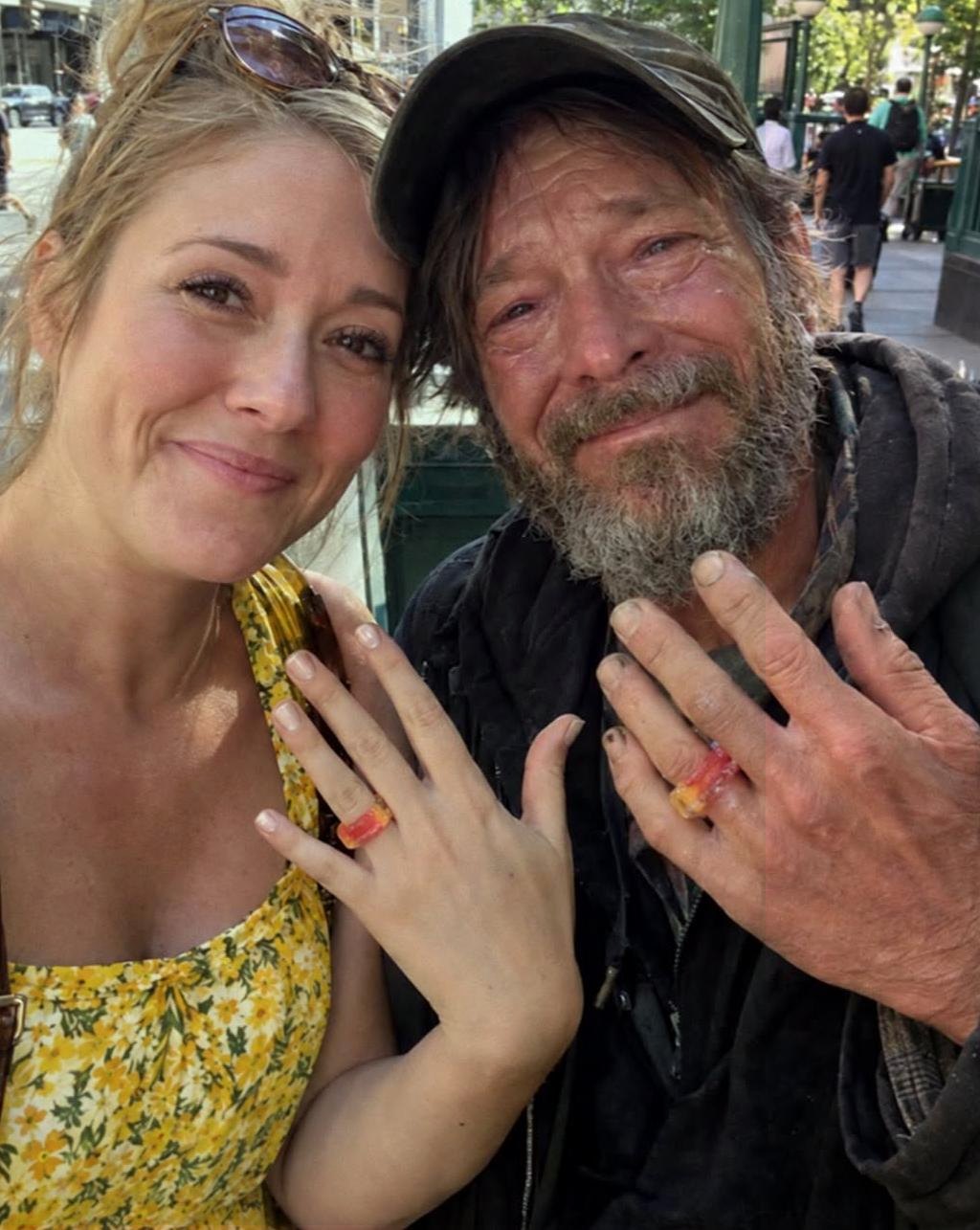
The last thing Larry asked me to do before he died was marry him, and I signed the papers before I understood why his hands were shaking.
It happened on a freezing Tuesday morning outside the subway station on Mercer Avenue. Snow had collected in the cracks of the pavement, and the metal grate beside Larry hissed warm air through his torn blanket. He usually held a paper cup and nodded when he saw me. That morning, he held a piece of cardboard instead.
MARRY ME. I HAVE ONE MONTH LEFT TO LIVE.
I stopped so abruptly that a man behind me cursed. Larry lowered the sign, his fingers trembling around the cardboard’s bent edge.
“Larry,” I said. “What is this?”
He took the black coffee I had bought him, but he did not drink it. A red thread from his frayed scarf had caught on the cup lid, vibrating in the wind.
“The clinic gave me a month,” he whispered.
“A month for what?”
“Liver failure.”
The station clock clicked toward eight. Commuters flowed around us, avoiding his eyes and mine. I knelt on the wet pavement.
“You need a hospital, not a wife.”
“I have a hospital.” His mouth twisted into a tired smile. “What I don’t have is a name anyone will care about after I’m gone.”
He explained that the city buried unidentified people in a public cemetery, without a marker, without anyone to claim their ashes. He wanted one person listed beside him. Someone who could make sure he did not vanish completely.
“It’s only paperwork,” he said. “You don’t have to love me. You don’t even have to visit me after.”
I should have walked away.
Instead, I remembered the first morning I had met him, two years earlier, when he had returned the ten-dollar bill I dropped beside the turnstile. I remembered how he always asked about my work, even though he never asked for anything more than coffee. I remembered my father’s ashes sitting in a cardboard box for six months because my family could not agree on a cemetery.
“Why me?” I asked.
Larry stared at the pavement.
“Because you say my name.”
Two days later, we stood in a municipal office beneath flickering fluorescent lights. The clerk slid the marriage forms toward us. Larry wore a borrowed navy coat that was too large through the shoulders. I wore my office blouse and still had snow melting on my boots.
The clerk glanced between us. “Are you both entering this marriage voluntarily?”
Larry looked at me.
I swallowed. “Yes.”
His hand was cold when he took mine. His wedding band was a thin brass ring bought from a street stall. The inside was engraved with three tiny letters: H.H.S.
“What does that mean?” I asked afterward.
He closed his fist around the ring.
“Something I failed to protect.”
For three weeks, I visited him at the hospice after work. He slept beneath a blanket patterned with yellow leaves and kept a small blue notebook under his pillow. He never let me read it.
On the twenty-first night, a nurse called me at my desk. Larry had died quietly before dawn.
Yesterday, his funeral was attended by me, one nurse, and a man in an expensive black coat who stood far away from the grave. When I approached him, he turned before I could speak.
That evening, a thick envelope waited beneath my apartment door. The postmark was dated the day before Larry died. My name was written across it in his uneven handwriting.
I sat at the kitchen table, still wearing my funeral clothes, and opened the pages. I expected gratitude. I expected sorrow.
The first sentence made my fingers go numb.
“Sarah, if you are reading this, they believe I am dead…”
PART 2
“Sarah, if you are reading this, they believe I am dead,” I read aloud, though nobody was in the apartment.
The radiator clicked behind me. Outside, a delivery truck groaned through the alley, and the brass ring Larry had given me pressed against my palm.
He wrote that his name was not Larry Bell.
His real name was Lawrence Vale.
For twelve years, he had owned a company called Harbor House Services, which managed temporary housing for veterans and families escaping domestic violence. The company had received millions in city grants. Larry had built it after his younger sister died in a shelter fire.
Then, three years earlier, money began disappearing.
“Not in large amounts,” he wrote. “That would have been obvious. It left in small, regular streams, like water through a cracked pipe.”
He suspected his chief financial officer, Daniel Vale—his only son. Before Larry could confront him, Daniel produced medical records claiming Larry suffered from early dementia. A private physician signed them. The board removed Larry from control. His bank accounts were frozen. His house was sold.
“I ran because the people around me had already agreed I was incompetent,” Larry wrote. “I lived outside the station because it was the one place Daniel never thought to search.”
I read the paragraph twice.
Then the letter changed direction.
“Sarah, I did not marry you only because I feared an unmarked grave. I married you because my legal wife died years ago, my son believes I left no family, and you are the only person who treated me like a man instead of a problem.”
A folded key fell from the pages and struck the table.
Beneath it was an address: 14 Bellwether Lane, Unit 3B.
At eight the next morning, I called the number printed at the bottom of the letter. A woman answered on the fourth ring.
“Ms. Reed?”
“Yes.”
“My name is Miriam Cole. I represented Lawrence Vale before his son took over Harbor House.”
“Why did he never tell me any of this?”
“Because he believed Daniel was watching everyone connected to him.”
I looked toward the apartment door. The chain was still fastened, but I suddenly imagined someone listening from the hallway.
Miriam asked me to meet her at a bakery across from the hospice. She arrived at ten, carrying a leather folder with a brass clasp. Her left thumb was wrapped in gauze.
“Larry said you would doubt the letter,” she told me.
“I do doubt it.”
“Good. Doubt keeps people alive.”
She opened the folder and showed me copies of bank transfers, property records, and a medical report. Every page carried the same signature: Daniel Vale.
“Why bring this to me?” I asked.
“Because the original ownership agreement names the surviving spouse as temporary custodian of the company if the founder dies before the fraud is resolved.”
I laughed once. It sounded ugly. “He married me for a company?”
“No,” Miriam said. “He married you because he needed someone Daniel could not dismiss as an employee.”
A black sedan rolled slowly past the bakery window. Miriam stopped turning pages.
“Do you know who that is?”
I shook my head.
“Then we leave through the back.”
The address on Larry’s key led to a narrow brick building behind an abandoned tailor shop. Unit 3B was empty except for a metal cabinet, a lamp, and dozens of sealed files. On the wall hung a photograph of Larry standing beside a ribbon-cutting ceremony at Harbor House.
He looked younger. Proud.
Miriam unlocked the cabinet. “There is one person who can prove the signature on the transfer was forged.”
“Who?”
“His former bookkeeper. She disappeared after Daniel threatened her.”
Before I could ask where she was, Miriam’s phone rang. She listened, then went pale.
“Sarah,” she said, “Daniel knows about the marriage.”
“What does he want?”
“He wants you to sign a waiver by noon.”
“And if I refuse?”
Miriam looked at the locked cabinet.
“Then he will show the world something that makes you look like a fraud.”
At noon, Daniel arrived at the apartment building with two men and a document case. He wore the same expensive coat I had seen at Larry’s funeral.
“You married my father for money,” he said before I invited him inside.
“I married him because he was dying.”
Daniel smiled. “Then you should have no trouble signing this.”
He placed a waiver on my kitchen table. The paper smelled faintly of cedar and fresh ink.
I picked up the pen.
Daniel leaned closer.
“Sign, Sarah. Or I’ll tell everyone you knew exactly who Larry was before you said yes.”
My hand touched the page, but I did not write my name. Instead, I asked, “Who was the woman who found the missing transfers?”
His smile disappeared.
For one second, something frightened flashed across his face.
Then his phone rang. He answered, listened, and turned toward the window.
“What do you mean she’s at the warehouse?” he demanded.
He ended the call and rushed for the hall.
Miriam gripped my arm. “We follow him.”
“Why?”
“Because whoever called him just told us where the witness is…”
PART 3
We followed Daniel to the Harbor House warehouse on Pilgrim Street, arriving at 12:47 in the afternoon. The building had once stored donated furniture; now its windows were boarded and the loading door hung crooked on one hinge.
Miriam parked behind a delivery truck. I could hear my own breathing.
“Stay behind me,” she whispered.
Inside, Daniel stood beneath a swinging work lamp, facing a small woman in a green wool coat. She held a canvas grocery bag against her chest. Her silver hair was pinned with a pencil.
“You should have stayed gone, Evelyn,” Daniel said.
The woman’s eyes moved to me. “That must be Sarah.”
Daniel turned sharply. “You brought her here?”
“No,” Miriam said. “You did.”
Evelyn took a folded document from her bag. The paper was creased at the corners and stained with coffee.
“I kept the original,” she said. “Your father told me to hide it if anything happened to him.”
Daniel stepped forward. “You stole company property.”
“I preserved evidence of theft.”
Miriam held out her hand. Evelyn gave her the document.
It was the original board resolution removing Lawrence Vale from Harbor House. The signature beneath Larry’s name had been traced over, but the paper beneath it showed the real signature in faint pressure marks. The date was three days after Daniel’s physician claimed Larry had become incapable of making decisions.
Evelyn pointed to the bottom margin.
“Your father signed the first page in my office,” she said. “He was angry, but he understood every number. Daniel came in later with a second page and replaced it.”
Miriam unfolded another sheet from the grocery bag. “And these are the transfers.”
Rows of payments led from Harbor House to three companies owned by Daniel’s wife, his cousin, and a corporation registered in the name of a dead man. The final transfer had been made two days before Larry was forced out of his home.
I stared at Daniel. “You stole from shelters.”
“I borrowed money,” he snapped. “The company was collapsing.”
“Then why hide it?”
“Because my father would rather let thousands of people lose housing than admit he had built something he couldn’t control.”
Evelyn shook her head. “He found out you were buying luxury apartments with grant money.”
Daniel’s face hardened. “You know nothing about what he did to me.”
“Tell her,” Miriam said. “Tell her why you needed him declared incompetent.”
Daniel looked at me instead.
“He was going to sign the company over to a foundation,” he said. “A foundation that would have given control to strangers. I stopped him.”
“You destroyed his life.”
“I protected what he built.”
“No,” Evelyn said quietly. “You protected what you could sell.”
Daniel lunged for the papers. Miriam pulled them back, and the work lamp swung wildly, throwing their shadows across the walls. I stepped between them, clutching Larry’s brass ring in my fist.
“Why did he die?” I asked.
Daniel froze.
Miriam turned toward him. “Sarah’s husband had a terminal illness. The hospice records are real. But the medication chart is not.”
Evelyn opened her bag again and removed a small envelope. Inside was a pharmacy receipt bearing Daniel’s signature for an unusually high dose of a drug known to worsen liver damage.
“I found it in the company ledger,” she said. “He charged it as a charitable medical expense.”
Daniel backed away. “My father was dying already.”
“Were you trying to make sure he died before he could speak?” I asked.
His eyes flicked toward the loading door.
Then he gave himself away.
“He was supposed to die in the clinic,” Daniel said. “Not in front of her. Not after changing the marriage documents.”
The warehouse went silent.
Miriam’s hand tightened around the original resolution. “What marriage documents?”
Daniel looked at me, and the color drained from his face.
I understood before anyone spoke. Larry had hidden another document, one Daniel had been desperate to find.
Miriam’s phone began ringing. She answered, listened, and covered the receiver with her palm.
“Sarah,” she said, “the hospice director says a man came for Larry’s personal effects. He presented a death certificate signed before Larry’s body was even released.”
Daniel’s gaze shifted toward the metal cabinet in the corner.
Behind it, something scraped against the concrete.
Someone else was inside the warehouse…
The person behind the warehouse wall changed everything…
I thought Larry’s letter had already revealed the worst betrayal. I was wrong. The final truth forced me to choose what his name would mean.
“I stopped being your accomplice when I saw Larry sleeping outside.”
Daniel looked at the receipt as if it had become a sentence.
👇 The final part of the story is open.






