PART 4
“The filing came from your ex-husband,” the major repeated.
For one stunned second, I could not breathe.
Preston had chosen his daughters as burdens. He had told me to take them. He had watched me leave. Now he was trying to stop the aircraft.
“Put him back on,” I said.
The major handed me the secure receiver.
“Preston.”
“I didn’t file anything,” he said immediately. “My father used my credentials.”
“Can you prove that?”
“I’m standing in front of him.”
In the background, Marcus shouted, “You have no idea what you’re doing!”
Preston answered, “I know exactly what you did.”
The line crackled. Then a woman began crying.
Brielle.
“Lena,” she said, “please listen to me.”
“I’m listening.”
“Marcus told me the trust required a male descendant. He said Preston’s daughters had no legal claim. He said if I gave him a son, everything would be secure.”
“You agreed.”
“I did.”
The honesty caught me off guard.
“I wanted the money,” she continued. “I wanted the house. I thought Preston knew. I thought he was part of it.”
“He wasn’t?”
“He knew his father wanted a grandson. He didn’t know about us.”
A heavy thud sounded over the line.
Preston said, “She’s telling the truth.”
I looked through the glass at Madeline and Sophie. My younger daughter was still holding the purple card. She had stopped asking whether her father would call.
“Why did you send me the message?” I asked Brielle.
“Because Marcus told me he would take the baby if I refused to marry Preston. He said I was just a carrier. Then I saw the trust. I understood that he didn’t want a family. He wanted a hostage.”
The word made my skin tighten.
“Where is the original trust?”
“In the study,” she said. “Inside a red metal cash box.”
Marcus roared, “Do not tell her that!”
A sharp metallic crash followed.
The major was already moving. He spoke into his headset, giving clipped instructions, while another officer escorted the girls away from the glass.
Preston came back on the line. “I found the cash box.”
“How?”
“My father keeps the key on his watch chain.”
“Then open it.”
“He’s refusing.”
“Tell him the truth can be shown without his permission.”
Marcus laughed bitterly. “You think a piece of paper will save you?”
“No,” I said. “I think your own greed will finish this.”
The major looked at me. “Colonel, the emergency filing was submitted with an electronic signature at 2:31. Your former husband’s divorce attorney has confirmed he did not authorize it.”
That was enough to suspend the filing. The aircraft could depart, but the military welfare office required a written statement from Preston clarifying that he had not challenged my custody.
I put him on speaker.
“Say it clearly,” I told him.
“My daughters are not at risk,” Preston said. His voice shook, but he continued. “Their mother has lawful primary custody. I did not file the emergency motion. My father did.”
Marcus cursed.
“Again,” I said.
“My daughters are safe with Lena.”
Sophie looked up at her name.
Preston swallowed. “And I want them to leave with her.”
The room seemed to release a breath.
Madeline stepped closer. “Is that Dad?”
I nodded.
She took the receiver from my hand. “Daddy?”
Preston’s voice broke. “Hi, sweetheart.”
“Did you want us to go away?”
There was no place left for a clever answer.
“Yes,” he said. “I did.”
Sophie’s mouth trembled.
“Why?”
“Because I believed something terrible about what made a family important.”
“That doesn’t answer me.”
“No,” he whispered. “It doesn’t.”
I wanted to take the receiver away. I wanted to protect them from the ugliness adults had created. But the girls deserved the truth in a language they could understand.
Preston said, “I was wrong to treat you like replacements. You are my daughters. Nothing your grandfather did changes that.”
Madeline’s eyes filled. “You said you would call later.”
“I should have called before you had to ask.”
Sophie stared at the purple card in her hands.
“Do you still want this?” she asked.
“What is it?”
“A goodbye card.”
Preston made a sound like he had been struck.
“I want anything you choose to give me,” he said. “But you don’t owe me one.”
Sophie looked at me. I did not tell her what to do.
She folded the card once, then again, and placed it in her backpack.
“Maybe later,” she said.
It was not forgiveness.
It was a boundary small enough for a seven-year-old to carry.
At 3:18, Preston’s lawyer sent the written statement. At 3:26, the military welfare office lifted the hold. At 3:41, Marcus’s access to the trust accounts was frozen by the family board after the laboratory request, the cash-box papers, and the fraudulent filing were delivered to them.
No dramatic courtroom was needed. Marcus lost the control he had built his entire life to possess. The board appointed an independent trustee until the child’s paternity could be established after birth. The company did not pass to him. The house did not become Brielle’s prize. The unborn baby became a child instead of a weapon.
Preston’s own position collapsed more quietly. The board removed him from executive duties because he had allowed his father access to his credentials and had signed financial documents without reading them. He was not imprisoned. He was not publicly dragged away.
He simply lost the empire he had assumed would forgive every careless decision.
Before we boarded, he asked to speak to me alone.
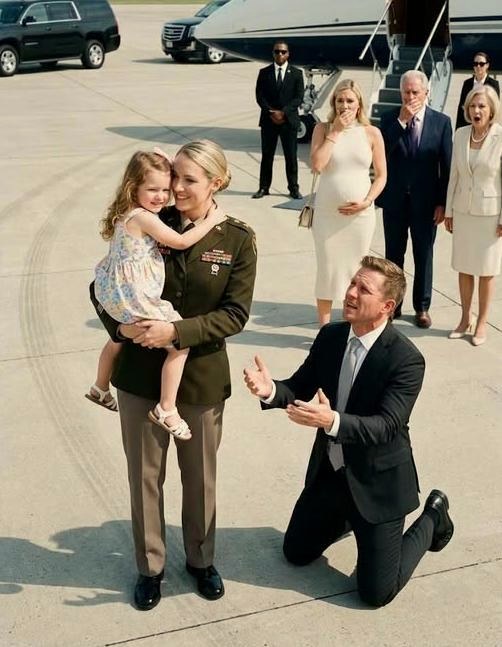
We stood beside the transport gate. The runway heat trembled above the concrete, and the red compass on my badge swung against my uniform.
“I don’t expect you to come back,” he said.
“I’m not coming back for you.”
“I know.”
“Do you?”
He looked toward the girls. “I thought your work made you distant. I thought the Army took you away from us.”
“It taught me to recognize people who confuse silence with surrender.”
His face tightened.
“I was cruel,” he said.
“Yes.”
“I don’t know how to repair that.”
“Start by showing up for the girls without asking them to comfort you.”
He nodded.
“And the baby?” I asked.
“The child will have a father who knows the truth. Whether that is me or not, I’ll make sure he isn’t raised as a family trophy.”
That was the first promise he made that did not ask me to carry it.
Brielle sent one final message before we boarded. She had left the Hale house and given the board a signed statement. She said she would keep the baby, refuse Marcus’s money, and accept whatever paternity test proved. I did not call her a good person. She had participated in the lie. But she had stopped it before the child was born, and that mattered.
Madeline pressed her forehead to my arm as we crossed the ramp.
“Mom?”
“Yes?”
“Are we still a family if Dad isn’t with us?”
I looked back once.
Preston stood behind the security line, holding nothing but his phone and the consequences of what he had said. He was not waving. He seemed to understand that a grand gesture would only make the moment about him again.
“We are a family,” I told her. “But families can change shape.”
Sophie unzipped her backpack and pulled out the purple card.
“Should I give it to him?”
I looked at the folded paper, at the purple hearts pressed into its center, at the child who had made it before she knew her father could choose against her.
“Only if you want to.”
She thought for a moment.
Then she tore off the front page and kept the drawing. On the back, she wrote a new sentence in careful block letters. She walked to the edge of the ramp and handed it to the waiting officer, who carried it to Preston.
He read it beneath the hard white sun.
His shoulders folded inward.
Madeline asked, “What did she write?”
Sophie answered before I could.
“I wrote that he can be our dad again when he learns how to act like one.”
The engines began to turn.
As the aircraft pulled away from the gate, I felt the red compass tap against my chest, once, twice, keeping time with the runway lights.
Below us, Preston held the torn purple card in both hands, while somewhere in the city an unborn child waited to enter a family that had finally stopped calling him an heir.
Sophie leaned against my shoulder.
“Which way is home?” she asked.
I touched the little compass and watched its needle settle toward the horizon.
“Forward,” I said.
Missed the beginning?






