PART 4
For three seconds, nobody moved.
Then Mark grabbed the phone from my hand.
Tessa caught his sleeve.
“Give it back.”
He shoved her away.
She struck the table and the silver lighthouse pin fell from June Mercer’s scarf, spinning across the polished wood.
Cole pulled Stefan behind him.
That small movement changed everything.
Mark saw the boys no longer as children who needed his explanation. He saw them as two witnesses standing together.
“I was going to handle this,” he said.
“By sending us away?” Cole asked.
“It was temporary.”
“Why?” Stefan’s voice shook. “Because she knows Hannah?”
Mark looked at me. “You have no idea what you’re doing.”
I picked up the lighthouse pin and placed it carefully in June’s palm.
“I know exactly what you did. You took one of my sons and made another woman believe she had been chosen to be his mother. Then you kept visiting him while sleeping beside me.”
Tessa stared at him. “You told me you worked late.”
“I did work late.”
“After seeing him?”
Mark said nothing.
That silence hurt more than any confession. He had not made one desperate mistake. He had built a second life out of repeated decisions, each one protected by another lie.
Principal Alvarez locked the conference-room door and called the school counselor, not the police. The boys needed someone who could keep them safe while the adults untangled the wreckage.
Mark noticed.
“You can’t keep me from my children,” he said.
I turned toward him. “You kept a child from his mother for eight years.”
His jaw tightened. “I was their father.”
June opened the ledger again.
“You were one parent,” she said. “That is not the same as owning the children.”
Mark’s eyes flashed. “You should have destroyed that page.”
June leaned back in her chair. “I preserved it because you threatened the nurse who questioned the transfer. Her name was Ruth Calder. She left the hospital after you paid her to resign.”
Mark froze.
“Ruth is alive,” June continued. “She lives three towns away. I spoke to her this morning. She remembers you carrying the infant from the ward.”
The room seemed to lose its air.
I looked at Mark. “You carried him?”
His face collapsed.
“I thought you would hate him,” he said.
I could barely hear him. “Why would I hate my own baby?”
“Because he was born while you were dying. Because I had to choose.”
“No. You chose for me.”
He pressed both hands over his face.
Tessa’s voice was quiet. “Tell her the rest.”
Mark lowered his hands.
Tessa was crying, but she stood straight. “Tell her why you needed Stefan with me.”
Mark looked at the floor.
“I owed money,” he said. “The company was failing. Tessa’s father offered to keep my contracts alive if I became part of their family. He knew she wanted a child. When she lost hers, I saw a way to keep the deal and save the company.”
I stared at him.
“So you traded our son for your business.”
“I thought I could repair everything.”
“You repaired your accounts.”
He flinched.
That evening, we went to Tessa’s house together. Stefan led us through a narrow hallway covered with framed school certificates. Cole followed him, carrying the bent backpack and the wooden zipper bead.
The nursery was painted yellow. Two beds stood against opposite walls, though only one had ever been used. On a shelf sat a plastic hospital bracelet inside a glass jar.
Stefan picked it up.
“Mom said Dad gave me this.”
Tessa touched his shoulder. “I thought it was yours.”
June examined the bracelet.
The printed number matched the carbon copy in the ledger.
Stefan looked at me. “Are you really my mother?”
The question I had imagined for eight years arrived in a room where my son’s old toys sat beneath another woman’s photographs.
I knelt in front of him.
“Yes,” I said. “I am.”
He did not run into my arms. He did not forgive the world because I had finally been found.
He asked, “Why didn’t you come?”
I answered honestly. “Because I was told you died.”
His mouth trembled.
“Did you want me?”
“I wanted you before I knew your face.”
He stepped forward slowly. I held out my hands, but I did not pull him closer. He chose the distance himself.
When he reached me, his forehead touched my shoulder.
Cole stood beside us.
“Does that make him my brother?” he asked.
Stefan turned, still holding my sleeve.
“Only if you stop punching me.”
Cole gave a weak laugh. “Only if you stop saying it like you’re trying to scare me.”
“I wasn’t trying to scare you.”
“What were you trying to do?”
“Make you believe me.”
The boys looked at each other. Then Cole handed him the little wooden bead from his backpack.
Stefan closed his fingers around it.
Mark remained near the hallway, watching the scene he had tried to prevent.
His phone began ringing. It was the chairwoman of his company. Then another call came from the bank. Then one from the family who had promised to keep his contracts alive.
He answered the first call on speaker by accident.
A woman’s voice said, “The board has frozen your authority. The payment records and hospital documents are being reviewed. We will not protect you from this.”
Mark ended the call.
Tessa took the envelope from the nursery desk. Inside were eight years of checks from Mark, each one marked as household support. She placed them in his hands.
“Take them,” she said. “You bought a role. You did not buy a family.”
He looked at her. “I loved him.”
“I believe you did,” she replied. “That is what makes what you did unforgivable.”
There was no dramatic arrest. No courtroom swallowed the truth. Mark lost the company because the people who had kept it alive finally saw what he had done with their money. He lost his marriage because I could not make a home beside a man who had hidden a living child behind a dead one. He did not lose his sons completely, but access to them became something earned through honesty, supervision, and patience—not something his surname guaranteed.
I moved slowly too.
I did not demand that Stefan call me Mom. I did not ask Tessa to disappear. She had loved him every morning, packed his lunches, sat beside fevers, and learned the exact way he hated his eggs cooked. She had been deceived, but she had also been there.
So we made room for a truth large enough to hold all three of us.
On Sunday morning, Tessa brought the boys to my house. Cole had taped the broken zipper bead back onto his backpack with silver repair tape. Stefan carried the hospital bracelet in his pocket.
He stood beside the kitchen table, studying the family photographs on the wall.
“Why aren’t there any pictures of me?” he asked.
I looked at the empty space above the mantel.
“Because I was told you were gone.”
He considered that, then took a photograph from his pocket. It showed him at six, missing one front tooth, wearing a crooked paper crown.
“Put this there,” he said.
I framed it beside Cole’s school portrait.
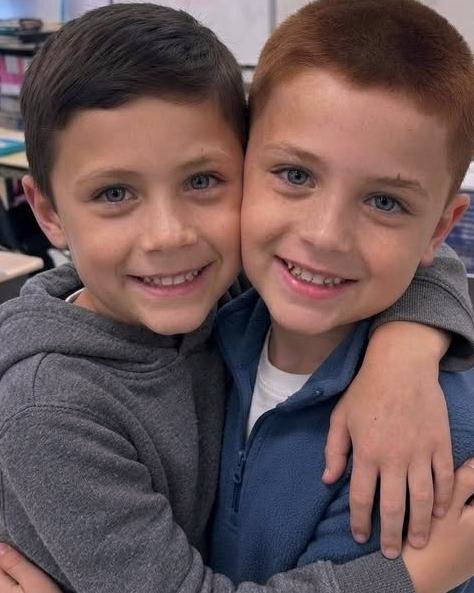
The boys leaned toward the glass, comparing their eyebrows.
“Mine is better,” Cole said.
“Yours is crooked,” Stefan answered.
“It is not.”
“It is exactly like Dad’s.”
They both stopped.
Then Cole removed his photograph from the frame and turned it facedown.
“Put mine somewhere else,” he said. “This one should be yours.”
Stefan looked at him.
“Why?”
“Because you were here too.”
I had spent eight years grieving a child who was alive, and one afternoon learning that the man I trusted had buried the truth without burying the boy.
The next day, I returned to the school office with June’s lighthouse pin fastened to my coat. Principal Alvarez handed me the old folder, now thick with signed statements and corrected records.
At the bottom of the last page, Stefan had written his own name in careful block letters.
Under it, he had added one sentence for the school file:
Cole Bennett is my brother, but he still owes me an apology.
Cole read it and groaned.
Stefan grinned.
I watched them argue over who had started the fight, while the brass compass sewn into my old hospital gown rested in my palm, its needle finally pointing toward both boys.






