PART 4
Elena’s message ended with an address in Palma and a time: eleven thirty.
We left immediately.
Nora sat in the back beside Carmen, clutching the brown envelope. Joaquín held the blue suitcase on his knees, as if the old thing contained something fragile enough to break under the weight of a single breath.
Mercedes rode in front with Álvaro. She had stopped arguing.
That frightened me more than her shouting had.
The notary’s office occupied the second floor of a narrow building above a shop that sold fishing equipment. At eleven twenty-eight, Elena opened the door before we knocked.
She was younger than I expected, with ink on her thumb and a silver chain around her neck.
“Come in,” she said. “We do not have much time.”
On her desk lay the original authorization, a ledger, and a small metal stamp.
Mercedes saw the papers and moved toward them.
Elena blocked her.
“Do not touch anything.”
“I am the client,” Mercedes said.
“No. You are the person who brought me a false authorization.”
The room seemed to shrink around us.
Álvaro looked at his mother. “You told them Claudia signed this.”
Mercedes looked at me instead. “I told them what they needed to hear.”
That admission landed harder than any confession could have.
Elena turned the document around. “The original has a second witness signature. It is not Nora’s.”
I leaned closer.
The name beneath the first witness line was Rafael Ortega.
Álvaro’s father.
For a moment, nobody moved.
“Dad?” Álvaro said.
Mercedes closed her eyes.
Rafael had been the silent man in the villa, the one who had watched Joaquín pick up Carmen’s suitcase without saying a word. He had left before dawn, claiming he needed medicine from the town.
Elena opened the ledger. “Mr. Ortega came here three weeks ago. He asked whether the authorization could be used to transfer the villa. I told him it could, if the signature was genuine. He said Mercedes had promised him half the proceeds.”
Álvaro’s face hardened. “Half?”
Rafael had not wanted to save Álvaro from debt. He had wanted to secure a private apartment and leave Mercedes with enough money to disappear before the lenders came for her. The loan was hers, not his. She had spent months feeding money into a failed property scheme, then borrowed against the future sale of my villa when the losses became impossible to hide.
The worst part was that Álvaro’s father had known the signature was false.
Nora covered her mouth.
Mercedes whispered, “Rafael was only trying to protect me.”
“He was trying to protect himself,” I said.
Elena picked up her phone. “I have already frozen the appointment. But I need Claudia to sign a statement confirming she never authorized the transfer.”
My hand shook as I signed. Not because I doubted the truth, but because I understood how close the lie had come to becoming an official fact.
When we returned to the villa, Rafael was waiting beside the pool. A brown leather bag rested at his feet.
Álvaro walked toward him alone.
“You signed it,” he said.
Rafael rubbed his thumb over the handle of the bag. “Your mother was drowning.”
“You put Claudia under the water with her.”
“I thought the sale would go through before she discovered anything.”
The words were so calm that I felt something inside me go numb.
Mercedes began to cry. “I was going to repay every cent.”
“With what?” I asked. “The money from a villa you did not own?”
She had no answer.
I gathered the documents on the patio table. The bank statements showed that money had moved from the shared account into the consultancy, then into three payments to the lender. The company account had been used as a bridge. Nora had signed one authorization. Rafael had signed as a witness. Mercedes had arranged all of it.
But there was another name in the ledger.
Daniel Ortega.
Álvaro’s younger brother.
Mercedes had not been paying only her own debts. She had been covering Daniel’s gambling losses for nearly a year, terrified that public shame would destroy the family. Daniel had told her he could recover everything with one final investment. She had believed him until the numbers became larger than any lie she could tell.
Álvaro sat down heavily.
“Daniel knew?”
Mercedes nodded through her tears. “He knew about the money. He did not know about the villa.”
“Because you decided that part alone,” I said.
She looked at me. “I thought you would help if you understood.”
“You never asked.”
“I was ashamed.”
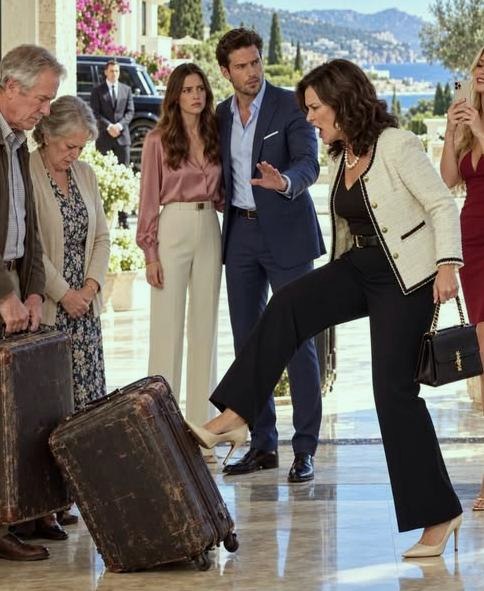
The word should have softened me. It did not erase the forged signature, but it changed the shape of the anger. Mercedes had not kicked Carmen’s suitcase because she hated an old piece of luggage. She had kicked it because its worn fabric represented everything she believed she had been denied: respect, comfort, and the right to belong without begging.
That did not make her innocent.
It made her human enough to be responsible.
I called the bank and cancelled every shared authorization. I removed Mercedes from the household account, secured the company funds, and instructed the bank to recover the transfers directly from the property lender. The lender agreed to release the claim once the money was returned. Nora’s signature would remain on record, but Elena promised to provide a written account of the pressure Mercedes had used.
I also made a choice that surprised everyone, including myself.
“I will not send this to the authorities,” I said. “Not if every euro is returned and the truth is signed by all four of you.”
Mercedes stared at me.
“Why?” Álvaro asked.
“Because I want a clean record of what happened, not another family performance where everyone pretends punishment solved it.”
I turned to Mercedes. “You will sell the apartment you bought with the first loan. You will repay the company before spending anything on yourself. You will sign a statement that says you forged my authorization and tried to transfer my villa.”
Her lips trembled. “And if I refuse?”
“Then Elena sends the original document where it belongs.”
Rafael lowered his head.
Álvaro looked at me for a long time. “What about us?”
That was the question I had been avoiding since the villa office in Marbella.
I looked at the man who had finally confronted his mother, suspended the card, searched the accounts, and carried my parents’ shame beside me through an airport. He had failed me for years before choosing me in one terrible afternoon.
“I am not ending our marriage today,” I said. “But I am ending the life where your family gets access to my work because you are afraid to disappoint them.”
He nodded.
“I will sign whatever you need.”
“No,” I said. “You will do more than sign. You will tell your brother the money is gone.”
Álvaro called Daniel while we stood around the patio table. Daniel answered laughing, then stopped when he heard the figures. The conversation lasted less than three minutes. When it ended, Álvaro placed the phone face down.
“He says he will repay it.”
“Then let him begin,” I said.
Carmen had been silent through the entire afternoon. She walked to the blue suitcase and ran her palm over the worn fabric. Then she opened it, removed the red scarf caught in the broken clasp, and took out the original papers from the loan my parents had given me years ago.
She placed them before Mercedes.
“These are not chains,” my mother said. “They are proof that help can be given without ownership.”
Mercedes looked at the pages for a long time.
Then she signed the first line of her confession.
Rafael signed after her. Nora signed with tears on her face. Álvaro signed last, not as a witness, but as the person who would oversee every repayment.
By evening, the blue suitcase had been repaired with a new brass clasp from a small shop near the harbor. Carmen insisted on keeping the old one in her pocket.
“Why save that?” I asked.
She smiled faintly. “Because it held the sound of someone kicking it away.”
I understood.
Some sounds disappear when the room changes. Others become evidence.
At dinner, Joaquín placed the repaired suitcase beside his chair. The sea wind lifted the corner of the signed confession on the table, and Mercedes reached out to hold it down.
This time, nobody told her the paper belonged to anyone else.
My mother looked at the suitcase, then at the signatures, and said quietly, “It opens only when the right person turns the clasp.”
Missed the beginning?






