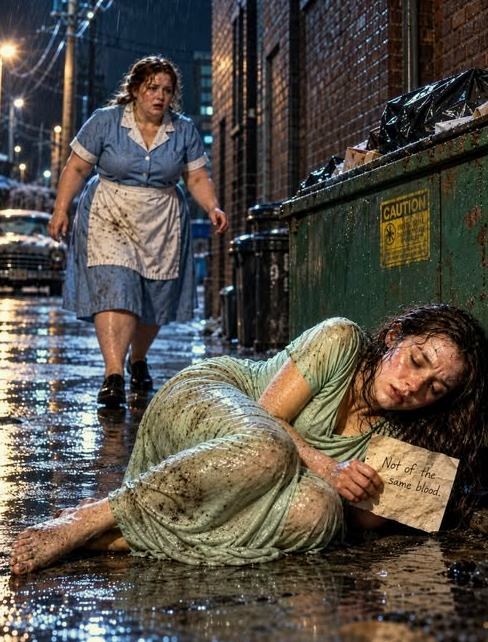
PART 4
I dropped the receiver.
For half a second, nobody moved.
Then I ran.
“Where are you going?” Luca called.
“To my daughter.”
He caught my arm before I reached the elevators. His fingers were hard around my coat, but not cruel.
“Whoever called knows your name, your child, and this hospital. If you leave alone, they will follow you.”
“They already have her.”
“I know.”
“Then let go.”
His grip loosened.
I saw something unexpected in his face—not authority, not anger. Fear. Raw and familiar. The kind that had lived in my chest every time Posy had a fever, every time rent was late, every time I imagined a stranger deciding my child was easy to take.
“Tell me where you live,” Luca said.
“No.”
“Tell me where you left her.”
“With my neighbor, Mrs. Patel. Fourth floor, Grayson Street.”
Luca turned to one of his men.
“Call Mrs. Patel. Do not frighten her. Ask for the red lunch tin on her kitchen shelf. If she answers with the number inside the lid, Posy is safe.”
I stared at him.
“Why the tin?”
“Because if the house is watched, she will not say my name.”
His man made the call. We waited beneath the harsh emergency lights while Elena fought for breath behind the glass and Mrs. Alvarez held the envelope against her ribs.
The phone rang twice.
Then the man listened.
“Twenty-seven,” he said.
My knees weakened.
“Posy is safe?”
“For the moment.”
A new voice came through the phone. Mrs. Patel’s, sharp and frightened.
“Tell Hollis they took the kettle off the stove. They were here less than ten minutes ago.”
The air left my lungs.
Luca’s expression changed.
“Get her to the church on Halsted,” he ordered. “Use the back entrance. No one follows you.”
The call ended.
I turned on him.
“You said they had her.”
“I said she was safe for the moment.”
“You used my daughter to control me.”
“No. They did.”
“Your family did this.”
“My family stole Elena. My father built an empire around the lie. But the man who took your daughter is not my father.”
“Who is he?”
Luca looked toward the guard pressed against the wall by security.
The scarred man, Rafe Danton, had been the person answering every phone, giving every order, and standing closest to Elena’s stretcher. He had followed Luca for seventeen years. He had also been the only one who knew exactly where I worked, when I finished, and which bus I took home.
Luca walked to him.
“Where is Posy?”
Rafe smiled despite the security officer’s hand on his shoulder.
“Ask the woman you rescued.”
“I am asking you.”
“You have no idea what she is.”
Rafe nodded toward the room. “She is the daughter of Gabriel Sarto. Your father’s enemy. Her real name is Mara Sarto, and she is worth more alive than your entire organization.”
Inside the room, the young woman opened her eyes again.
“Mara,” she whispered.
Luca heard her.
He went still.
Mrs. Alvarez opened the envelope at last. Inside was a brittle photocopy of the Saint Agnes ledger and a second page covered in a woman’s handwriting.
Luca read it aloud, his voice breaking on the final line.
“I gave them my daughter because Gabriel promised to end the war. He never did. If Mara survives, tell Luca the truth: she was not stolen to punish him. She was hidden to save him.”
I looked at him.
“What does that mean?”
Mrs. Alvarez answered.
“Your father ordered Gabriel’s murder. Mara’s mother knew Luca would be killed too once he learned what had happened. She left the girl in the Moretti nursery because it was the one place no enemy would search.”
Luca folded the page carefully.
For eleven years, he had believed his father had failed to protect Elena. The truth was worse. His father had used a living child as a shield, while Luca inherited the machine built around her disappearance.
Mara tried to sit up.
“Luca,” she said.
He went to her bedside.
She flinched when he reached for her hand.
“I am not your sister,” she whispered.
“No,” he said. “But you were the only person in that house who never lied to me.”
Her eyes filled.
“I wrote the note because Rafe found the ledger. He wanted me dead before I could tell you.”
“Where is my daughter?” I asked.
Mara looked at me.
“Rafe has a man at the freight station. He thinks I still have the original ledger.”
I understood before Luca did.
The note had not been a confession. It had been bait.
Rafe had expected Mara to wake, accuse the Morettis, and lead everyone toward the old station. But the real ledger was in Mrs. Alvarez’s hat, and the page had exposed a second truth: Rafe had been protecting the lie because he was not merely a captain.
Luca searched him. From the inside seam of Rafe’s sleeve, he pulled a small brass key stamped with the number 14.
Mrs. Alvarez gasped.
“Saint Agnes basement,” she said. “Locker fourteen. That is where I hid the original birth book.”
Rafe’s smile disappeared.
Luca understood.
The ledger was not the only thing in that locker. The old hospital records also contained every name connected to the false adoption, every payment, every signature. Rafe had spent years threatening people to keep the book buried. If it surfaced, the Moretti empire would not simply lose its reputation. Its own captains would learn that Rafe had forged orders in Luca’s father’s name and diverted money into his private network.
He had kidnapped Posy to force Mara out of hiding and the ledger into his hands.
He had chosen me because he thought a tired single mother could be frightened into obedience.
He had miscalculated.
Luca took my coat from the chair.
“Stay here with Mara.”
“No.”
“Hollis—”
“My daughter is at that station because of me. I am coming.”
He looked at my raw hands, my torn sleeve, and the plastic container of cold pasta still hidden in my bag.
“You should be terrified.”
“I am.”
“Then why are you standing?”
“Because Posy is waiting.”
We left through the service corridor with Mrs. Alvarez and two hospital guards. Mara insisted on coming despite the doctor’s objections. Her legs shook, but she refused the wheelchair.
At 3:11 in the morning, the old freight station crouched beneath the elevated tracks, its windows black and its loading doors chained open. A single lamp swung over the platform.
Posy sat on a wooden crate beneath it, wrapped in Mrs. Patel’s red shawl.
A man stood behind her with one hand on her shoulder.
I stopped breathing.
“Mommy!”
“Posy!”
The man lifted a pistol.
Luca stepped in front of me.
“Put it down,” he said.
“You brought the girl.”
“Mara is not a bargaining chip.”
Rafe emerged from the shadows, wrists free. He had bribed someone during the hospital confusion, or perhaps he had planned the escape long before. He held the brass key between two fingers.
“Give me the ledger,” he said.
Mrs. Alvarez stepped forward.
“You already know what is inside.”
“I know enough to burn it.”
“You cannot burn every copy.”
Rafe’s eyes flicked toward her.
She smiled sadly.
“I mailed photocopies to every name in that book before I came here.”
Rafe’s face twisted.
Luca looked at him.
“Even if you kill us, the truth leaves this station.”
“That is your plan?” Rafe sneered. “Let your father’s crimes become public? Let every family you threatened tear you apart?”
Luca’s gaze did not leave him.
“Yes.”
I turned toward him.
He was holding the original ledger, which I had not seen him take from Mrs. Alvarez. He placed it on the concrete between us.
Rafe stared at the book.
“You would destroy the Moretti name for her?”
“For Mara,” Luca said. “For the people my father buried beneath it. And for the child you touched.”
The man behind Posy shifted his grip.
That was enough.
Mara grabbed the swinging lamp and slammed it into the man’s wrist. The bulb exploded. Posy dropped low and crawled beneath the crate. I ran through the darkness, seized her, and pulled her against my chest.
A gunshot cracked under the tracks.
Luca tackled Rafe into a stack of wooden pallets. The second shot struck the ledger instead of Luca’s heart, tearing through its leather cover.
Mrs. Alvarez screamed.
Mara found the fallen brass key and drove it into the gunman’s hand. He released the weapon. One of the hospital guards kicked it across the platform.
Then the trains began to thunder overhead.
The whole station shook.
Rafe dragged Luca against a pillar and pressed a broken piece of metal to his throat.
“Tell them to back away,” he snarled.
Luca’s blood ran down his collar.
I held Posy behind me.
Mara stood in the middle of the platform, pale and swaying.
“Rafe,” she said.
He looked at her.
“You wanted the ledger because it proves I am not a Moretti.”
“Yes.”
“You are wrong.”
His grip tightened on Luca.
Mara pointed to the torn book.
“It proves I am not what my father made me. It proves your whole power depends on people believing blood is stronger than choice.”
Rafe laughed.
“You think words will save you?”
“No,” Mara said. “Luca will.”
Luca drove his head backward into Rafe’s face.
Rafe staggered. Luca twisted free, caught his arm, and sent him crashing onto the rails just as the departing train shrieked past the platform edge. The wind pulled Rafe’s coat toward the darkness, but Luca caught his wrist.
For one breath, Rafe hung between the tracks and the concrete.
“Let me fall,” he gasped.
Luca hauled him up.
The freight station filled with sirens as the people Mrs. Alvarez had contacted arrived from every direction—journalists, former hospital employees, families named in the ledger. Not an army. Witnesses.
Rafe saw them and understood what he had lost.
Not his life.
His silence.
He released the metal shard.
At dawn, doctors treated Mara’s infection and Posy’s bruised shoulder. Luca surrendered the ledger, his accounts, and the records of his father’s organization to the families listed inside. He did not ask me to forgive him. He did not ask Mara to call him brother.
He only stood outside the treatment room with his bloodstained shirt and waited for her decision.
Mara came out after sunrise.
She held the torn ledger against her chest.
“Luca,” she said, “I don’t know what to call you.”
He nodded.
“Then call me when you do.”
She studied him for a long moment.
“Bring the hospital book.”
“I will.”
“And no more men following me.”
“They are gone.”
“Good.”
She reached for his hand.
He took it carefully, as if it were something newly returned to the world.
Posy slept against my shoulder while I watched them walk together toward the records office, carrying two names, one ruined empire, and a truth that had survived eleven years of blood.
Before we left, Mara stopped me.
She held out the small silver earring I had saved in the alley.
“Keep it,” she said.
“Why?”
“So you remember that you did not rescue a stranger.”
I looked at her.
She touched the place beneath her ear where the matching earring had been.
“You rescued the sister I was still trying to become.”
Missed the beginning?






