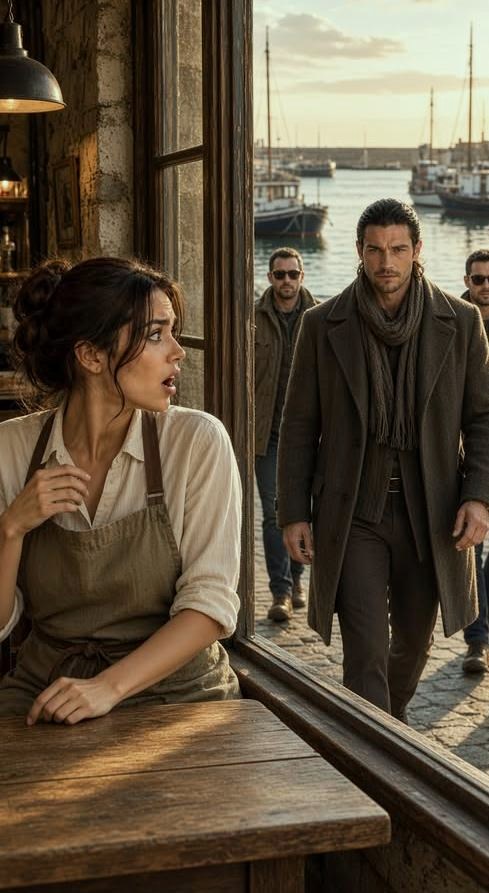
The first thing I saw when I pushed open the restaurant door was my own face printed beneath the words GOLD DIGGER, while Claudia sat at my usual table with a champagne flute raised in triumph.
It was 7:42 on Thursday evening in Madrid, and rainwater was still dripping from the hem of my coat onto the black-and-white tiles. The photograph had been enlarged and taped to the host stand. Someone had drawn a red circle around me.
Claudia Valcárcel looked up from table nine. She wore a cream suit, diamond earrings, and the calm expression of a woman who had rehearsed every second of my humiliation.
—So you’re the new one.
The room went quiet except for the hiss of the espresso machine.
I looked at Adrián’s empty chair, then at the champagne she had ordered. That was my table. Two nights earlier, he had sat there soaked by the rain, shaking over the lentil stew I gave him from my own dinner. The next morning, he had returned in a black car and told me he was Adrián Valcárcel, founder of one of the country’s fastest-growing technology companies.
He had asked about my life. I had admitted that I wanted to study nursing, though my salary barely covered my mother’s medication, my brother Diego’s exam fees, and our rent. Before leaving, Adrián had written a number on the back of a receipt.
“If you ever need help with your application,” he had said, “call me. Not because you fed me. Because you deserve the chance.”
I had not called him.
Claudia lifted the newspaper clipping beside her glass. It showed the photograph of Adrián and me drinking coffee. The caption claimed I had targeted him after discovering his wealth.
—You should be proud, Elena —she said—. It takes talent to look innocent while climbing into a man’s life.
Marta, my coworker, stepped from behind the bar with a trembling hand pressed against her apron.
—Claudia, that is not fair. Everyone knows what happened that night.
—Everyone knows what the photograph shows.
—The photograph shows breakfast.
—It shows a waitress making herself comfortable beside my fiancé.
The word fiancé struck harder than the accusation. I had never known Adrián was engaged until that moment.
My fingers closed around the little brass service bell on the counter. Its cold edge dug into my palm, keeping me from shaking.
—Where is Adrián? I asked.
Claudia smiled.
—He is learning what you are.
At 8:05, my manager, Mateo, came out of the kitchen carrying a folder. He would not meet my eyes.
—Elena, go home.
—Why?
—Because this has become bigger than the restaurant.
—It became bigger when someone printed my photograph and put it online.
Claudia tapped one manicured finger against the table.
—There is a meeting tomorrow morning. Bring your employment records, your scholarship application, and every message you exchanged with Adrián. If you have nothing to hide, you will have nothing to fear.
I stared at her. She knew about my scholarship. Only three people knew: my mother, Mateo, and the foundation office where I had submitted the forms.
Then Mateo placed another envelope on the counter.
—This arrived for you at noon. I was told not to hand it over until she came.
The paper was damp along one corner. My name had been written in black ink.
Claudia’s smile sharpened as I reached toward it…
PART 2
…My fingers had just touched the envelope when Claudia said, “Open it in front of everyone.”
The restaurant smelled of wet wool, coffee grounds, and the burnt orange peel Mateo used in the evening cocktails. I slid one finger beneath the seal. Inside was a single typed page, but the first line was enough to make my stomach tighten.
NOTICE OF REVIEW: ELENA MARTÍN SCHOLARSHIP APPLICATION.
—There —Claudia said. —The generous little waitress has been applying for money from Adrián’s foundation.
—That application was submitted six weeks ago, I answered.
—And Adrián met you two nights ago. Convenient timing.
—He did not approve anything for me.
—Not yet.
Marta snatched the page from my hand and scanned it.
—This says the application was selected for review before the photograph was taken.
Claudia reached across the table and took it back.
—Selected is not awarded. Do you understand the difference?
I did. I also understood what she wanted everyone to believe: that I had found Adrián, learned his name, and designed my entire future around his wallet.
My phone buzzed against the counter. The photograph had been shared thousands of times. Comments rolled across the screen faster than I could read them.
She saw his watch.
Poor man. She trapped him with a sob story.
I wanted to throw the phone into the sink, but my mother’s face appeared in my mind, pale beneath the fluorescent light of our kitchen. She had told me that morning, “Do not let rich people make you ashamed of being poor.”
At 8:31, Adrián finally called.
I answered in the storage room, where sacks of flour leaned against the wall like tired soldiers.
—Where are you? I asked.
—At the foundation office. Elena, I saw the post.
—Did you know Claudia was here?
A pause.
—She said she was going to speak with you.
—She called me a fortune hunter.
—That is not what I believe.
—But you believed her enough to let her come alone.
His breathing changed.
—Claudia has been telling people we are still together.
—Are you?
—No.
—Were you ever going to tell me you had a fiancée?
—She was my fiancée. The engagement ended before I met you.
The distinction felt too polished to comfort me.
—Then why is she sitting at my table with champagne?
—I don’t know.
—Find out before she destroys my name.
—Elena, please do not leave. I am coming.
When I returned to the dining room, Claudia was gone. So was the envelope. Mateo stood behind the register, twisting the brass bell until it squeaked.
—She took it, I said.
—She said it belonged to the foundation.
—Did you let her?
His face collapsed.
—She showed me a message from Adrián telling me to cooperate.
—Did you see the message?
—Only for a second.
The back door slammed in the alley. I ran outside, my shoes slipping on the wet pavement. A black car was pulling away, its tires scattering dirty rainwater over the curb.
A man in a green delivery jacket stood beneath the awning, holding a cardboard box against his chest. He watched the car disappear, then looked at me.
—You are Elena Martín, aren’t you?
—Who are you?
He set the box down. A narrow metal key rested on top of it.
—I deliver to this restaurant every Tuesday. I was here the night that woman came before opening.
My heart began to pound.
—What did you see?
He glanced toward the dark windows.
—She did not come for champagne. She came for the office cabinet.
Before I could ask what she had taken, he pulled a folded receipt from his pocket.
—And I know why she was looking for your file…
❤️ I could barely breathe while writing this part. The continuation is waiting in the first comment. 👇
PART 3
PART 3
The delivery driver unfolded the receipt beneath the awning. Rain tapped against the metal frame above us, quick and nervous.
His name was Samuel Ortega. He had been bringing produce to the restaurant for eleven years and remembered every person who entered through the service door.
—At 6:12 that morning, he said, Claudia came in alone. She told Mateo she needed Adrián’s business papers.
—Why would Mateo give them to her?
—Because she had a key.
He turned the receipt over. On the back, someone had written the number 17 and the words cabinet B.
My hands went cold.
—What was in cabinet B?
—Your scholarship file, according to Mateo. She asked for it by name.
At 8:52, Adrián arrived at the restaurant without security. His hair was wet, his tie loosened, and the careful distance in his face had disappeared.
—Where is Claudia? he asked.
—She took my application.
His jaw tightened.
Samuel stepped forward.
—I saw her open the cabinet. She had a key and a folder with your company seal.
Adrián looked at the receipt.
—This key belongs to the old foundation office. Claudia had no right to possess it.
Mateo came from the kitchen carrying a ledger. He placed it on the counter with both hands.
—There is more, he said. I should have told you before.
He opened to a page marked with a torn yellow label. Beneath the restaurant’s expenses was a payment to Valcárcel Foundation, dated six weeks earlier. Beside it was Elena Martín’s application number.
I stared at the ink.
—What is that?
Adrián took the ledger, then pulled a cream-colored document from inside his coat.
—Your scholarship decision.
—Decision?
—Your application was approved before I ever saw you at this restaurant.
The room seemed to tilt.
He placed the document beneath the hanging lamp. At the bottom was his signature, dated Tuesday at 4:18 p.m.—hours before the storm, hours before I gave him my dinner, hours before our lives touched.
—You signed it? I whispered.
—As trustee. The selection committee chose you because of your grades, your hospital volunteer work, and the nursing entrance examination you passed while working full time.
Marta covered her mouth.
Mateo lowered his head.
I looked at Adrián.
—Then why did Claudia tell everyone I came after your money?
The answer came from behind us.
—Because if they believed that, no one would ask what she had done.
Claudia stood in the doorway, pale beneath the restaurant’s gold light. She held the envelope against her chest.
Adrián moved toward her.
—Give it back.
—You signed the scholarship without telling me.
—It was not your decision.
—Nothing was my decision anymore! You ended the engagement, froze my access to the foundation accounts, and left me with nothing.
—You used the foundation to move money into your brother’s company.
Her eyes flashed.
—He was going to repay it.
—He forged invoices. You approved them.
Samuel whispered, “So that was why she wanted the cabinet.”
Claudia turned on him.
—You know nothing.
—He knows enough, I said.
She threw the envelope onto the table. A second paper slipped free, covered with signatures and bank references.
Adrián picked it up. His face changed as he read.
—This is not my approval, he said. —This transfers control of the scholarship fund to Claudia’s private company.
Claudia stepped backward.
—You were never supposed to see that page.
The sentence hung there, heavier than the rain.
Then Adrián’s phone rang. He answered, listened, and looked directly at me.
—Elena, the foundation’s account has been emptied. Every scholarship payment is scheduled to leave tomorrow morning…
PART 4
The call ended before I could ask how much money was gone.
Adrián stood beneath the restaurant’s brass pendant lamp, holding the transfer document between two fingers. The paper trembled—not from fear, I realized, but from the force with which he was trying not to tear it apart.
—How much? I asked.
—Enough to cancel every award this year.
My award included.
The thought landed quietly and hurt more than the photograph had. The photograph had been cruel. This was different. This threatened the one thing I had earned before Adrián ever learned my name.
Claudia pressed both palms against the table.
—You cannot blame me for protecting myself.
—You forged a transfer from a charitable foundation, Adrián said.
—You were going to leave me with nothing.
—You had a home, shares in the company, and access to accounts you had no legal right to touch.
—You promised me a future.
—Not ownership of other people’s futures.
The words struck her harder than a shout. Her champagne glass rolled beneath her hand and fell against the table edge. It did not break. It spun in a bright circle, leaving a wet ring on the white cloth.
I looked at the document again.
—Why was my file in that cabinet?
Adrián turned to me.
—Because Claudia discovered the committee had chosen you. She thought I had personally selected you after meeting you.
—But you signed it before the rain.
—Yes.
—Then you knew nothing about me.
—I knew what was in your application. That you worked evenings. That you volunteered twice a week at the San Gabriel clinic. That you had passed the entrance examination and could not afford to enroll. The committee read all of it. I only signed the final approval.
I remembered the damp receipt in my pocket, the one with his number on the back. I had kept it because throwing it away felt ungrateful. Now it looked like proof of a boundary I had been afraid to defend.
—Did you ever tell Claudia about me?
—No. She saw the photograph after someone at the restaurant posted it.
Marta stepped forward, her voice steadier now.
—Claudia brought the printed copies herself. She asked me to say Elena had been following Adrián for weeks.
Mateo flinched.
—She offered to pay my debts if I confirmed it.
I turned toward him.
—You agreed.
—For one hour. Then I saw your mother crying in the kitchen when she came to bring your medication. I could not do it.
—But you still let her take the envelope.
—I was afraid she would expose the restaurant’s accounts.
—What accounts?
His face drained of color.
—The owner has been hiding cash sales. Claudia found out. She said she could make the tax problem disappear if I helped her.
That was the unexpected center of the trap. Claudia had not merely wanted Adrián back. She had been collecting weaknesses: Mateo’s hidden accounts, the foundation’s transfer, my scholarship, the photograph. She believed enough shame would make everyone obey her.
Adrián read the room and understood it at the same moment I did.
—She needed the restaurant because it is the only place where all of us crossed paths, he said.
Claudia laughed once, without humor.
—Do you think I planned all this because of a waitress?
I felt the word strike me, but I did not lower my eyes.
—You planned it because you needed someone poorer than you to carry the blame.
Her expression cracked.
—You have no idea what it is like to lose everything overnight.
—You took my name before you lost anything.
For several seconds, only the rain answered.
Then Samuel placed his receipt on the table.
—I wrote down the time because the delivery office requires it. I also saw Claudia photograph the transfer document before she put it in the envelope.
Claudia spun toward him.
—You are lying.
—No, he said. —I am tired of pretending not to see.
That sentence changed the room. Not because it was dramatic, but because it came from the quietest person there.
At 9:14, Adrián called the foundation’s accountant on speakerphone. She confirmed that the transfer had been blocked when the bank flagged the signature as inconsistent with the foundation’s records. The money was still there, frozen until the trustees verified the documents.
Claudia’s shoulders dropped.
—You cannot destroy my life over a mistake.
—A mistake is entering the wrong account number, Adrián said. —You built a false story, stole a key, and tried to move scholarship money.
—The story was already believable.
I felt something inside me settle—not peace, not yet, but certainty.
—Only because you counted on everyone believing that wanting an education made me greedy.
Claudia looked at me for a long moment.
—He will never marry you.
Adrián’s face tightened.
—This is not about marriage.
—It is always about what women get from men like you.
—No, I said. —That is what it was about for you.
She reached for the champagne bottle. Her fingers missed the neck, and the bottle struck the table with a dull thud.
No one moved to help her.
The next morning, the photograph was still online, but the foundation released the timeline: my application, the committee’s decision, Adrián’s signature, and the attempted transfer. Marta posted the restaurant’s security log. Samuel gave his written statement. Mateo repaid the money he had taken from the register before asking to resign.
He did not ask me to forgive him.
That mattered.
The restaurant owner shut the dining room for an audit. Claudia lost her position at the foundation and every financial benefit tied to the engagement. Adrián did not call the police. Instead, the foundation trustees took the matter to the bank and to the people responsible for reviewing financial fraud. He told Claudia one final thing in front of them all.
—You wanted to keep the life my name gave you. What you are losing is the right to use it.
She left carrying nothing but her cream jacket and the champagne-stained folder.
I thought that would be the ending.
It was not.
Three days later, I met Adrián at the San Gabriel clinic, not at the restaurant and not in his office. I wore my old green scarf, the one with the loose thread near the fringe, and carried the enrollment papers in a plastic sleeve.
He stood beside the clinic’s donation cabinet, looking less like a billionaire than the soaked stranger I had found beneath the awning.
—The scholarship is yours, he said.
—I know.
—You can accept it without owing me dinner, friendship, or anything else.
—I know that too.
—Then why did you ask me to meet here?
I handed him a form.
—Because the clinic needs a night assistant. The pay would cover my transport while I study. I wanted to know whether your foundation could fund the position without putting my name on another photograph.
He read the form carefully.
—You are asking me to support a program, not rescue you.
—Exactly.
A tired smile touched his mouth.
—Then I will take it to the trustees.
—And Adrián?
—Yes?
—If you want to know me, do it without buying the table, the building, or the story around me.
He nodded.
—I can try.
It was not a promise large enough for newspapers. That was why I believed it.
Before leaving, he handed me the original approval document. The ink date was still visible: 4:18 p.m., before the clouds opened, before I found him, before Claudia placed my face beside her champagne.
I folded it into my nursing enrollment file.
Months later, on my first night assisting at San Gabriel, an elderly patient woke frightened before surgery. I sat beside her bed and explained every step until her breathing slowed. Through the corridor window, the restaurant’s sign glowed across the street, its letters reflected in the wet pavement.
Marta had reopened the place under a new manager. Samuel still delivered vegetables every Tuesday. Mateo had found work at a smaller café and paid back every cent in envelopes, one week at a time.
Claudia never sent an apology. She sent documents instead: restitution agreements, account statements, and a signed letter giving up her claim to the foundation funds. It was the only honest language she seemed able to speak.
I did not answer her.
I did keep the scholarship.
Not because Adrián had chosen me, but because a committee had seen the work I had done when no one was watching.
At 2:17 in the morning, the patient squeezed my hand.
—Are you a nurse?
I looked at the enrollment badge pinned to my green scarf.
—Not yet.
She smiled sleepily.
—You sound like one.
Outside, a delivery truck stopped beneath the clinic awning. Samuel climbed down with a crate of oranges and lifted two fingers when he saw me through the glass.
I lifted the approval paper from my pocket, its ink softened at the fold but still legible.
4:18 p.m.
Before the rain.
Before the photograph.
Before anyone could call my hunger ambition and mistake my future for something they owned.
Then the patient’s monitor began to beep faster, and I stood up with my hand already reaching for the call button.
“Stay with me,” I told her. “I’m right here.”
The document dated before the storm changed everything…
I thought the photograph was the worst part. I was wrong. The final pages reveal why my future had been targeted before Adrián ever met me.
“Stay with me,” I told her. “I’m right here.”
And then the monitor began to beep faster.
👇 The final part of the story is already open.






