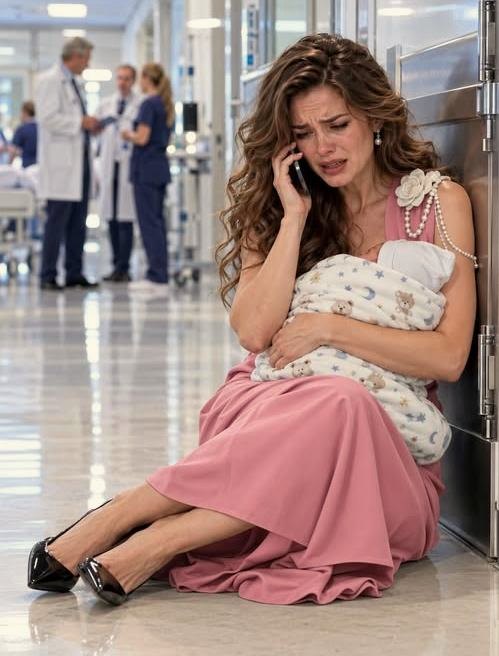
The hospital administrator was still holding the death certificate when my husband asked me to sign away my daughter’s eyes.
“Her medicine is already handled,” Andrei said over the phone. “Just sign the cornea consent too. Christina needs them urgently.”
For several seconds, I could hear only the fluorescent lights buzzing above the morgue corridor.
Then I looked down at the paper in my hand.
Darina Kovalenko. Three years, four months.
Cause of death: complications related to congenital heart disease after an interruption in essential medication.
“She died at 3:17 this morning,” I said.
There was a pause. Not grief. Calculation.
“What do you mean, died?” Andrei asked. “I told you the payment had been arranged.”
Behind his voice came music, clinking glasses, and a woman laughing.
I pressed Darina’s small pink pillow against my chest. It still smelled faintly of the strawberry shampoo the nurses had used when they washed her hair.
“The medicine never arrived,” I whispered. “I called you forty-seven times.”
“I’ll find out what happened.”
For six years, Andrei had been finding out what happened. He would find out about the accounts, the insurance, the specialists, the pharmacy, the invoices Christina rejected. He would find out after the crisis had passed, after I had begged enough, after he had made me feel unreasonable for asking.
Now there was nothing left to wait for.
“Don’t find out,” I said. “It’s too late.”
I ended the call before he could answer.
At nine twenty in the morning, the morgue clerk led me into a small examination room. Darina lay beneath a white sheet, her curls spread against the pillow. Her fingers were folded over a paper butterfly she had colored in the children’s ward.
“Mrs. Kovalenko,” the clerk said gently, “your husband has already sent a preliminary authorization through the hospital portal. We still need your signature.”
“My husband authorized this?”
“He listed the donation as a family decision.”
A cold pressure formed behind my ribs.
“He does not get to decide what happens to her body while I am standing here.”
The clerk lowered her eyes. “No one is forcing you. But there is a recipient waiting.”
“Christina?”
The woman’s silence answered me.
Christina Vale had managed Andrei’s finances for nearly four years. She had also appeared in photographs beside him at business dinners, charity galas, and hotel openings while I stayed beside a hospital bed with Darina’s medication schedule written on my wrist.
I signed nothing.
Instead, I took the old phone from the bottom of my bag. I had switched it off five years earlier, after walking out of my father’s house with one suitcase and a husband who promised he would protect me from everyone who doubted him.
The screen woke beneath a flood of unread messages.
I ignored them and searched for one name.
Dad.
My father had warned me before my wedding.
“That man doesn’t love you,” Nikolai Stoyan had said. “He loves the doors our name opens.”
I had shouted that I was an adult, that I needed neither his money nor his name, and that Andrei was my family now.
Five years later, I stood beside my dead child and called the man I had punished for being right.
He answered after one ring.
“Elena?”
I tried to speak. My throat closed around the word.
“What happened?” he asked.
“Dad…” I looked at the pink pillow. “Come get me.”
His breath caught.
“And Darina?”
“She’s gone.”
I expected anger. I expected him to remind me of every sentence I had thrown at him.
Instead, he said, “What do you need?”
“I need to leave this place.”
“I’m coming.”
Then his voice changed.
“What did Andrei do?”
I told him about the missing medicine, the unpaid nine-thousand-dollar invoice, Christina, and the corneas. I told him about the forty-seven unanswered calls.
He listened without interrupting.
When I finished, he asked, “What do you want me to do?”
I looked toward the morgue door.
“Close every door he opened with our family name.”
“Done,” he said.
Twenty minutes later, a message arrived from Pavel, the family archivist who had handled my father’s legal papers for decades.
“Your father has activated the Kovalenko file.”
I read it twice.
I had never heard of such a file.
The corridor elevator opened. My father stepped out wearing a dark wool coat, his silver hair damp from the rain. He looked older than he had five years ago, but his eyes were exactly the same.
He stopped in front of me.
Neither of us moved.
Then he removed his coat, held out his hand, and said, “Give me the certificate.”
I placed it in his palm.
He read the cause of death. His face tightened.
“Did the payment truly have to come through Andrei?”
“Yes.”
“And did he tell you it had been made?”
I nodded.
My father folded the certificate with extraordinary care and handed it back.
“Then we leave first,” he said. “After that, you decide what happens next.”
His phone began ringing before we reached the elevator.
He glanced at the screen, then at me.
“Are you ready to hear him?”
My own phone lit up.
Andrei was calling again.
I pressed accept, raised it to my ear, and heard his voice crack for the first time.
“Elena, what have you done?”
Behind me, my father reached into his briefcase and touched the corner of a black folder…
PART 2
My father’s fingers rested on the black folder, but he did not open it.
He watched me instead.
I stood beneath the hospital’s humming elevator light, still holding Darina’s death certificate. The paper had softened at the fold where my thumb kept pressing it.
“What have I done?” I asked Andrei.
“Why are people calling me?” he demanded. “The bank’s compliance office, the trustees, two lenders I’ve known for years. They’re saying my guarantees are being reviewed.”
“They are reviewing them.”
“Did your father do this?”
My father’s jaw tightened, but he remained silent.
Andrei lowered his voice. “Elena, you’re upset. You don’t understand how serious this is.”
“Our daughter is dead.”
“I know that.”
“You were at a party.”
“It was a business dinner.”
“I heard champagne.”
“People were celebrating a closing. I stepped away when you called.”
“You answered and asked about her corneas.”
His breathing changed.
“Because Christina’s condition is critical.”
“Christina’s condition is not my daughter’s responsibility.”
“No one said it was.”
“You did.”
The elevator doors opened. My father touched my elbow, not to pull me away, only to remind me that I could choose.
“Where are you?” Andrei asked.
“Leaving the hospital.”
“Do not make any decisions until I get there.”
“For six years, I made every decision while waiting for you to act.”
“You’re being cruel.”
I almost laughed. The sound came out broken.
“Cruel was watching her ask whether tomorrow would hurt and knowing the medicine was sitting in a warehouse because you had not paid for it.”
“I told you the payment was arranged.”
“Then show me the receipt.”
Silence.
A long one.
My father looked at me, and something settled in his expression.
Andrei finally said, “I’ll send it.”
“Send it now.”
“I’m not going to argue in a hospital corridor.”
“You are not arguing. You are avoiding.”
He hung up.
At ten fifteen, we sat in the rear of my father’s car. Rain crawled down the windows in crooked silver lines. The leather smelled of cedar and cold air, a scent I remembered from childhood drives to the coast.
My father placed the black folder on his knees.
“I opened this file four years ago,” he said.
“Why?”
“Because Pavel found irregular transfers from a medical trust I created for you after Darina was born.”
I turned toward him.
“What medical trust?”
“The one Andrei told you was a standard investment account.”
My stomach tightened.
“There was an account?”
“There were three. One for your care, one for Darina, and one reserved for emergencies. They were funded through companies that used our family guarantees.”
“Why didn’t you tell me?”
“Because the accounts were locked behind a condition. You had to request them yourself. Andrei convinced you that using them would prove you had married me for money.”
I remembered his words with painful clarity: Your father wants to keep you dependent. Every dollar from him is another chain.
The car stopped at a red light.
“I believed him,” I said.
“I know.”
“Then why wait?”
“Because I wanted proof that could survive your anger at me.”
He opened the folder halfway. I saw bank statements, delivery records, copies of signatures, and a small brass key taped to an index card.
“What is the key?”
“Your daughter’s trust was moved into a private escrow account last winter. The key opens the records vault where the transfer instructions are stored.”
My phone vibrated.
A message from Andrei appeared: Payment receipt attached.
I opened it.
The document showed that nine thousand dollars had been wired to the distributor three days earlier.
For one impossible second, relief rose in me.
Then I noticed the date.
The wire had been sent at 6:42 a.m., nearly three hours after Darina died.
My hands went numb.
“Dad,” I whispered.
He took the phone, studied the receipt, and called Pavel.
“Check the distributor’s account,” he said. “Not the document. The settlement.”
Pavel answered through the speaker.
“I’m checking now.”
Andrei called again.
I answered.
“You received the receipt?” he asked.
“Yes.”
“Good. That proves I handled it.”
“It proves you sent money after she died.”
“I was waiting for confirmation from the bank.”
“You said it had already been paid.”
“I was trying to protect you from panic.”
My father closed his eyes.
Pavel’s voice came through the speaker, suddenly hard.
“The distributor rejected the payment. The account number was invalid.”
I stared at the rain-streaked window.
“Who gave them the account number?” I asked.
Pavel hesitated.
“An authorization form came from Kovalenko Holdings.”
“Whose signature?” my father asked.
“Christina Vale’s approval stamp. But there’s more. The original invoice was marked canceled two days before Darina’s admission.”
Andrei spoke rapidly. “That is an administrative error.”
“Then explain why the corrected invoice was sent to a private address,” Pavel said.
No one spoke.
I looked at my father.
He finally opened the folder and turned one page toward me.
At the bottom was an address I knew.
Christina’s apartment.
Above it, in Andrei’s handwriting, were four words: recipient consent—urgent.
My phone slipped from my fingers.
At that exact moment, Christina called.
I answered before I could stop myself.
Her voice was weak and frightened.
“Elena, please,” she whispered. “You have to listen. Andrei told me the child had already been declared beyond saving. He said the donation was the only way to keep me from losing my sight. But he never told me the medicine had been withheld.”
My father leaned forward.
“What else did he tell you?” I asked.
Christina began to cry.
“He said your signature was already secured. He said you would never fight him because you had nowhere else to go.”
The car seemed to shrink around me.
“Where are you?”
“At the private clinic. He brought me here this morning.”
“Is Andrei there?”
“He just walked out. He told the surgeon the consent would arrive before noon.”
My father took the phone from my hand.
“Christina,” he said, “look at the papers in front of you. Is there a transfer agreement from Kovalenko Holdings?”
Paper rustled.
“Yes.”
“Read the final paragraph.”
Her breathing stopped.
Then she said, “It says the transplant is funded through the Darina Kovalenko Memorial Trust.”
My blood turned cold.
Darina’s name had been placed on an agreement for a surgery that had not even begun.
Christina whispered, “Elena, there is a second page. It says if the donor’s family refuses, the trust owes the clinic the full amount.”
My father looked at the black folder.
“Andrei did not just steal the medicine money,” he said. “He wagered your daughter’s trust on the transplant.”
Before I could answer, Pavel shouted through the speaker.
“Mr. Stoyan, I found the vault entry. Someone accessed the emergency account last night.”
“Who?”
Pavel’s voice dropped.
“The access was made with Elena’s old security phrase.”
My mouth went dry.
I had not used that phrase in five years.
Andrei knew it.
But so did one other person.
My father turned toward me.
“Your mother’s former secretary,” he said. “Mara.”
The phone chimed again.
A message arrived from Mara’s number.
“Come to the family office alone. I know who ordered the transfer, and I have the original document…”
PART 3
“Do not go alone,” my father said.
The car was parked beneath the stone awning outside his office. Rain tapped the roof like impatient fingers. On the seat between us, the black folder lay open beside Darina’s death certificate.
“I’m going,” I said.
“Then I’m coming with you.”
“Mara asked for me.”
“She asked for you because she is afraid.”
“So am I.”
My father studied my face. “Fear is not a reason to walk into a trap without witnesses.”
At eleven forty, we entered the family office through a side entrance. The reception room smelled of dust, polished wood, and the bitter coffee someone had abandoned near the copier.
Mara stood beside the long conference table. She was sixty-eight, narrow-shouldered, and wore the same bronze brooch I remembered from my childhood. Her hands shook around a leather document case.
“I’m sorry,” she said.
“Were you the one who accessed the emergency account?” I asked.
“Yes.”
My father’s voice hardened. “Why?”
“Because Andrei forced me to.”
She opened the case and removed an original transfer order.
The paper carried my name, my old security phrase, and a digital signature that looked almost like mine.
Almost.
“The emergency account was opened at 11:18 last night,” Mara said. “Andrei sent me the authorization through Christina’s office. He told me Elena had approved the transfer and that the child’s condition was irreversible.”
“I never approved anything.”
“I know that now.”
“How did he force you?” my father asked.
Mara swallowed. “He found a mistake I made in the old estate records. He said he would accuse me of embezzlement unless I cooperated.”
My father reached for the document.
She pulled it back.
“There is more.”
She turned the page over.
On the back, in blue-black ink, was Andrei’s handwritten instruction: Release funds only after cornea consent is confirmed. If Elena resists, use the marital authorization clause.
The room tilted.
I gripped the edge of the table. Its carved wood cut into my palm, sharp enough to keep me standing.
“He planned it,” I said.
Mara’s eyes filled. “He planned the money. I don’t know whether he planned for Darina to die.”
That distinction hurt almost as much as the truth.
My father looked at the signature.
“And the medicine payment?”
Mara removed a second paper. “Andrei ordered Christina to cancel the distributor’s first invoice. He moved the money into a bridge account that secured the clinic’s transplant contract. He said the payment would be restored after the donation.”
My breath left me.
The room door opened.
Andrei walked in.
He had changed out of his dinner jacket, but a wine stain remained on his cuff. His face was pale, and his eyes moved from Mara to the documents, then to my father.
“You should not be here,” he said.
“This is my office,” my father replied.
“You’re interfering in a medical emergency.”
“No,” I said. “You are.”
Andrei turned toward me.
“Elena, listen to me. Christina will lose her sight without that transplant.”
“And Darina lost her life without her medicine.”
“I was trying to save someone.”
“You canceled the payment.”
“I moved it temporarily.”
“You sent the replacement after she died.”
“I thought there was still time.”
Mara flinched.
I stared at him. “You thought there was still time because you knew the delivery had been stopped.”
His mouth tightened.
“Don’t reduce this to a payment error.”
“Then tell me what it was.”
He looked at the papers on the table.
The silence became a confession before he spoke.
“The clinic would not hold Christina’s place without proof of funding,” he said. “The trust was the only money available quickly enough.”
“You used Darina’s trust.”
“I was going to replace every dollar.”
“With what?”
He said nothing.
My father stepped closer. “With the nine-million-dollar development loan you secured through our guarantees?”
Andrei’s face changed.
“You had no right to examine that.”
“I had every right. The guarantee was revoked this morning.”
“You destroyed my company.”
“No,” my father said. “You built a company that could survive only while my name stood beneath it.”
Andrei looked at me again.
“You called him.”
“Yes.”
“After one tragedy, you handed our entire life to the man who hated me.”
“My father did not kill our daughter.”
Andrei recoiled as if I had struck him.
Mara placed the original instruction between us.
“Christina does not know,” she said. “She signed the clinic forms believing Darina had already died naturally and that the trust was a charitable donation. She called me this morning because the surgeon asked why the donor consent was missing.”
Andrei’s voice became thin.
“She needed help.”
“And Darina needed medicine,” I said.
My phone rang.
The number belonged to the clinic.
I answered on speaker.
A woman introduced herself as the transplant coordinator. “Mrs. Kovalenko, we have suspended the procedure. The consent documents are invalid, and the funding agreement contains a false donor declaration.”
Christina’s voice rose in the background.
“What do you mean false?”
The coordinator continued, “Ms. Vale has stated she was misled. The clinic will not proceed until the financial and consent issues are resolved.”
Andrei grabbed the edge of the table.
“You cannot do this. She will lose her place.”
“She will not lose her life,” I said. “But you may lose everything you built on her desperation.”
The coordinator hesitated.
“There is another matter. A medical charity has offered Christina an emergency evaluation through a separate donor registry. It is not guaranteed, but it is legitimate.”
Christina began sobbing.
My father looked at me. “The charity is one of ours.”
Andrei stared at him.
“You would help her after what she did?”
“I would help a patient who was deceived,” my father said. “That is different from helping the man who deceived her.”
The call ended.
For a moment, only the copier clicked in the corner.
Then Pavel rushed into the room with a courier envelope.
“Mr. Stoyan,” he said, “the distributor sent this. They found the original delivery confirmation.”
He handed it to me.
The medicine had been ready at the warehouse seventy-two hours earlier. The carrier had waited for payment until midnight. At 12:07 a.m., a cancellation request arrived from Andrei’s private account.
Darina died three hours and ten minutes later.
I read the line twice.
Andrei saw it over my shoulder.
“I canceled the order because the bank froze the bridge account,” he said.
“You canceled it after Christina’s clinic demanded the money.”
“I thought I could fix it.”
“You chose her appointment over Darina’s life.”
His eyes filled, but the sight no longer moved me the way it once would have.
My father reached for the phone on the table.
“Pavel, send copies to every trustee and lender. Include the handwritten instruction, the false authorization, and the distributor’s confirmation.”
Andrei’s head snapped up.
“What are you doing?”
“Ending your authority over the accounts you misused.”
“You’ll ruin me.”
“No,” I said. “The truth will explain you.”
Pavel’s phone rang before he could leave.
He answered, listened, then looked at me.
“Mrs. Kovalenko, the clinic says Christina has given them a statement. She named Andrei as the person who told her the donation was guaranteed.”
Andrei’s face went blank.
But Pavel was not finished.
“She also says there is another beneficiary listed on the trust. A child named Leo Vale.”
I turned toward Christina’s voice still echoing faintly from the speaker.
Andrei had told me Christina needed corneas.
He had never told me she had a six-year-old son.
Then the clinic coordinator sent one final message to my phone:
“Mrs. Kovalenko, your husband has been attempting to access the child’s records. You need to know why…”
Then the clinic revealed one more name in the file…
I thought the truth ended with Darina’s medicine and the stolen trust. I was wrong. The last name in that file changed what justice had to look like.
“Why is my son listed beside Darina’s name?”
Andrei’s face turned white.
👇 The final part of the story is open now.






