PART 4
I arrived at the banquet hall at 11:16 a.m. with Pavel, Marina, and Lyubov Viktorovna behind me.
The wedding had been canceled, but the room looked as if it hadn’t received the news. White roses crowded the tables. Gold ribbons hung from the backs of chairs. At the entrance, a man in a black raincoat was arguing with the manager while holding a leather folder against his chest.
Andrei stood beside him.
When he saw me, relief flashed across his face.
“Lera, listen before you make another scene.”
I stopped three steps away.
“Why is your lender here?”
The man in the raincoat introduced himself as Viktor Karelin. He did not offer his hand.
“I’m here because Mr. Belov assured us the marital property arrangement would be completed today.”
“There is no marital property arrangement.”
Andrei stepped forward.
“There can be, if you stop behaving like this.”
Marina placed the scanned valuation on the nearest table. A drop of rain slid from her sleeve onto the paper.
“He submitted a request in your name,” she said. “He also claimed you had approved the collateral.”
Viktor looked at Andrei.
“You said she signed.”
“I said she would sign.”
“You said the transfer was agreed.”
“It was a family matter.”
“No,” I said. “It was a lie used to obtain credit.”
The manager’s eyes moved from one face to another. Behind him, a florist carried in a crate of unopened candles and froze.
Andrei lowered his voice.
“Lera, I was trying to keep six people employed. The workshop was one contract away from surviving.”
“Then you should have told me.”
“You would have left.”
“That was your decision to fear, not mine to prevent.”
His mother came forward and set the loan agreement on the table.
“Show her the last page,” she told Viktor.
He turned it over. At the bottom was a clause stating that if the expected guarantee failed, Andrei’s mother’s apartment would be seized. Her signature was there too.
I looked at her.
“You signed this?”
“I signed to keep him from borrowing from men who break fingers. I believed his promise that you knew.”
Andrei looked at her sharply.
“You had no right to bring this here.”
“I had every right. You used my home as well as hers.”
That was the unexpected blow. I had thought Lyubov Viktorovna was the architect of everything, the woman who had spoken about family while measuring my walls. She had pushed him toward my apartment, but she had also risked her own home to keep his debt from becoming dangerous.
It did not excuse her. It changed the shape of the betrayal.
Viktor picked up the forged valuation request.
“Mr. Belov, I will not release another ruble. You have until ten days from the original agreement to settle the loan or negotiate a lawful repayment plan. But I will not accept property that does not belong to you.”
Andrei’s face drained.
“You can’t abandon me.”
“I’m not family,” Viktor replied. “I’m a creditor.”
The word struck harder than shouting.
I took my phone from my coat pocket and called the notary whose number Marina had given me. She arrived at the hall forty minutes later, carrying a narrow wooden case and wearing a green scarf pinned with a silver compass. I placed Grandma’s letter, the registry statement, and the false valuation on the table.
The notary examined each page.
“This apartment is solely yours,” she said. “No spouse, fiancé, or relative can acquire a share without a separate voluntary transfer signed by you before a notary. You have signed nothing.”
Andrei rubbed both hands over his face.
“I never meant to hurt her.”
“You meant to make her sign under pressure,” I said.
“I meant to ask.”
“You told a lender she had already agreed.”
He looked at the white roses.
“Because if I told you the truth, you would cancel everything.”
“I did cancel everything.”
The hall manager approached with an envelope.
“Your cancellation costs are calculated here,” she said. “The deposit will cover the flowers already prepared, but the rest can be returned.”
I opened it. The amount was smaller than I expected. The photographer had agreed to reschedule the unused session. The caterer could redirect the food to a shelter. The dress salon would refund most of the deposit after inspection.
For one strange second, the wedding became a collection of practical problems. Problems could be counted. Problems could be solved.
Andrei came closer.
“Don’t leave me with this.”
I watched the man I had planned to marry standing beneath a banner with our names printed in silver. He had wanted my apartment because he was drowning. He had wanted my trust because he believed trust meant access. He had wanted the ceremony because witnesses would make his demand look like a family formality.
What he had not expected was for the ceremony to disappear before the paperwork did.
“I’m not taking responsibility for your debt,” I said. “But I can give you one honest option.”
His eyes lifted.
“What option?”
“Sell the workshop equipment yourself. Tell the employees the truth. Give the lender a repayment schedule. Stop using my name.”
“That won’t save everything.”
“No. It may save what can still be saved.”
“You’re ending us.”
“We ended when you brought my false signature to a lender.”
He flinched.
Lyubov Viktorovna stepped between us, not to defend him but to face him.
“You will sign a written statement today that Lera never promised you property,” she said. “You will send it to the lender and the realtor. You will return every ruble she paid for the wedding. And you will come with me to sell my car before you touch her apartment again.”
“Mother—”
“No. You wanted a family asset. You will learn what family actually costs.”
He stared at her, then at me.
“I’m sorry.”
The apology was small, late, and not enough to rebuild anything. But I believed that he finally understood the size of the thing he had tried to take.
I nodded once.
“Write it down.”
At 3:05 p.m., in the empty banquet room, Andrei signed the statement. Marina witnessed it. The notary sealed a copy. Viktor took another. Lyubov Viktorovna signed last, her hand trembling above the page.
Then she removed a key from her purse and placed it beside the document.
“What is that?” I asked.
“Your grandmother gave it to me years ago,” she said. “She asked me to keep it until you needed the basement cabinet.”
I stared at the key.
“You knew about the letter all this time?”
“I knew she left instructions. I did not know why. When Andrei told me you had agreed to share the apartment, I convinced myself it was true because I wanted the wedding to happen.”
“And when did you stop convincing yourself?”
“When he asked me to lie about your signature.”
She pushed the key toward me.
“I’m sorry, Lera.”
I took it, but I did not hug her. Forgiveness was not a ribbon to tie around an ugly package. Maybe it could come later. Maybe it would become something quieter and more useful than affection.
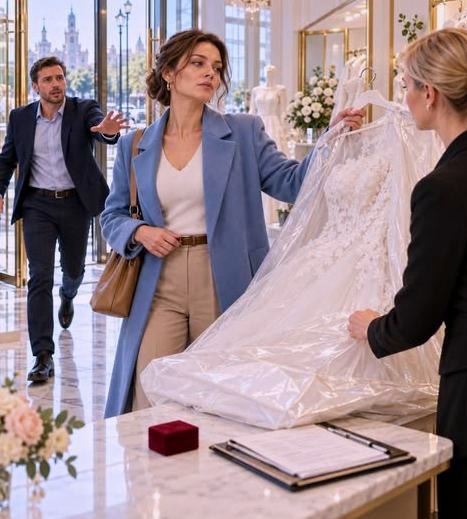
That evening, I returned the dress. The salon clerk checked the hem, the sleeves, and the tiny pearl buttons. One button had loosened near the wrist, so she deducted a small amount from the deposit.
I signed the receipt.
The money was less than I had paid, but the page contained no promises, no hidden clauses, and no one else’s name.
At 7:42, the hotel manager called me about a night shift. A receptionist had fallen ill. I accepted before she finished explaining the hours.
Then I went to my apartment and opened the basement cabinet with the key Lyubov Viktorovna had kept for years. Inside was a metal tin, a bundle of utility receipts, and one more envelope addressed in Grandma’s crooked handwriting.
I opened it carefully.
Lera, it said, if someone asks you to prove love by surrendering the place where you learned to stand, ask what they are willing to build with their own hands.
I read the sentence twice.
Then I placed the letter beside the dented bread box and carried the box upstairs—not as a relic, but because the loose hinge needed fixing before morning.
The next day, Andrei’s employees received his statement. Two left the workshop. Four stayed after he showed them the actual accounts and offered the equipment for sale instead of pretending a miracle was coming. Viktor accepted a repayment schedule secured by the remaining tools. Lyubov Viktorovna sold her car and moved temporarily into her sister’s spare room. She never asked me for the apartment again.
Andrei did not come back to my life.
He came once to collect his winter clothes. He stood in the hallway, looked at the framed photograph of Grandma, and said, “She saw me clearly.”
“No,” I answered. “She saw me clearly.”
He took the clothes and left.
A week later, I received the refunded wedding money. I used part of it to repair the loose hinge on the bread box and the rest to pay for a new sign at the city hotel, where the old one flickered above the reception desk.
The repairman asked what words I wanted on it.
I thought of the banquet hall, the forged signature, the letter hidden beneath old receipts, and the key that had traveled through three people before returning to my hand.
“Just put the hours,” I said. “People should know exactly when they can find us.”
He painted them in white enamel: OPEN ALL NIGHT.
Underneath, I hung Grandma’s dented bread box, empty except for the apartment deed and the key to the basement cabinet.
At midnight, a tired woman came through the hotel doors carrying a garment bag and asked whether the night clerk could keep it safe until morning.
I took the bag from her, checked the zipper, and said, “Nothing gets signed until you’ve read every line.”
Then the old sign hummed above us, bright enough to show the ink on the receipt in my hand.
Missed the beginning?






