PART 4
The name was Richard Bennett.
My father.
For a moment, I heard only the faint tick of the grandfather clock in the hall. The pendulum swung beneath its brass face, steady and indifferent, while my daughter’s life hung between machines and midnight.
Daniel stared at the page.
Then he smiled.
“There,” he said. “I knew it. Your father planned everything.”
Richard did not move.
I looked at him. “Why is your name in Daniel’s ledger?”
His jaw tightened.
“Because I paid the missing money back.”
The words landed harder than any confession Daniel had made.
Miriam turned toward him. “You restored the restricted funds?”
“Not all of them. Enough to keep the hospital project operating while the audit continued.”
Daniel laughed bitterly. “So you did steal from me.”
“No,” Richard said. “I stopped your theft from killing innocent people.”
The interim director opened the ledger again. Beside my father’s name was a handwritten note: Emergency bridge payment. To be recovered from responsible parties.
I read it twice.
“Why didn’t you tell me?”
Richard looked at the stairway, where Vanessa’s diamond necklace glittered beneath the chandelier.
“Because I knew you would try to protect Daniel from the consequences.”
The accusation hurt because it was true.
For years, I had translated Daniel’s cruelty into stress, his contempt into insecurity, his betrayals into temporary mistakes. I had called patience a virtue because admitting the truth would have forced me to choose myself.
Richard continued, “The hospital project employs three hundred people. Its financing was tangled with the same accounts Daniel raided. I could have shut everything down, but families would have lost wages before anyone proved what he did.”
Daniel stepped toward him.
“You’re taking my company.”
“The board is taking control of an insolvent company,” Richard replied. “There is a difference.”
“You want revenge.”
“I want the money returned and the workers paid.”
Vanessa pressed a hand to her throat. “Daniel, do something.”
He turned on her.
“You were the one who created the shell companies.”
“You approved every payment.”
“You kept the ledger.”
“You gave me the key.”
Their argument rose and broke across the room like glass. The necklace bounced against Vanessa’s collarbone. One diamond struck the pendant with a tiny, bright click.
I thought of my mother wearing it at my graduation. I remembered her fastening the clasp behind my neck and whispering, “Never let anyone make you smaller so they can feel tall.”
I had forgotten that sentence until then.
My phone rang.
The neonatal nurse’s name appeared on the screen.
I answered immediately.
“Ms. Whitmore, your daughter is having trouble maintaining her oxygen level,” the nurse said. “The doctor is with her now.”
“I’m coming.”
I turned toward the foyer.
Daniel moved in front of me.
“You are not leaving until you sign the divorce agreement.”
Miriam stepped between us. “Move.”
He ignored her. “You wanted money. Take the million. Take two. But you will not walk away with my name, my house, and my company.”
I looked at him and realized he still did not understand what he had lost.
He believed my victory was ownership.
It was not.
“My daughter is in a hospital,” I said. “And you are bargaining over property.”
“She is my child.”
“Then you should have called the ambulance.”
His face tightened.
“I was angry.”
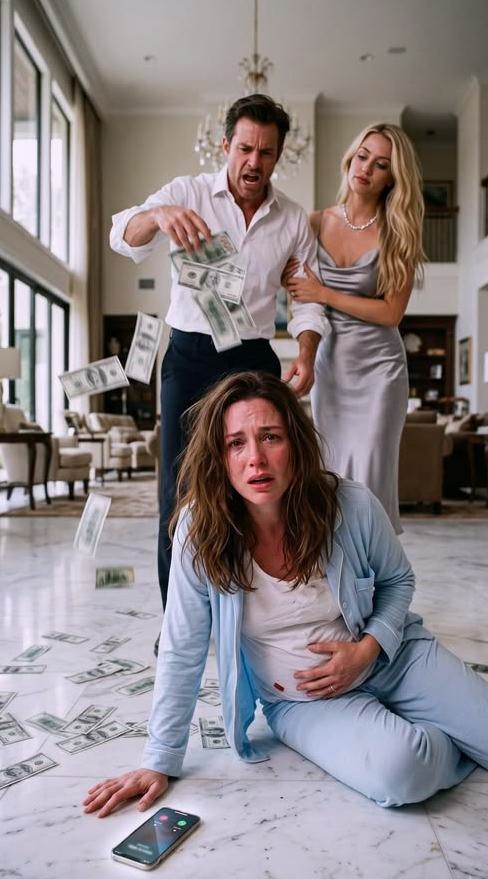
“You were standing beside my blood.”
The foyer went quiet.
I took the copy of the divorce agreement from Miriam’s folder and held it out to Daniel.
He reached for it.
Then I tore it in half.
His eyes widened.
“I am not signing a private settlement designed to hide what happened,” I said. “The company can be restructured. The assets can be traced. Custody can be decided by people who care about the child’s safety. But I will not help you buy a clean story.”
Daniel’s hands curled into fists.
“You think your father will keep you safe forever?”
“No.”
The answer surprised him.
“I think I have to learn how to keep myself safe.”
Richard looked down, and something in his expression softened. He had wanted to rescue me. I had spent years pretending I did not need rescuing. Both of us had been wrong about what protection meant.
The interim director addressed Daniel.
“Effective immediately, your voting rights are suspended under the financing agreement. Your shares will be placed into a recovery trust until the missing funds are accounted for.”
Daniel turned pale.
“What trust?”
“One established for the hospital project, unpaid contractors, and your creditors.”
He looked at the chandelier, the marble, the staircase where Vanessa stood wearing the necklace he had promised her.
All the symbols of power were still there.
None of them belonged to him anymore.
Vanessa ripped the necklace from her throat.
The clasp caught in her hair, and she cried out. A strand of dark hair came loose as the pendant fell into her palm.
“I am not going down for you,” she said.
Daniel stared at her. “You owe me.”
“I owe you nothing.”
She threw the necklace onto the desk.
The diamond pendant slid across the polished wood and stopped beside the ledger.
I picked it up.
For years, I had thought the necklace represented my mother’s approval, my marriage, and the place I had supposedly earned in Daniel’s family. Now it felt like evidence of a woman who had survived a different kind of cruelty and still expected more from me.
I gave it to Tomas.
“Please return it to my mother’s things,” I said.
He nodded. “I will.”
Then I left for the hospital.
The neonatal unit smelled of disinfectant and warm plastic. Blue monitor lights pulsed above the incubators. My daughter lay beneath a clear hood, her chest rising with help from a narrow tube.
I placed my palm against the glass.
“I’m here,” I whispered.
The nurse adjusted the blanket. “She fought hard.”
“She gets that from her grandmother.”
Behind me, Richard stood at the entrance. He did not come closer until I nodded.
“I’m sorry,” he said.
I kept my hand against the incubator.
“For hiding the agreement?”
“For hiding how bad things were. I thought if I handled everything quietly, you could keep believing your marriage might recover.”
I turned toward him.
“You let me stay in that house.”
“Yes.”
“You knew Daniel was moving money.”
“I suspected. I did not have proof until the audit.”
“And when I called, you activated the agreement without asking whether I wanted to destroy him.”
Richard’s eyes shone.
“You asked me to protect your child.”
I looked back at the tiny face beneath the hood.
“I did.”
“Then I did what you asked.”
The monitor gave a soft, repeating beep.
I realized the agreement had never been a trap designed to punish Daniel. It was a net beneath a collapsing building. My father had built it years earlier because he knew that money could become a weapon in careless hands. Daniel had signed it because he believed signatures were for other people.
By midnight, the board had approved the recovery trust. The hospital project remained funded. Workers would be paid. The properties Daniel had transferred were frozen, and the accounts connected to Vanessa were being examined. No dramatic speech saved the company. Numbers did what anger could not: they followed every stolen dollar back to its source.
Daniel lost control of Whitmore Development, but he did not lose every possession. The estate was sold to cover debts. The family’s private plane went next. His father resigned from the board after signing a statement acknowledging that the dynasty had been managed through secrecy for too long.
Vanessa left with a suitcase and no diamond necklace. She later agreed to return the money her companies had received in exchange for immunity from the company’s civil claims, but the settlement required her to testify about every transfer. She had wanted Daniel’s empire. Instead, she spent her days explaining its ruins to accountants.
Daniel fought the custody arrangement until the photographs, medical records, witness statements, and financial ledger were placed before the family magistrate. He was granted supervised visits only after completing an anger program and surrendering control of his financial accounts.
I did not celebrate that.
A child should not need supervised visits with her father.
But my daughter needed safety more than I needed a satisfying punishment.
Three weeks after the night at the mansion, I returned to the hospital carrying a small cloth pouch. Inside was my mother’s necklace, cleaned and repaired. Tomas had found a jeweler who replaced the bent clasp without changing the pendant.
My daughter was strong enough to leave the incubator.
The nurse placed her in my arms.
She was impossibly small, warm beneath the knitted blanket, and furious about the world.
I laughed through tears.
Richard stood beside the chair, holding the repaired necklace.
“Your mother would have wanted you to have it,” he said.
I fastened it around my neck.
The pendant rested just above my daughter’s sleeping cheek.
A week later, Daniel asked to see us in the hospital garden. He arrived without his expensive watch. The cracked silver case was gone, leaving a pale mark around his wrist.
He looked at our daughter through the glass nursery wall.
“She has your eyes,” he said.
“She has her own life.”
He swallowed.
“I was wrong about you.”
“Yes.”
“I thought you needed my family.”
“You thought needing someone made you valuable.”
His gaze lowered.
“I don’t know how to fix this.”
“Start by telling the truth when no one is paying you to.”
He nodded.
It was not redemption. It was a beginning he had not earned yet.
I handed him a single document through the garden gate: the schedule for supervised visits, the financial disclosure requirements, and the account designated for our daughter’s medical care.
He read every page.
For once, he did not sign blindly.
Before he left, he looked at the necklace around my throat.
“Your mother’s?”
“Yes.”
“Vanessa said you would never get it back.”
I touched the pendant. “She was wrong about many things.”
My daughter stirred against my shoulder.
The nurse opened the nursery door and called my name. I went inside, carrying my child beneath the repaired diamond, while behind me Daniel remained on the garden path with a stack of papers he could no longer throw away.
On the first page, beneath the visitation schedule, one sentence waited for his signature: The child’s safety comes before everything else.
This time, he read it twice.
Missed the beginning?






