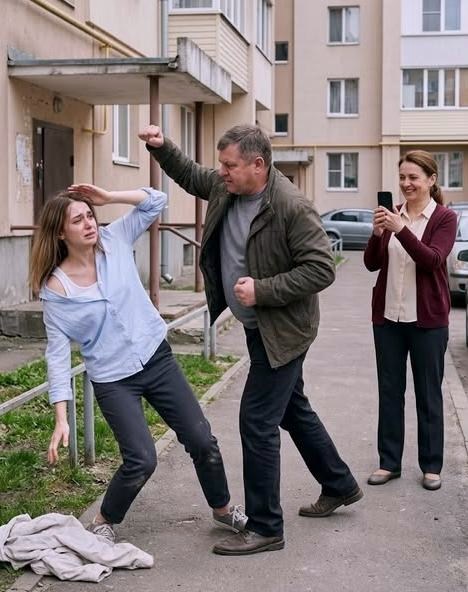
My mother was still laughing when my father dragged me through the back door of our house and threw my coat after me.
“Look at yourself, Natalia,” Irina said, pointing her phone at my face. “Thirty-four years old and still begging for attention.”
It was 1:17 a.m. in the narrow service lane behind a supermarket in Chernihiv. I knew that only because a delivery truck’s dashboard clock glowed red as it passed. My cheek was pressed against frozen asphalt. Every breath tore through my ribs.
A man in a reflective vest crouched beside me, but I flinched so hard that pain flashed white behind my eyes.
“Don’t touch me,” I whispered.
“I won’t,” he said. “My name is Mykola. I’m calling an ambulance.”
The last thing I remembered before that was my father’s study at 10:42 p.m., the brass desk lamp burning over a blue folder.
I had opened it because three hundred thousand hryvnias had vanished from the Shevchuk Family Fund. The fund had been created by my grandparents for their children and grandchildren. My father, Oleh, had managed it since their deaths.
The transfers were not payments for medicine, education, or housing. They were scattered withdrawals, sent to companies I had never heard of, then routed through an account belonging to someone named Daria Melnyk.
I had asked one question.
“Why is money leaving the fund under your authorization?”
My father’s face had tightened.
“Close the folder.”
“I’m one of the beneficiaries.”
“You’re an ungrateful child who learned a few accounting words and thinks she can accuse everyone.”
My mother entered behind me and locked the door. I remember the tiny click of the bolt. I remember the smell of burnt coffee. I remember my father’s hand hitting my mouth.
After that came the floor, the edge of the desk, and my mother’s phone held above me like a second pair of eyes.
“Tell her what you found,” Irina had said, laughing. “Go on. Tell the camera how your parents ruined your life.”
Then another blow.
At the hospital, I woke fourteen hours later beneath a white blanket stiff with starch. Three broken ribs. A fractured cheekbone. A concussion. Hypothermia. My clothes had been cut away, and my left foot was wrapped because the skin was torn from walking barefoot across gravel.
On the fourth day, two investigators came to my room at 3:30 p.m. Their plastic chairs squeaked every time one of them moved.
“My parents attacked me,” I said.
The woman with the red notebook studied my bruised face. “Your parents claim you attacked your father first.”
“They left me behind a supermarket.”
“They say you ran away during a breakdown.”
“And the money?”
Her pen stopped.
“What money?”
That was when I understood. My parents were not only denying the assault. They were building a story around me before I could speak.
They had already called relatives, neighbors, and my employer. Natalia is unstable. Natalia is obsessed. Natalia invents accusations.
When the investigators left, I called my attorney, Lena Voronina. She arrived at 6:18 p.m. carrying a paper cup of tea and the blue folder I had given her before confronting my father.
She read the first page beside my hospital bed. Then the second. At the third, the color drained from her face.
“Lena,” I whispered, “what is it?”
She closed the folder.
“Your father believes the only evidence is inside his office.”
She reached for the metal clasp again, and just as it began to open, someone knocked hard on my hospital door…
PART 2
The knock came again, sharper this time.
Lena slid the folder beneath my blanket, and I felt the stiff cardboard press against my hip.
“Who is it?” she called.
A nurse opened the door halfway. Behind her stood my cousin Pavel, holding a bouquet of yellow tulips and wearing the expensive watch my grandfather had once given my father.
“Your mother sent me,” Pavel said.
“Then your mother can come herself,” Lena replied.
Pavel’s smile faltered. He placed the flowers on the windowsill, where one broken stem leaked water onto the paint.
“She wants peace,” he said. “The family is willing to forget the argument.”
“Which argument?” I asked.
He looked at my bandaged ribs. “You know what I mean.”
“I was unconscious behind a supermarket.”
“No one wanted that.”
“Then why did you come with conditions?”
Pavel glanced at Lena. “You need to stop discussing the family fund. Withdraw your statement. Say you don’t remember what happened in the study.”
My pulse began pounding beneath the hospital bracelet.
“If I was having a breakdown,” I said, “why does everyone care what I remember about the fund?”
Pavel’s fingers tightened around the tulip stems. A green leaf snapped under his thumb.
“You’re making this worse.”
“No,” Lena said. “You are.”
He left without taking the flowers. The smell of crushed stems stayed in the room long after the elevator doors closed.
At 8:00 p.m., Lena wrote down every word Pavel had used. She did not let me call my mother. She did not let me answer the messages appearing on my borrowed phone.
There were nineteen of them.
Some begged me to think of the family. Others warned that I would regret destroying my father’s reputation. One came from my uncle Serhii, who had not spoken to me in six years.
“Your father saved you from poverty,” it said. “Do not repay him with lies.”
Lena read it twice.
“Did he?” she asked.
“My grandparents paid for my education,” I said. “My father always claimed the fund was empty afterward.”
She looked at the folder. “It was never empty.”
The following morning, at 9:15, she returned with printed bank statements and a witness statement from Mykola, the night guard who had found me. He had described my torn clothing, the distance from the road, and the dark sedan that had driven away moments before he reached me.
“There is more,” Lena said.
She placed a statement on the blanket.
The transfers began eleven months before I ever questioned my father. The first payment went to a construction firm called North Star Development. The second went to a private clinic. The third went to Daria Melnyk.
I recognized the name only after Lena turned the page.
Daria had been the fund’s accountant. She had resigned two years earlier, claiming she was moving abroad.
“She never left,” Lena said. “She works three streets from your father’s company.”
My throat tightened. “Why would she hide the payments?”
“Maybe she didn’t hide them. Maybe she processed them because someone forced her.”
“Then why didn’t she speak?”
Lena opened a photocopy of an old authorization form. The signature at the bottom looked like mine, but the final letter in my surname curled the wrong way.
“I never signed this,” I said.
“I know.”
For the first time, Lena allowed herself to look frightened.
That afternoon, the hospital administrator called to say my parents were waiting downstairs. They had brought a family elder and a notary. My mother wanted to see me alone.
Lena stood beside the bed.
“Let them come up,” I said.
The elevator bell sounded at 4:02 p.m. Footsteps approached. My father entered first, carrying a leather briefcase. My mother followed with her phone hidden in her palm.
Oleh looked at the folder beneath my hand.
“Give me that,” he said.
I held it tighter.
He stepped toward the bed, and Lena moved between us.
Then the door opened again, and a woman with rain-dark hair walked in behind the notary.
Daria Melnyk looked at my father and said, “I am done signing what you tell me to sign…”
PART 3
Daria’s words struck the room harder than any raised voice.
My father stopped three steps from my bed. The leather briefcase hung from his hand, its brass clasp catching the hospital light.
“Get out,” Oleh said.
Daria did not move. She was wearing a cheap gray sweater with a loose thread at the cuff. Her hands shook, but her eyes stayed on him.
“I brought the original ledger,” she said.
My mother’s phone lowered by an inch.
The notary closed the door behind them. Lena pulled a chair forward.
“Sit down, Ms. Melnyk.”
Daria sat. My father remained standing.
“You were paid to keep records,” he said. “Not to create theater.”
“I kept records for six years.” She reached into her canvas bag and placed a black ledger on the bed table. “I also kept copies of every transfer.”
Lena opened it carefully. The pages smelled of dust and printer ink.
Daria pointed to the first column.
“Your father told me the fund was being used to buy land for the grandchildren. That was a lie. The money went to North Star Development, which he secretly owned through a shell company.”
My father gave a bitter laugh. “You have no idea what you’re talking about.”
Daria turned to the next page.
“The clinic payment was for your son Andriy’s surgery. The company payments covered your gambling debts. The transfers to my account were immediately sent back to you in cash.”
My mother’s face went white.
I looked at her. “You knew?”
“I knew your father was under pressure,” she said.
“That wasn’t my question.”
Her lips parted, but no answer came.
Daria pulled another document from the bag. “And this is the authorization used to remove Natalia as a beneficiary.”
The notary leaned over the page. “This signature is not hers.”
“It was copied from an old school form,” Daria said. “Oleh brought it to me and told me to attach it to the fund amendment.”
My father slammed his palm against the table. The water in my plastic cup jumped over the rim.
“You were grateful when I gave you work!”
“I was afraid,” Daria replied. “There is a difference.”
Lena looked at me. “Natalia, your parents did not attack you because of one suspicious transfer. They attacked you because you had found the structure of the entire scheme.”
My chest hurt, but not from the broken ribs.
Oleh pointed at me. “She was going to destroy all of us.”
“No,” I said. “You did that when you stole from the people who trusted you.”
My mother began crying. Not loudly. She covered her mouth with both hands, as if the sound might expose her more completely than the documents had.
The notary asked whether Daria was willing to sign a sworn statement. She nodded.
“Yes. And I will give the originals to Lena.”
That was the moment my father lunged for the ledger.
Lena caught it first. Pavel, who had been standing outside the door, stepped in and blocked Oleh with his shoulder.
“Don’t touch her,” Pavel said.
My father stared at him. “You owe me everything.”
“I owed you loyalty,” Pavel answered. “Not my name.”
The room filled with the smell of antiseptic and wet wool. For a few seconds, no one moved.
Then Lena’s phone rang.
She listened, said nothing, and handed it to me.
It was the director of my employer. He had received a letter accusing me of embezzlement and threatening to publish private medical information unless I resigned by noon.
The letter carried my father’s company seal.
Lena took the phone back. “There’s more,” she said. “The bank just notified us that the fund’s remaining account was emptied this morning.”
My stomach dropped.
Oleh looked toward the window, and the corner of his mouth lifted.
“By tomorrow,” he said, “you will have nothing left to claim.”
Then Lena opened the final page of Daria’s ledger and saw the name of the person who had received the money…
The final signature changed what the whole family believed…
I thought the ledger would only expose stolen money. The last document revealed why my father was truly afraid.
“I will keep sending the pages.”
I understood that remorse would have to arrive one signature at a time.
👇 The final part of the story is already open.






