PART 4
The bank notification showed a destination account with a name I recognized.
Mavis Cole.
Not her personal account. A business account belonging to a small event company she had registered six months earlier.
Ryan read the screen twice.
Then he placed the phone flat on the table.
“How much?” I asked.
“Eight thousand four hundred dollars,” he said.
Mavis’s face had gone almost white.
“That was temporary,” she said.
Ryan looked at her. “You moved our entire wedding fund.”
“I moved part of it.”
“Eight thousand four hundred.”
“I was going to put it back.”
“With what?”
She glanced toward me, and I understood before she answered.
“With the gifts.”
The room seemed to tilt.
She had not only changed the venue. She had built an entire event around money that did not belong to her, invited people we had never approved, and destroyed our invitations when she realized we might proceed without her version of the wedding.
The woman from Bellweather Estate was still on speakerphone.
“Mr. Cole,” she said carefully, “your mother told us the bride was having second thoughts and that the date might be moved. We have already contacted several vendors.”
Ryan’s eyes stayed on Mavis.
“Did she tell you Claire signed the contract?”
“Yes.”
“She didn’t.”
Mavis reached for the phone. “Ryan, stop this.”
He moved it out of her reach.
“To the estate,” he said, “freeze every change made under my name or Claire’s name. We’ll deal with the deposit directly.”
“You’ll lose the ballroom,” Mavis said.
“We never wanted it.”
“You’ll lose the money.”
“That money was already gone.”
For the first time, the real fear in her face became visible. She had not been fighting for a larger celebration. She had been trying to keep a promise she made with our savings, and she had assumed the wedding gifts would cover the hole.
Ryan ended the call.
Mavis sank into a dining chair. One of the wet envelopes stuck to her sleeve and tore when she moved.
“I did all of this because people were coming,” she whispered. “The Harringtons, the Cole cousins, everyone from your father’s office. They expected something beautiful.”
Ryan pulled out the chair across from her but did not sit.
“You could have asked us.”
“You would have said no.”
“Yes.”
Her eyes filled. “You used to listen to me.”
“I still listened. I just stopped obeying.”
That sentence broke something in her expression.
At 8:10, the doorbell rang again. This time it was Nina, the coordinator, carrying a cardboard box and a folder sealed with a red elastic band.
“I brought what I could save,” she said.
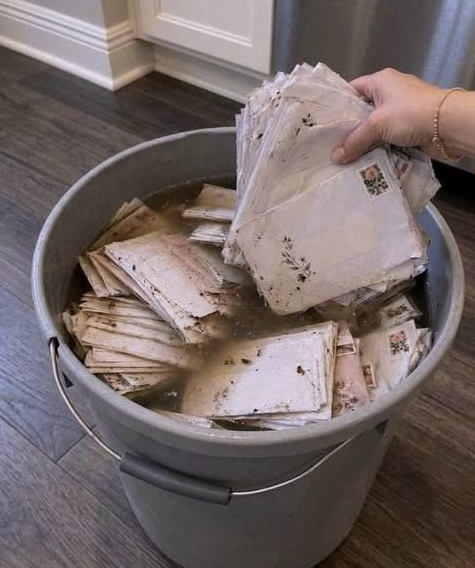
Inside the box were the invitation inserts, the ones printed on thicker paper. Most had dried enough to read. The marigold border was warped, but the names remained visible.
Nina placed the folder in front of Ryan.
“Before you decide what to do, you should see this.”
He opened it.
The first page was a payment ledger from Mavis’s event company. Bellweather Estate was listed as a client expense. So were catering, flowers, a string quartet, and a photographer.
The final column was labeled reimbursement source.
Wedding gifts.
I pressed my fingers against my mouth.
Mavis closed her eyes.
Nina’s voice softened. “She gave me instructions to collect every gift card and cash envelope at the reception before they reached you.”
Ryan’s face changed.
He looked at his mother. “You planned to take our gifts.”
“I planned to recover what I borrowed.”
“That isn’t recovering.”
“It was one day!” she cried. “One day where nobody could look at our family and see that you had chosen a tiny restaurant over the people who raised you.”
I stood so quickly my chair scraped the floor.
“It was not a tiny restaurant,” I said. “It was the place where Ryan proposed.”
Mavis stared at me.
“He chose it because his father took him there every Sunday,” I continued. “You knew that.”
Her mouth trembled.
Ryan had told me that story on our first date. His father, Daniel, had died when Ryan was nineteen. The restaurant had been sold twice since then, but the owner agreed to let us hold our reception in the back garden. Forty guests from Ryan’s father’s side. My sister. Our closest friends. The people who actually knew us.
Mavis had called it embarrassing.
At 8:35, Ryan opened his banking application and changed the account permissions. Then he called the bank himself and canceled every pending payment connected to the event company.
Mavis watched him.
“You’re cutting me off.”
“I’m protecting Claire.”
“You’re choosing her.”
“I’m choosing the truth.”
She flinched as though he had struck the table between them.
I expected him to demand repayment immediately. I expected anger to carry him through the night.
Instead, he pushed the box of damaged invitations toward her.
“Help us fix them.”
Mavis stared at him.
“What?”
“You wanted to be part of the wedding so badly. Then be part of the repair.”
Her hand hovered over the box.
“You still want me there?”
“I want the mother who tells the truth,” Ryan said. “I don’t know if she’s here yet.”
Mavis looked at me.
The apology that followed was not polished. It did not contain the words everyone was waiting for. She admitted she had taken the money, forged my signature, lied to the estate, and ruined the invitations. She admitted she had been terrified that a small wedding meant Ryan no longer needed her.
Then she said something I had not expected.
“Claire, I was jealous of the way he looks at you.”
I felt anger rise, hot and immediate.
“That is not my burden to carry.”
“No,” she said. “It’s mine.”
Ryan remained standing between us.
“What happens now?” he asked.
I looked at the box. At the marigold borders softened by dirty water. At the names we had chosen together.
“We send them,” I said.
Mavis blinked. “The ruined ones?”
“Not as invitations.”
I took one from the box. The paper was wrinkled, but the date was still readable.
“We send a correction. We tell everyone the ceremony is staying where we planned. We explain that the larger event was never authorized. Anyone who wants to come can come. Anyone who expected a spectacle can stay home.”
Ryan nodded.
“And the money?” he asked.
“Mavis sells the event company’s equipment and repays what she took. Not to punish her. To make the damage real.”
Mavis lowered her head.
“I’ll do it.”
Ryan looked at her sharply. “You’ll show us every account.”
“I will.”
“No more private arrangements.”
“I understand.”
The next morning, Nina helped us create a simple notice. Each ruined envelope went into a clear sleeve with a new card. It explained the date, the location, and the only fact that mattered: the wedding would be ours.
Mavis addressed the first envelope herself.
Her handwriting shook.
When she reached the Harringtons’ invitation, she stopped.
“What should I say to them?”
I handed her the card.
“Say the truth.”
She wrote for a long time.
The money was not recovered overnight. The ballroom deposit was partially lost, and Mavis sold the sound equipment, folding chairs, and decorations she had purchased without permission. She met with the bank beside Ryan and me, item by item, until every transfer was documented.
Bellweather Estate withdrew the forged contract after Ryan sent them the records. The owner apologized and returned the remaining deposit directly to our wedding account.
Mavis did not attend the rehearsal dinner.
She said she had not earned the right yet.
But she came to the restaurant two hours before the ceremony and placed a small metal box on the table beside the marigold cards.
Inside was Daniel’s old brass table number from the restaurant’s original dining room.
“I found it in your father’s things,” she told Ryan. “He kept it because he said that table was where you learned to count.”
Ryan touched the worn number with one finger.
“You could have given this to me years ago.”
“I was saving it for something important.”
He looked toward the garden, where chairs faced the flowering trees and the owner had hung tiny glass lanterns from the branches.
“This is important.”
Mavis nodded, then turned to me.
“I don’t expect you to forgive me today.”
“I don’t,” I said honestly.
Her eyes lowered.
“But you can sit in the third row,” I added. “And you can give Ryan the brass number after the vows.”
Her hand closed around it.
“I can do that.”
The ceremony began at 4:00 p.m.
Ninety-six people had been invited. Seventy-three came. No one complained about the garden, the simple meal, or the invitations with rippled edges.
Some guests asked what had happened.
Ryan answered them himself.
“My mother made a terrible choice,” he said. “We made a better one.”
After the vows, he took the metal number from Mavis and placed it on the table beside our marriage certificate.
She cried quietly.
Not because she had lost control of the wedding.
Because she had finally been allowed to attend the one we were actually having.
Later, while the musicians packed away their instruments, Mavis approached me with the last damaged invitation in her hand. My name was nearly unreadable, but the date remained clear beneath the stain.
“I kept this one,” she said.
“Why?”
“So I wouldn’t forget what I did.”
I took the card from her and turned it over. On the back, in fresh ink, she had written the address of the restaurant and one sentence.
No changes. No additions. Just the truth.
I folded the card and placed it beside Daniel’s brass table number.
Then Ryan called us both toward the garden, where the owner was cutting the wedding cake with the same silver knife his father had once used on Sundays.
Mavis walked beside me.
Neither of us pretended the damage had vanished.
But when the knife touched the cake, the warped marigold invitation beside the brass number caught the lantern light—and held it.
Missed the beginning?






