PART 4
The message remained on the screen for three seconds before the security system erased it.
Richard saw my face and understood that I had read every word.
“Michael,” he said, “don’t make this worse.”
I let go of his wrist.
“Who sent it?”
He rubbed the red mark on his skin.
“You’re frightened and angry. Go home with the child.”
“Who sent it?”
Helen stepped between us.
“Mr. Rivers, there is something else.”
She opened the taped ledger to a page near the back. The ink was faded, but the numbers were clear. Beside each intercepted letter, Richard had written a short code. Most were initials. One was repeated beside Claire’s final three messages.
A seven-digit number.
I recognized it.
It was the private account number of the company’s outside trustee, Martin Vale.
Martin had been the man who introduced Richard to me twelve years earlier. He had helped me build Rivers Capital from a borrowed office and two exhausted employees. He had also approved every major transfer Richard requested.
My phone rang again.
This time, the caller was Martin.
“Michael,” he said, “you need to listen carefully.”
I put him on speaker.
“Did you send that message?” I asked.
“No.”
“Did you authorize Richard to move my shares?”
A pause.
“Not exactly.”
Richard stepped toward the phone.
“Martin, stop.”
The voice on the speaker became rough.
“I was told Claire had agreed to keep you away. I was told she wanted no contact.”
My skin prickled.
“Who told you?”
Martin exhaled.
“Richard.”
Richard’s face turned gray.
“I never said that.”
“You gave me copies of letters,” Martin continued. “You said Claire was threatening to expose private company information unless you paid her. I believed you.”
I looked at the ledger.
“The letters were real.”
“I know that now.”
“Why did you stay quiet?”
“Because I signed the first transfer. I thought I was protecting the company. By the time I understood, Richard had forged enough documents to ruin me.”
Richard grabbed the phone from the table and hurled it against the wall. It shattered beside the brass lamp.
Emma cried out.
I turned toward her.
“Take Emma to the waiting room,” I told the therapist. “Stay with her.”
“But Daddy—”
“I’ll be right there.”
She searched my face, then handed me Oliver, her stuffed rabbit.
“Keep him safe.”
“I will.”
When she left, Richard dropped into a chair.
“You don’t understand what would happen if the board discovered the transfers,” he said. “The company would collapse. Thousands of employees would lose everything.”
“You stole from them.”
“I borrowed it.”
“For six years?”
His fingers twisted together.
“I was going to replace it after the acquisition.”
“There was always another acquisition.”
He looked toward the corridor where Emma had disappeared.
“I needed time.”
“You used Claire to buy it.”
His shoulders sagged.
“She found the account. She said she would contact you.”
“And you intercepted her.”
“She would have destroyed everything.”
“No. She would have brought me back.”
That was the truth Richard had spent five years trying to prevent.
Not because he feared my anger.
Because he feared the version of me that would stop trusting him.
The bank froze the attempted share transfer before it completed. By noon, the board had received copies of Helen’s ledger, the hospital receipt, the intercepted letters, and the forensic report showing where the money had gone.
Richard tried to resign before anyone could remove him.
The board rejected the resignation.
He tried to claim mental exhaustion.
The auditors asked him to explain the signatures.
He tried to blame Claire.
Helen opened the ledger again.
There was nowhere left for him to hide.
I did not follow him through every official consequence. I had spent enough years allowing Richard to turn every important question into a business problem. The company handled the financial investigation, and the board restored the stolen charitable funds through a separate account.
My part was more personal.
I went to the hospital where Claire had died.
A nurse named Patricia remembered her. She led me to a small storage room and brought out a canvas bag with a broken zipper. Inside was the mint ribbon Emma had worn as a baby, a stack of unsent drawings, and a sealed letter.
Claire’s handwriting covered the front.
For Michael, if he ever comes back for her.
I opened it alone in the hospital chapel.
“Michael,” it began, “I am not writing to punish you. You have punished yourself enough, even if you hid it beneath expensive things. I am writing because Emma deserves a story that does not begin with abandonment.”
I read until the words blurred.
Claire wrote that she had never stopped being afraid. She wrote that she had been angry, then sick, then too tired to carry either feeling. She wrote that Emma knew my name because she wanted our daughter to understand that a person could fail and still choose differently later.
But the last paragraph changed everything.
“Do not make Emma responsible for forgiving you. Do not turn her childhood into a ceremony of regret. If you come, come for the mornings, the fevers, the lost shoes, and the questions you cannot answer. Come when nobody is watching.”
I folded the letter against my chest.
That evening, I returned to Sunrise with the canvas bag. Emma sat at the child-sized table, drawing a fox wearing a crown.
“Did you keep Oliver safe?” she asked.
I placed the rabbit beside her.
“Very carefully.”
She studied the bag.
“Is that from Mom?”
“Yes.”
“Did she write about me?”
“Almost every word.”
Emma picked up the mint ribbon.
“She wore that when she was sick.”
I nodded.
“Do you want to hear what she said?”
Emma considered this. Then she pointed to the empty chair beside her.
“Sit there.”
I sat.
She listened while I read Claire’s letter aloud. I did not soften the truth. I did not tell Emma that I had been brave. I told her I had been scared, and that being scared did not excuse leaving.
When I finished, Emma stared at the fox on her paper.
“Did Mom hate you?”
“I think she hated what I did.”
“Do you hate yourself?”
The question left me defenseless.
“Sometimes,” I said. “But your mother asked me not to make you carry that.”
Emma pushed the drawing toward me.
“Then you can help me color.”
I picked up the orange crayon.
For several minutes, we worked without speaking. Outside, the staff moved quietly through the hall. The world did not repair itself because I had finally arrived. Claire did not return. The missing years stayed missing.
But Emma kept the empty chair filled.
Before we left, the director handed me a folder containing the final transition papers. She hesitated before releasing it.
“Mr. Rivers, there is one condition.”
“I know.”
“No disappearing when this becomes difficult.”
I looked at Emma, who was fastening the mint ribbon around Oliver’s neck.
“I’m not promising that I’ll never fail,” I said. “I’m promising she will never have to wonder where I am.”
The director studied me, then let go of the folder.
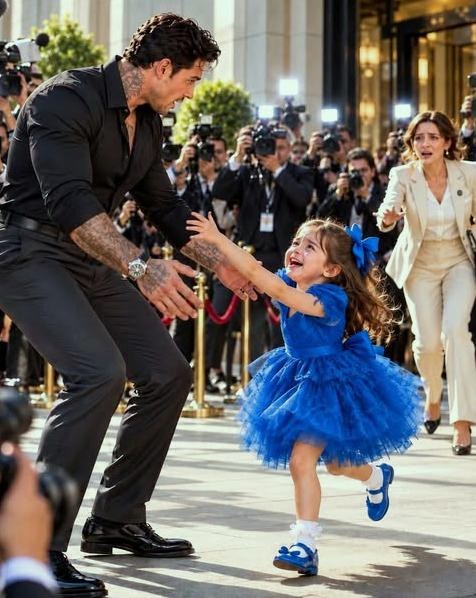
Outside, reporters still waited near the entrance. They shouted about the company, the donation, and Richard Collins. I ignored them.
Emma placed her hand in mine.
“Daddy?”
“Yes?”
“Tomorrow, can we make the fox a family?”
I looked down at the drawing. The crowned fox stood alone beneath a crooked yellow sun.
“Tomorrow,” I said. “And the day after that.”
She smiled, then added a second fox beside the first.
Underneath them, in careful uneven letters, she wrote: “He came back for the coloring.”
Missed the beginning?






