PART 4
Eleanor’s voice floated up the staircase with frightening calm.
“You brought them back to me.”
Lydia clutched my hand. Mara pressed her face into Evelyn’s coat.
I closed the ledger and slipped the hospital envelope inside my jacket.
“Stay behind me,” I whispered.
Evelyn shook her head. “No more hiding behind anyone.”
We stepped into the corridor.
The townhouse was dark except for the pale glow of Manhattan leaking through the tall windows. At the bottom of the stairs, Eleanor stood beside the marble console table, still wearing the cream suit she had worn to the board meeting that morning.
Her silver hair was perfectly arranged.
Only the red wax from the broken folder stained one of her gloves.
“You always were dramatic,” she said.
I descended slowly. “You sent someone to take my daughters.”
“I sent a guardian to protect them from a woman who abandoned you.”
Evelyn’s voice cut through the hall. “You threatened me while I was pregnant.”
Eleanor turned toward her. “You were offered a generous settlement.”
“You offered me money to disappear.”
“I offered you dignity.”
“No,” I said. “You offered me a lie.”
Eleanor’s gaze snapped to mine. “Be careful, Marcus. You are standing in a house owned by your family.”
“Not anymore.”
She gave a small, almost amused laugh. “The deed says otherwise.”
I pulled the forged deed from my jacket and held it up.
“The deed says I signed at 3:40 in the afternoon on October twelfth.”
“Yes.”
“I was in Key West until midnight.”
“You authorized your office.”
“Then why did Harold Pike say he watched you use my signature stamp?”
The amusement disappeared from her face.
Evelyn took one step forward. “And why did you keep a record of every payment you made to the people who helped you?”
Eleanor looked toward the nursery.
That glance answered more than an argument could have.
I opened the leather ledger and read the first entry aloud.
“Payment to Harold Pike. October fourteenth. Reason: witnessed transfer.”
Eleanor’s jaw tightened.
“Payment to Dr. Salazar. December third. Reason: amend birth records.”
Evelyn made a strangled sound.
“You changed the girls’ records?” she asked.
“I corrected an administrative error,” Eleanor replied.
“An error that listed Marcus as their father?”
“I prevented a custody dispute.”
“You prevented him from knowing his children existed.”
Eleanor’s eyes hardened. “I prevented you from destroying the Vance legacy for a woman who wanted access to it.”
I felt something inside me settle into place.
“All of this was about the company?”
“It was about control.”
The admission surprised even her.
She looked at the dark chandelier above us. “Your father left you the controlling shares because he believed you had his judgment. But you were weak where Evelyn was concerned. You would have given her a seat, a name, and eventually the company.”
“I would have built a family.”
“You would have handed our history to someone who had never earned it.”
Evelyn stepped beside me. “I earned every night you made me wonder whether my children would eat.”
For one second, Eleanor’s expression flickered.
Then she reached for the ledger.
I moved it out of reach.
“You don’t understand what you’re holding,” she said.
“I understand that the forged deeds are here. The false letter is here. The birth record is here. And you just admitted the reason you separated us.”
“I admitted nothing that matters.”
“Harold’s testimony matters. Daniel has the transfer records. The company’s outside counsel has the files.”
Her eyes narrowed. “You called them?”
“Before we came upstairs.”
That was the part she had not expected.
At the airport, while Evelyn spoke to the security guard, I had sent Daniel a photograph of the ledger and instructed him to distribute copies to the board, the title company, and the trustees of my father’s estate.
Eleanor had spent six years making sure one man controlled every door.
She had forgotten that paper could pass through many hands.
The front door opened again.
Harold entered with a cane in one hand and a small wooden box in the other. Daniel followed him, carrying a banker’s box sealed with red tape.
Eleanor stared at Harold.
“You,” she said.
“I should have come sooner,” he replied.
“You were paid to keep quiet.”
“I was paid to forget. I couldn’t.”
He placed the wooden box on the console table and opened it. Inside lay a brass signature stamp, several ink pads, and a stack of pages bearing my name.
My stomach turned.
Harold pointed to the stamp. “Your mother kept this in the desk beside the nursery. She used it whenever she needed your approval without your presence.”
Eleanor’s hand began to shake.
“Harold, if you continue, your grandson loses every benefit I arranged.”
“No,” he said. “He loses the money you used to frighten me. His treatment was covered by a foundation grant last week.”
Daniel lifted his phone. “A grant from Vance Hospitality’s charitable trust.”
Eleanor looked at me.
“You did that?”
“I did not know his name until this morning. Daniel did.”
The room changed.
Not because Eleanor was defeated. She was still dangerous. She still had influence, money, and people willing to carry out her instructions.
But the private system she had built around fear had developed a crack.
The guardianship order was invalidated through the family’s counsel before sunset. The false birth record was withdrawn. The authentic hospital record was sent to Evelyn, and the girls were placed under my protection only after she signed the arrangement herself.
She refused to move into the townhouse.
I did not ask her to.
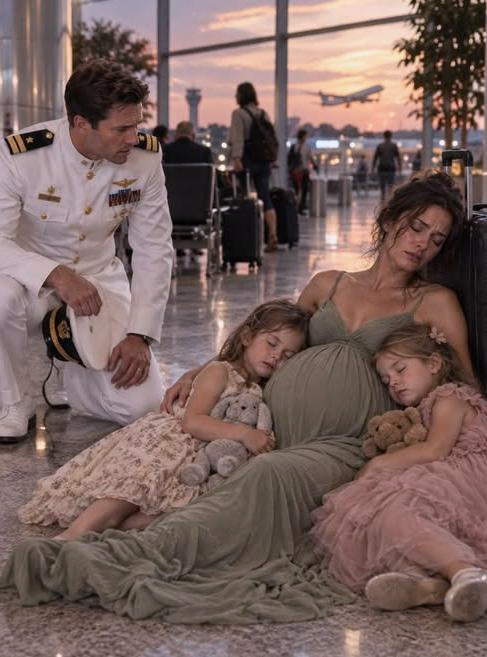
We stayed that night in a small hotel near the airport, in two connected rooms with a brass luggage cart parked outside. Lydia fell asleep holding a paper cup filled with colored pencils. Mara lined up sugar packets on the carpet and announced that each one was a hotel guest.
I sat on the floor while Evelyn stood beside the window, still wearing the coat with the torn yellow zipper pull.
“You can hate me,” she said.
I looked up. “For what?”
“For not finding another way to reach you.”
“My mother built a wall between us.”
“I let her convince me it was permanent.”
“So did I.”
She folded her arms tightly. “I was terrified. She knew where the girls were born, where we slept, what I owed. Every time I thought about calling you, she sent me proof that she could hurt you or take them.”
“I’m sorry I believed the easiest version of your disappearance.”
Evelyn’s eyes filled.
“I’m sorry I made you carry six years of silence.”
We did not embrace.
Not yet.
The girls were not a reward waiting at the end of an argument. They were two small people who deserved adults willing to move slowly.
The next morning, the board removed Eleanor from every operating role. The Boston estate owner accepted my cancellation of the acquisition and returned the deposit after Daniel explained the forged transfer. The fifty million dollars disappeared from the deal, but no stolen property changed hands.
Eleanor kept the family residence under a trust my father had created, but she lost access to the company accounts, the signature stamp, and the charity funds she had used as private weapons.
She did not go to prison.
That was not because she had been forgiven. It was because Harold, Evelyn, Daniel, and I chose a different kind of consequence: every transaction was exposed, every person she had threatened was released from her control, and the company she had tried to possess would never again be governed by one family member alone.
Three days later, Eleanor asked to see the girls.
Evelyn looked at me.
The decision was hers.
We met in the garden of a public conservatory, beneath glass roofs filled with orchids. Eleanor arrived without her usual driver, carrying a small wooden carousel horse painted green.
Lydia stared at it.
“Your grandfather carved this,” Eleanor said. “He intended it for the nursery.”
Mara did not reach for it.
“Did he know about us?” Lydia asked.
Eleanor’s face tightened.
“He knew your mother was expecting children.”
“Did he know our dad was our dad?”
Eleanor looked at me.
“Yes.”
The answer was quiet, but it cut through every room I had ever stood in.
“Why didn’t he tell me?” I asked.
“Because I told him you would choose Evelyn over the company.”
“And he believed you?”
“He believed you would choose love.”
That was the unexpected wound.
My father had not been ignorant. He had been afraid of what Eleanor would do with the truth after he was gone.
Eleanor handed the carousel horse to Lydia.
“I was wrong,” she said.
Lydia looked at her solemnly. “Are you sorry?”
Eleanor’s fingers tightened around the empty air where the toy had been.
“I am sorry I thought protecting a family meant owning everyone in it.”
Mara took Lydia’s hand.
“Are you going away?”
Eleanor looked toward me. “Yes.”
It was the first promise she made that did not come with a condition.
A week later, Evelyn and the girls visited the headquarters. Not the executive floor. The old ballroom, where the company hosted charity dinners. Evelyn had once coordinated events there before Eleanor erased her from the foundation’s records.
Daniel placed a new sign beside the entrance.
The Evelyn Brooks Family Travel Fund.
It would pay for emergency lodging for families stranded by sudden eviction, medical crises, or domestic threats. Evelyn had designed the program herself. She insisted on reading every application before a dollar was released.
“You named it after me,” she protested.
“I named it after the person who survived what my company failed to see.”
She touched the brass plaque but did not smile.
“Then make sure it helps people who don’t have a Marcus Vance waiting at an airport.”
“I will.”
Lydia tugged my sleeve. “Dad?”
The word still startled me.
“Yes?”
“Can we fix the hotel in Boston?”
I glanced at Evelyn.
She raised an eyebrow. “Only if you let the girls choose the curtains.”
Mara gasped. “Purple!”
“Absolutely not,” Evelyn said.
“Gold,” Lydia declared.
I laughed, and this time the sound did not break.
On the ballroom stage, Daniel placed the forged deed inside a transparent archive sleeve. Not as a trophy. As evidence of what the company would never permit again. Beside it, he mounted a copy of the authentic birth record, with the girls’ names printed clearly and my name restored beneath theirs.
Evelyn stood beside me as the afternoon light crossed the paper.
“You know this doesn’t erase anything,” she said.
“I know.”
“It won’t make six years return.”
“I know that too.”
She slipped her hand into mine.
Not as a promise of marriage. Not as an apology accepted. Just a hand, warm and deliberate, choosing not to pull away.
Across the room, Lydia placed the little green carousel horse on the registration desk. Mara arranged three hotel key cards in a neat row beneath it.
“Dad,” Mara called, “the guests are ready.”
I looked at the two girls with my father’s eyes, Evelyn beside me, and the forged signature locked behind glass where no one could use it again.
“Then let’s give them a room,” I said.
Missed the beginning?






