PART 4
The hospital was forty minutes from Fort Halden, but the drive felt like crossing a country that had been erased from every map.
Lena drove. I sat in the passenger seat with Nora’s compass in my palm, while Ryan and my parents followed in a military sedan behind us.
Nobody spoke for the first ten minutes.
Then Lena said, “There is something I didn’t tell you in the conference room.”
I watched the road markings slide beneath us. “Today seems to be full of that.”
“The patient was admitted under the name Elise Moreno. The file was created four years ago after a woman was found near the northern border.”
“Why was she connected to Nora?”
“Because the emergency tag sewn into her clothing carried Nora’s service number.”
My fingers closed around the compass. “Is she conscious?”
“She has been asking for you by your full name.”
A sharp ache moved through my chest.
“Have you seen her?”
“No. The physician called me ten minutes before I reached the conference room. He said she was afraid of military personnel and would only speak to the person listed as her emergency contact.”
“I was never Nora’s emergency contact.”
Lena glanced at me. “You were.”
The hospital entrance smelled of antiseptic and burnt coffee. At 11:03, a nurse hurried us through a secured corridor. Her rubber soles squeaked against the polished floor.
“Room 418,” she said. “Please prepare yourself. She has extensive nerve damage and limited mobility.”
“What did she look like?”
The nurse hesitated. “Like someone who has spent years expecting footsteps outside her door.”
I pushed the room open.
Nora was sitting upright beside the window, thinner than memory and older than the thirty-two years printed on her file. A scar crossed her left cheek. Her hair had been cut close to her skull, and two fingers on her right hand were missing.
But her eyes were the same.
She looked at the compass.
“You kept it,” she whispered.
My knees nearly gave way. “You gave it to Ryan.”
“I gave him the wrong one.”
Behind me, Lena inhaled.
Nora reached toward the bedside cabinet. Her hand shook as she dragged out a second compass, smaller and blackened around the edges.
“The brass one was meant to bring you here,” she said. “The real evidence was inside this.”
She pressed her thumb against the cracked lid. A hidden compartment opened.
Inside lay a narrow strip of memory film, a folded receipt, and a silver identification disk bearing my own name.
I stared at the disk. “Why is this here?”
Nora’s mouth trembled. “Because you were the person who changed the route.”
The words struck harder than any accusation.
“I never touched the deployment file.”
“You did not know you had access.”
Lena stepped forward. “Explain.”
Nora looked toward the hospital door. “Emily’s father was not the only contractor with authorization. Emily was assigned to emergency routing during her last year in the program. She discovered the route had been changed before the convoy left.”
“I reported it,” I said. “I remember sending the alert.”
“You sent it to Bell.”
My stomach twisted. “He was my supervisor.”
“He redirected it to a dead mailbox. Then he used your credentials to approve the altered route.”
The room blurred at the edges.
The scars on my body had always been explained as the price of saving the survivors. The memory I carried was simple: I had received a message, entered the recovery vehicle, and found the convoy after the attack.
But there had been a six-hour gap in my medical records.
A gap I thought came from shock.
Nora tapped the folded receipt. “You found me after the blast. You pulled me from the vehicle. Bell arrived with two men and ordered you to leave.”
“I would have stayed.”
“You tried.”
Nora’s eyes filled. “He struck you with the rifle. You hit your head. When you woke, they had taken me.”
A memory surfaced: a white ceiling, a copper taste, someone saying, “Tell her she ran.”
I gripped the edge of the bed. “Why did you let me believe I abandoned you?”
“I was held in a private clinic owned by your father’s company. I escaped three years later, but Bell found me again. I used Elise Moreno’s name because every official system belonged to the people who wanted me gone.”
The door behind us opened.
Ryan stood there. His uniform jacket was gone, and his white shirt was wrinkled at the collar. He had heard enough.
“Nora,” he said, “I came back.”
She looked at him for a long time. “I know.”
“Why didn’t you tell me?”
“Because Bell told me you signed the death report willingly.”
Ryan folded against the wall. “I thought you hated me.”
“I hated what they made us believe about each other.”
My parents entered behind him.
Mother looked at Nora and began to cry. It was not the graceful crying she used at funerals. Her face collapsed, and her pearl necklace slipped loose from her throat.
Father remained in the corridor.
“Come in,” I said.
He did not move.
“Dad.”
He stepped into the room, carrying the weight of every lie he had polished into family history. He looked at Nora’s missing fingers, then at the compass in my hand.
“I can testify,” he said.
Mother turned on him. “You will destroy us.”
He answered without looking at her. “We were already destroyed. We just kept setting the table.”
Ryan stared at him. “You knew Emily was alive after the ambush?”
“I knew she had survived.”
“You told everyone she quit.”
“I was afraid the inquiry would expose the contract.”
“And you let us call her unstable.”
Father’s lips shook. “I thought if she hated us, she would stay away.”
I felt no triumph. Only exhaustion.
“You didn’t protect me,” I said. “You buried me.”
He nodded. “Yes.”
That answer hurt more than denial would have.
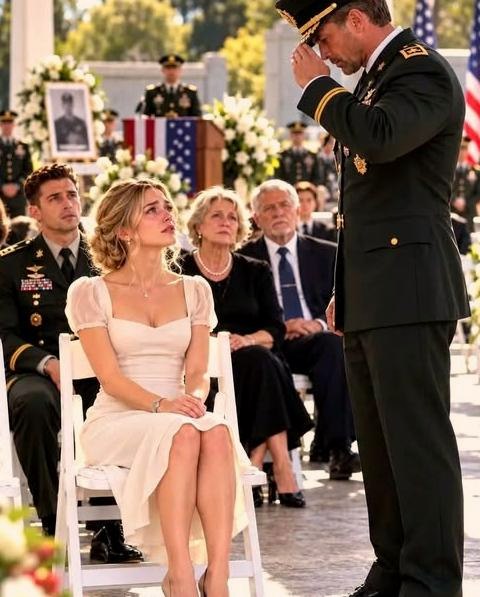
At noon, Colonel Bell arrived at the hospital with two officers and a lawyer. He entered Nora’s room carrying the same leather folder from the ceremony. The gold insignia still gleamed on Ryan’s abandoned jacket, folded over a chair.
Bell looked at me. “You have no idea what you are about to unleash.”
Nora’s voice was quiet. “I know exactly what I am about to end.”
Bell reached for the folder.
Lena blocked him. “The evidence has already been copied.”
His eyes moved from her to Father. “You will lose your company.”
Father answered, “It was built on a route that killed people.”
“You think confession makes you noble?”
“No,” Father said. “It makes me late.”
Bell turned to Ryan. “You can still protect your career. Say your sister manipulated the records. Say Nora was delirious.”
Ryan looked at me.
For years, I had wanted him to defend me in front of our family. I had imagined a dozen speeches, each one sharper than the last.
He only said, “I was there.”
Bell’s face changed.
Ryan continued, “I signed the false report because you threatened my mother’s medical coverage and my father’s contract. I watched you remove Nora from the vehicle. I watched you strike Emily. I will sign the corrected statement.”
Mother caught his sleeve. “Ryan, think about what they will do to you.”
He gently removed her hand. “I am thinking about what I already did.”
Bell left under escort, but the consequences did not end in that hallway. The review board suspended the promotion ceremony, froze the contractor’s accounts, and reopened the Arak investigation using Nora’s testimony, Father’s signed authorization, Ryan’s statement, and the evidence hidden inside the blackened compass.
There was no clean victory.
My father lost the company he had built. Mother moved out of the house three weeks later, not because she had suddenly become brave, but because she could no longer sit beside the man whose fear had become the family’s religion.
Ryan resigned from the unit before anyone could decide whether to remove him. He gave back the gold insignia in a plain envelope and began working with the families of the soldiers injured at Arak.
He came to see me every Thursday at the rehabilitation center where I was relearning how to trust my own memories.
The first time, he brought Nora’s original field map.
“I thought you should have it,” he said.
I looked at the creases, the ash stains, and the red line showing the route that had never been safe.
“You should keep it.”
“I carried the wrong thing for four years.”
I took the map from him. “Then carry something true.”
He nodded.
Our mother never apologized in the way I once expected. She did not make a speech or ask me to understand her. She sent Nora a new medical brace, paid for quietly from an account she had kept separate from Father’s business, and wrote one sentence on the invoice: I am trying to repair something I helped break.
Nora accepted the brace but not her forgiveness.
“That is fair,” Nora told me. “Repair is not the same as erasing.”
The hardest conversation was with my father.
It happened in a small hearing room after he signed his final statement. There was no audience, no polished platform, and no band waiting to make him look honorable.
He placed a keycard on the table.
“What is that?” I asked.
“Access to the archive where the original routing files were stored.”
“I thought the files were destroyed.”
“Bell ordered the copies destroyed. I kept one archive because I was afraid I might need leverage.”
I looked at him. “You kept proof as insurance.”
“Yes.”
“Why give it to me now?”
“Because you are the only person left who will use it for the dead instead of the living.”
I almost laughed. “That sounds like another way to make me carry your guilt.”
His eyes dropped to the table. “Then don’t carry it. Use it and leave it there.”
So I did.
The archive contained sixteen altered deployment files, seven concealed injury reports, and a payment trail linking Bell to the private clinic where Nora had been held. It also contained the message I had sent before the convoy departed, warning that the route was compromised.
My name was on the message.
Not as the person who approved the route.
As the person who tried to stop it.
Reading those words did not heal the years I had lost. It did something quieter. It returned the missing shape of me.
On the day Nora gave her statement, she asked me to walk with her to the rehabilitation courtyard. She moved slowly, one hand on the rail, while the blackened compass hung from a cord around her neck.
“Why did you keep the brass one?” she asked.
“Because I thought it was all I had left of you.”
“And now?”
I looked at the compass in my palm. Its needle no longer pointed north. The impact had bent it permanently toward the east.
“Now I know it was never meant to guide me back,” I said.
Nora smiled, tired but real. “Where does it point?”
I turned it once and watched the damaged needle settle.
“Toward the place where the records begin.”
She handed me a new folder, thick with names and dates. At the top was a list of families still waiting for answers about the Arak convoy.
Ryan was already in the courtyard, setting up a folding table for them. He had no insignia on his shirt, only a plain cloth badge with the names of the three soldiers he had failed to save.
When he saw me, he lifted the map.
“Emily,” he called, “the first family is here.”
I tucked Nora’s compass beneath my collar and walked toward the table, where the dead finally had somewhere to point.
Missed the beginning?






