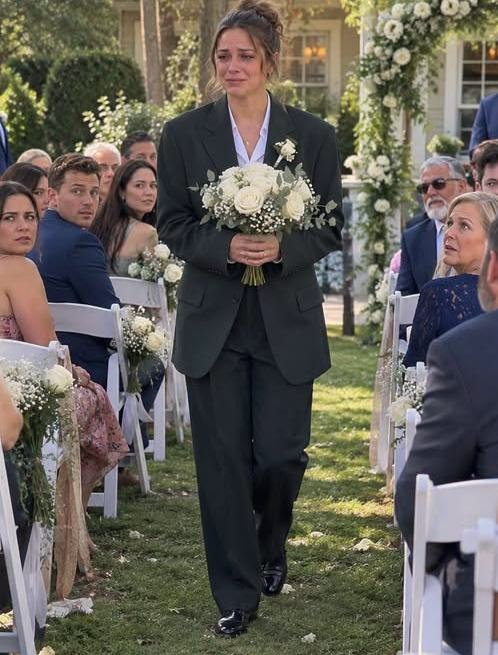
PART 4
The phone landed beside the wedding rings.
For one second, no one moved.
Then Claire picked it up.
“Who is the second beneficiary?” she asked.
The man on the line cleared his throat.
“Mr. Robert Vale named Thomas Bell.”
Mrs. Bell closed her eyes.
“My husband,” she whispered.
Claire looked toward the old tailor shop owner’s widow.
“Thomas was your husband?”
“He was the man Robert trusted most.”
Eleanor gave a sharp, humorless laugh.
“So that is it? He left everything to the Bells and called it a gift to Claire?”
“No,” the man said through the phone. “The trust gives Claire the money and property. Mr. Bell was named trustee and manager until she chose what to do with it.”
Claire frowned.
“He died years ago.”
“His instructions passed to his wife.”
Mrs. Bell lifted her chin.
“And I have followed them exactly.”
The guests had gathered closer now. Nobody seemed interested in the ceremony anymore. The white roses lay scattered around our shoes, crushed beneath the feet of people who had forgotten to sit down.
Eleanor reached for the phone.
“Give me that.”
Claire pulled it away.
The voice continued.
“There is one more condition. Mr. Vale required Claire to receive the trust only after hearing the truth about his departure from someone who had witnessed it.”
Claire looked at Mrs. Bell.
“You witnessed it?”
Mrs. Bell nodded.
“I was there when Robert left.”
Eleanor’s lips tightened.
“You were his employee.”
“I was his bookkeeper, and I was the person who watched you intercept his letters.”
A shudder ran through the crowd.
I glanced at Claire. Her face had gone pale, but she was standing straighter than she had all morning.
Mrs. Bell reached into her handbag again and removed a small envelope. It was not gray or new. It was made of thick cream paper, its edges softened by years of handling.
“This was meant for you,” she said.
Claire took it.
Her fingers hovered over the seal.
“What does it say?”
“Nothing that will make the past kinder.” Mrs. Bell’s voice cracked. “But it may stop you from carrying the wrong guilt.”
Claire broke the seal.
She read silently for several seconds.
Then she pressed the letter against her chest.
“Did he hate me?” she asked.
Mrs. Bell stepped closer.
“He was afraid you would hate him.”
Claire’s shoulders began to shake.
I wrapped my arms around her, and she held on to me with both hands. The old suit scratched my cheek. Beneath the smell of cedar was something warmer, almost invisible: soap, fabric dust, and the faint sweetness of peppermint.
Robert had worn it often.
Not for one dramatic departure.
For work. For birthdays. For ordinary days when he still believed he would be allowed to come home.
The letter had been written in 1971. Robert explained that he had tried to return several times, but Eleanor had threatened to disappear with Claire. He had chosen distance because he believed it would keep Claire safe from a bitter custody fight and from the relatives who wanted to send her away.
He had not been perfect. He admitted that.
He had been proud. He had waited too long. He had mistaken silence for protection.
But he had never abandoned her.
At the bottom, he had written one sentence that Claire read aloud through tears.
“If she ever marries, tell her I hope the man beside her understands that love is not proved by being seen; it is proved by who remains when the story becomes difficult.”
Nobody spoke.
Then Eleanor said, “He always knew how to make himself the hero.”
Claire lowered the letter.
“You are still doing this.”
“I am telling you the truth.”
“No. You are trying to keep control of the moment.”
Eleanor’s face hardened.
“I raised you.”
“And I am grateful for the things you did.”
The answer seemed to surprise her.
Claire continued.
“But gratitude is not permission to erase someone.”
Eleanor looked at me.
“You are going to let her throw away her mother for a dead man?”
I felt every face turn toward me.
Claire’s hand slipped from mine.
“Daniel, you don’t have to answer her.”
“I know.”
I looked at Eleanor.
“I’m not choosing between you. Claire has been forced to choose between a lie and a truth her entire life. That ends today.”
Eleanor’s eyes filled, but whether it was grief or anger, I couldn’t tell.
The bank representative remained on the phone.
“There is also a practical matter,” he said. “The wedding venue and catering were paid from an account connected to the old trust. The funds were not Eleanor Vale’s to use.”
Claire stared at her mother.
“What does that mean?”
“It means,” Mrs. Bell said quietly, “your mother used Robert’s money to pay for your wedding while telling you he left you nothing.”
The discovery struck Claire harder than the hidden letters.
She stepped back as if the grass had shifted under her feet.
Eleanor reached for her.
“Claire, listen to me.”
Claire recoiled.
“You paid for this day with his money?”
“I paid for everything you needed.”
“You let me mourn a father who had been paying for my life.”
“I was angry.”
The admission came out so softly that it almost disappeared beneath the wind.
Everyone heard it anyway.
Eleanor sat down.
The wedding chair scraped against the stone.
“I was eighteen,” she said. “Robert wanted to take my child because he believed I was too young. He was right. I was terrified. I thought if he left, I would lose Claire forever. Then the money started coming, and I told myself I was using it for her. Later, I told myself I deserved it.”
Claire stood in front of her.
“Why didn’t you tell me?”
“Because every year it became harder.”
“That is not an answer.”
“It was shame.”
The word seemed to drain what little strength remained in her.
“I kept thinking I would tell you next year. After graduation. After you moved out. After your birthday. Then Robert died, and I convinced myself the truth could only hurt you.”
Claire’s eyes were wet.
“You didn’t protect me from pain. You made me live inside it without knowing its name.”
Eleanor covered her face.
For the first time that day, nobody rushed to comfort her.
Not because she deserved cruelty.
Because the center of the story had finally returned to the person who had been denied it.
Claire turned to me.
“I can’t get married today.”
I nodded.
“I know.”
“I love you.”
“I know that too.”
“But I don’t want you to say yes because everyone is watching.”
I looked at the aisle, the crushed roses, the officiant holding our rings, and the old suit hanging from Claire’s shoulders like a lifetime someone had tried to bury.
“I won’t.”
She swallowed.
“What do you want?”
“I want to marry the woman who tells me the truth, even when the truth arrives wearing someone else’s clothes.”
A small, broken laugh escaped her.
“But not today.”
“Not today.”
The officiant stepped forward.
“What should I tell the guests?”
Claire looked at the rows of people who had come expecting vows and cake.
“Tell them the ceremony is postponed.”
Eleanor suddenly stood.
“Postponed?”
Claire faced her.
“Yes.”
“You are going to let Robert take this day too?”
“No,” Claire said. “You took it when you made it about the money. Robert gave me something else.”
“What?”
“The chance to decide what happens next.”
The bank representative explained that the trust could be transferred immediately, but Claire refused to sign anything until she had read every page with an independent adviser. She also refused to take the old business for herself.
Instead, she asked Mrs. Bell whether the tailor shop could be reopened as a community workshop, using Robert’s tools and the trust’s money.
Mrs. Bell stared at her.
“Your grandfather wanted that.”
“Then that is what I want.”
“And your mother?” I asked quietly.
Claire looked toward Eleanor, who was sitting alone beneath the wedding arch.
“She will not manage the trust. But she will be offered a place in the workshop if she wants to help repair the damage.”
I wasn’t expecting that.
“After everything?”
Claire folded Robert’s letter and placed it back inside the suit.
“Punishment won’t give me the years back. But making her face what she did might.”
Eleanor stared at her daughter for a long time.
Then she asked, “Would you really let me work there?”
“Only if you stop calling him a liar.”
Eleanor’s gaze fell to the jacket.
“I don’t know how to face him.”
“You can start by facing me.”
It was not forgiveness.
Not yet.
But it was the first honest sentence between them that did not demand anything in return.
The guests left slowly. Some hugged Claire. Some avoided Eleanor. My best man gathered the rings and put them back into their velvet box. The cake remained untouched, its icing beginning to soften in the afternoon heat.
Claire and I stayed beneath the arch while Mrs. Bell carefully measured the sleeves of the suit.
“It can be altered,” she said.
Claire shook her head.
“No. Leave it as it is.”
“Why?” I asked.
She looked down at the oversized cuffs.
“Because he spent his whole life being made smaller than the truth. I don’t want to shrink him anymore.”
A week later, Claire brought the suit to the old shop. Inside the lining, behind the letter and the ledger, Mrs. Bell found one final object: a brass tailor’s chalk case with Robert’s initials scratched into the lid.
Claire opened it and found a single white chalk stick.
On the wooden case, Robert had carved four words.
“Measure twice. Cut once.”
Claire read them, then handed the case to me.
“What am I supposed to do with this?”
“Keep me from rushing into anything.”
I smiled.
“You wore a dead man’s suit to our wedding and now you’re giving me tailoring advice?”
“He had excellent judgment.”
“He left your mother in charge of the guest list.”
She laughed, and the sound finally belonged to her.
We did marry later, but not in the ceremony Eleanor had arranged and not with money hidden from us. We stood inside the reopened tailor shop, surrounded by bolts of fabric, old wooden tables, and the people who had stayed after the truth came out.
Claire wore a simple ivory dress.
Over it, for the vows, she placed Robert’s jacket across her shoulders.
I did not ask her to take it off.
When she finished speaking, Mrs. Bell opened the old ledger and wrote the date of our marriage beneath Robert’s final entry.
Then she drew a clean line through the page and closed the book.
Claire touched the brass chalk case in my hand.
“Ready?” she asked.
I looked at the words Robert had carved into the lid.
“Measure twice,” I said.
She smiled.
“Cut once.”
And behind us, beneath the dusty sign of Bell and Sons, the first length of fabric slid across Robert Vale’s cutting table.
Missed the beginning?






