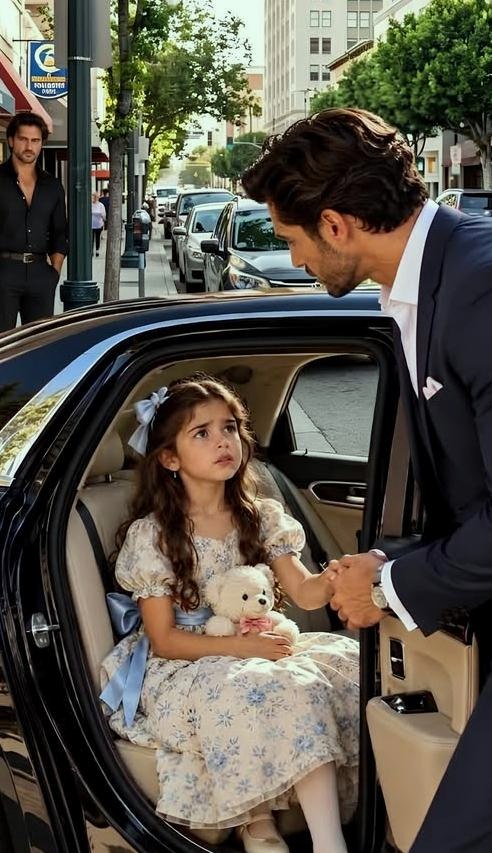
My eight-year-old daughter whispered that she had been forced to drink something strange, while the man who served it kept smiling behind us.
I was already pulling away from Rodrigo Ledesma’s house when Vega finally spoke.
“Dad, Nico’s father made me drink something weird.”
The words came from the back seat, small and broken.
I slammed on the brakes near a roundabout outside Madrid. A delivery van behind us blasted its horn, but I barely heard it. In the mirror, Vega sat curled around her backpack, both hands gripping the faded yellow strap so tightly that her knuckles had turned white.
“What did he give you?” I asked.
Her lower lip trembled.
“I don’t know. It tasted bitter. Like medicine.”
I turned toward her, but stopped myself. I was a child psychologist. I knew frightened children often changed their stories when an adult pushed too hard.
“Are you hurting anywhere?”
“My stomach.”
“When did it start?”
“After dinner.”
The car smelled of wet wool and the apple juice she had left unopened in the cup holder. That ordinary smell made the moment worse. It belonged to a normal Saturday morning, not to the fear spreading through my daughter’s face.
I lowered my voice.
“Tell me only what you remember.”
Vega stared at the buckle across her chest.
“Nico drank orange soda. His dad brought me a different glass. He said it was special because I was a guest.”
“Did Nico drink any?”
She shook her head.
“Then I got sick in the bathroom. I threw up. Rodrigo told me not to wake anyone.”
My fingers tightened around the steering wheel.
“What else did he say?”
“He said if I made a scene, Nico wouldn’t be my friend anymore.”
I called my wife, Irene, and tried to keep my voice steady.
“We’re going to Puerta de Hierro.”
“What happened?” she asked.
“I’ll tell you when we get there. Call my sister and ask her to meet us.”
At the hospital, a nurse took Vega from me at the entrance. I watched her backpack slide from her shoulder and land beside the examination bed. A plastic star on the zipper spun in a circle before stopping.
Three hours later, a doctor led me into a private room where two police officers were waiting.
“Her tests show a toxic substance,” the doctor said. “It isn’t consistent with food poisoning.”
“Will she be all right?”
“She’s stable. But you were right to come quickly.”
Relief hit me first. Then something colder replaced it.
One officer opened his notebook.
“Who prepared the drink?”
“Rodrigo Ledesma.”
The pen paused over the page.
That name dragged a locked memory into the light.
Eighteen years earlier, at the Complutense University, I had helped a terrified student named Marta report a boyfriend who controlled her clothes, her friends, and every hour of her day. His name had been Rodrigo Ledesma.
Before leaving the disciplinary hearing, he had looked straight at me.
“You’ll understand what it costs to lose everything,” he said.
I had not seen him again until Vega’s classmate became Nico.
The officer looked up.
“You knew him before?”
I nodded.
Rodrigo had not chosen my daughter by accident. I was certain of that now.
Then my phone vibrated on the metal table. The caller was the school principal.
“Álvaro,” she said, “Rodrigo is here with a folder, and he’s making an accusation about you.”
A chair scraped behind me as one of the officers reached for the folder she had carried into the room. Her hand moved toward the first page, and I saw a black label stamped across it: FINAL PHASE…
PART 2
The officer’s fingers stopped less than an inch from the folder.
“Don’t open that here,” I said.
The principal’s voice crackled through the phone.
“He says you’ve been harassing his family for months. He has printed messages, school complaints, everything.”
“I haven’t harassed anyone.”
“I know that. But he brought parents with him. They’re standing in the office.”
The officer beside me took the phone from my hand.
“This is Sergeant Molina. Keep everyone there. Nobody touches that folder.”
Vega whimpered behind the curtain.
I turned toward her. Her face was pale against the white pillow, and an adhesive patch covered the back of her hand. I wanted to tear through the hospital and reach Rodrigo myself. Instead, I forced my feet to stay planted.
Molina examined the folder without opening it. A strip of black tape crossed the cover. In the center, someone had written FINAL PHASE in block letters.
“Where did you get this?” he asked the principal.
“Rodrigo gave it to me. He said it proves Álvaro has been conducting psychological experiments on children.”
My stomach dropped.
The second officer, Ruiz, looked at me.
“Have you ever done anything involving children and medication?”
“I assess trauma. I don’t prescribe drugs, and I don’t conduct experiments.”
“Could he have access to your professional records?”
“My clinic has strict security.”
A nurse entered carrying a sealed specimen bag. Inside was Vega’s half-empty cup, the rim stained with a cloudy film.
“The laboratory wants to know whether this came from the home,” she said.
“Keep it sealed,” Molina replied. “We’ll collect it properly.”
My hands were shaking so badly that I had to press them against my knees.
At eleven that morning, I had stood on Rodrigo’s doorstep while he smiled and told me the children had stayed awake too late. A brass wind chime above his porch had tapped against the wall in the breeze. I remembered it now with unbearable clarity.
He had looked at Vega, not at me.
“Precisely why you were useful,” he had murmured.
I had thought he was talking about her being a guest.
I called Irene. She answered on the first ring.
“How is she?”
“Stable. But Rodrigo is trying to turn this against me.”
“Why?”
“I don’t know yet.”
A pause.
“Álvaro, you do know him, don’t you?”
“Not like this.”
At noon, Molina returned from speaking with the doctors.
“The substance is a sedative compound mixed with something that can cause severe cardiac instability in children. The dose was measured.”
“Measured?”
“Not accidental.”
The words seemed to shrink the room.
That afternoon, my sister took Vega to a protected pediatric ward while I went with Molina and Ruiz to the school. The principal’s office smelled of burnt coffee and printer toner. Rodrigo stood beside the desk in the same immaculate shirt he had worn that morning.
His smile was gone.
“You’ve been waiting eighteen years to punish me,” he said.
“You drugged my daughter.”
“I gave her a harmless sleep aid. You’re using your profession to create panic.”
Ruiz placed a clear evidence bag on the desk.
“Then you won’t mind explaining the residue in the glass.”
Rodrigo’s eyes flicked toward the bag.
Only for a second.
But I saw it.
The principal opened a drawer and removed the folder. Beneath the black label, a corner of paper showed through. On it was a list of children’s names, dates, and tiny handwritten circles.
One name was Nico.
Another was Vega.
A third belonged to a boy who had transferred schools in January.
Rodrigo moved suddenly.
“Give me that.”
Molina blocked him.
“You’re coming with us for questioning.”
Rodrigo’s face hardened.
“You think this is about revenge? Ask Álvaro what happened to Marta after he destroyed my life.”
I stepped closer.
“What did you do to her?”
He leaned toward me, his breath sharp with mint.
“She never told you the whole story.”
Then his phone rang.
He looked at the screen, and the color drained from his face. Before Molina could take it, Rodrigo answered.
A woman’s voice came through the speaker.
“Rodrigo, the final subject survived. You need to come back to the old clinic now.”
He ended the call, but not before all of us heard the words…
PART 3
Rodrigo stood motionless beside the principal’s desk.
Molina reached for his phone.
“Who was that?”
“No one.”
Ruiz opened the folder. The paper inside was not a school document. It was a laboratory chart, printed on thick cream stock, with columns for weight, dosage, reaction, and recovery time.
Vega’s name appeared on the last line.
My knees weakened.
“This isn’t an experiment,” I said. “It’s a plan.”
Rodrigo’s jaw tightened.
“You don’t understand what you’re looking at.”
“Then explain it.”
He glanced at the exit.
Molina caught his arm.
“Stay where you are.”
The principal began crying quietly near the filing cabinet. A paper cup slipped from her hand and rolled beneath the desk, spilling coffee across the floor.
Rodrigo looked at me.
“You ruined my life over a lie.”
“Marta reported you before I ever spoke.”
“She was unstable.”
“She had bruises.”
“She wanted attention.”
“You locked her in your apartment.”
His expression changed.
Only slightly, but enough.
Molina and Ruiz exchanged a glance.
Rodrigo’s hand tightened around the edge of the desk until his knuckles blanched.
“I was trying to help her,” he said.
“With what? The drug you gave my daughter?”
He looked toward the folder.
“The compound suppresses panic responses. It was designed for people who suffer from extreme trauma. Marta was supposed to be the first trial.”
The room seemed to tilt.
“You tested it on her?”
“I studied her reactions.”
“You poisoned her.”
“I stopped her from destroying herself.”
A voice came from the doorway.
“No. You stopped her from leaving you.”
An older woman stood there, holding a canvas medical bag against her hip. Her hair was silver, and one of her shoes had a cracked leather strap.
Rodrigo stared at her.
“Clara.”
She looked at me.
“My name is Clara Vidal. I worked at the private clinic where Rodrigo trained after university.”
Molina moved aside.
Clara placed a small ledger on the desk. Its cover was swollen from water damage, and a red thread had been tied through the spine.
“I kept this because I knew one day he would try to say there were no records.”
Rodrigo’s voice dropped.
“You signed a confidentiality agreement.”
“I signed one to protect patients. Not to protect you.”
She opened the ledger.
Every entry had a date, an initial, and a reaction. Marta’s name appeared near the beginning. Vega’s name appeared at the end, written in Rodrigo’s handwriting.
Clara pointed to the first page.
“After Marta rejected the trial, Rodrigo became obsessed with proving the compound worked. He recruited children through families who trusted him. He used harmless sleep problems as an excuse.”
“Nico?” I asked.
Clara nodded.
“His son was not the target. He was the door.”
Rodrigo’s face had gone gray.
Clara continued.
“Rodrigo believed you took his future. He wanted to use your daughter for the final trial, then claim you had given her the substance yourself through your clinic.”
The room fell silent.
I looked at the chart. Beside Vega’s name, Rodrigo had written one sentence: Father will be blamed.
The truth hit harder than anger.
He had not simply wanted to frighten me. He wanted to erase my name while making my daughter evidence against me.
Molina closed the folder.
“Where is this old clinic?”
Clara’s fingers tightened around the ledger.
“Behind the abandoned sports center in Getafe. But you’re too late.”
“Why?” I asked.
She looked at Rodrigo.
“Because the person who funded him has just taken Nico there.”
Rodrigo lunged toward the phone on the desk.
Molina caught him, but Rodrigo shouted over his shoulder.
“Don’t let them give him the second dose!”
Clara’s face collapsed.
I felt every sound in the room sharpen—the buzzing light, the dripping coffee, the scrape of Rodrigo’s shoe.
Nico was alive.
But someone had taken him to the clinic.
And Rodrigo was not the only person who knew how the final phase worked…
The second child was already inside the abandoned clinic…
I thought the poison was meant only for my daughter. Then a witness showed me how deep the plan went. The final truth changed what revenge really meant.
“Vega was never the only child.”
Rodrigo’s face turned gray.
👇 The final part is now open.






