PART 4
It said the account would be closed after my delivery—and the beneficiary of the remaining money was not David.
The name beneath his handwriting belonged to a woman I had never met.
Mara Vale.
I stared at it while the monitor beside me recorded every frightened beat of my heart.
“Who is Mara Vale?” I asked.
Nora’s face changed.
“She was the director of Mercer Family Relief before David took over the region.”
Wyatt added, “She died last winter.”
The baby kicked again.
For several seconds, nobody spoke.
Then I remembered the name.
Not from David. From a letter I had found in the back of our desk drawer three years earlier, before our wedding. Mara Vale had written to David about “the woman who deserves to know where the money went.” He had torn the letter into pieces while smiling at me.
I had assumed it was business.
It had never been business.
“Why would David list a dead woman as the beneficiary?” I asked.
Nora took the paper from Wyatt and examined the ink.
“He did not list her,” she said. “He copied her name from an old file.”
“What does that mean?”
“It means the account did not belong to you or David. It was a holding account created for emergency grants. The bank’s compliance department was preparing to close it because the original trustee was dead. Whoever controlled the account could redirect the balance.”
My throat tightened.
“How much was in it?”
Nora looked at me.
“Two hundred and twelve thousand dollars.”
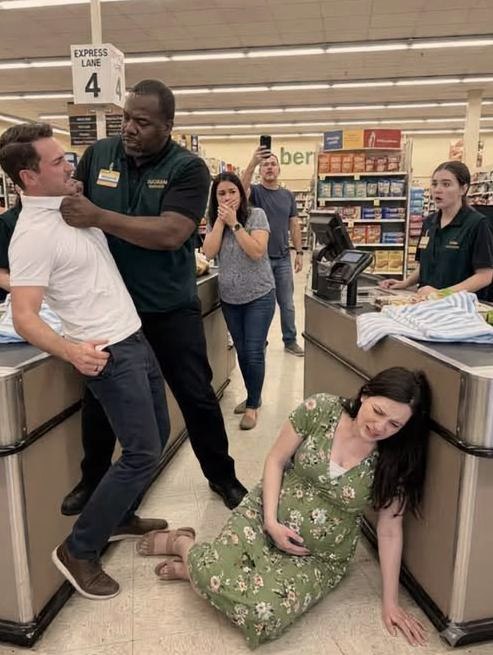
The blanket with the tiny moons lay folded on a chair near my bed. Fourteen dollars. A purchase so small that David had risked everything to stop me from making it.
I understood why now.
He had used the account like a private reservoir. Every withdrawal was hidden beneath another woman’s name. Every forged signature made me the person who appeared responsible. If the bank had reviewed the file after my delivery, the debt would have followed me.
The baby would have been born into a financial disaster David had built around my identity.
And he had attacked me because the cashier’s system was about to reject the card linked to the account.
A fourteen-dollar blanket would have created a record.
A tiny purchase would have forced someone to ask why a regional director was spending charity money at a neighborhood store.
Wyatt sat in the chair beside me.
“I knew David’s face because Mara was my sister,” he said.
I looked at him.
He rubbed his palm over his beard. “She told me she was afraid of him. I thought she meant his temper. I did not know about the accounts until after she died.”
“Why was her file in your store?”
“Because she used this store’s community office for grant interviews. We kept the records after Mercer abandoned the program.”
Nora lowered her eyes.
“I found the folder three weeks ago. I was too scared to take it to anyone. David had connections everywhere.”
“You brought it today,” I said.
“I saw him with you,” she replied. “I realized waiting had already cost enough.”
The room blurred again, but this time I was not afraid of the tears.
A nurse entered with a discharge packet and stopped when she saw the folder.
“Your husband is downstairs,” she said. “He is demanding to speak to you.”
“No,” I answered.
The word came easily.
Then the nurse added, “He says he has information about your mother.”
My mother had been dead for eleven years.
I felt something inside me shift.
David knew exactly which buried wound to touch.
“Let him come in,” I said.
Wyatt immediately stood. “Elena—”
“I want to hear what he thinks can still control me.”
The guard brought David into the room with his wrists secured in front of him. He looked smaller without his jacket, his expensive shirt wrinkled where Wyatt had grabbed him.
He stopped when he saw the document on my bed.
“You read it,” he said.
“I did.”
“You do not understand what happens if this goes public.”
“People learn that you stole money?”
“People learn that you were part of it.”
I almost laughed, but the pain in my ribs prevented it.
“You forged my name.”
“Because I needed you to trust me.”
“You used my identity.”
“Because you were my wife.”
“You hurt me because a blanket might expose you.”
His eyes moved to my stomach.
For one brief moment, I saw the terrified man beneath the practiced confidence. Not a man sorry for the bruise forming beneath my ribs. A man watching the life he built from stolen money collapse piece by piece.
“I can fix it,” he said. “I can transfer everything back.”
“It is not yours to transfer.”
“I can protect you from the debt.”
“You created the debt.”
His voice lowered. “If you cooperate, you can keep the apartment. The account can disappear. We can say the papers were misfiled.”
Nora stepped forward.
“No,” she said. “We cannot.”
David looked at her with naked hatred.
“You should have stayed quiet.”
“My sister stayed quiet,” Nora replied. “She died waiting for money you had already taken.”
That struck him harder than any accusation I could have made.
He turned back to me.
“Elena, please.”
The word sounded foreign coming from him.
Not tender.
Desperate.
I thought of every time he had told me I was too emotional to manage money. Every bill he had hidden. Every appointment he had interrupted. Every bruise explained away as an accident.
I also thought of my child, still moving beneath the monitor, still unaware of the man who had turned a charity into a weapon.
“What happened to Mara?” I asked.
David’s mouth tightened.
“She knew too much.”
Wyatt went rigid.
“Did you kill her?” I asked.
“No.”
His answer came quickly, almost angrily.
Then he looked at the floor.
“She had a heart condition. I told her I would arrange treatment through the foundation. I used the money for the account instead.”
Nora covered her mouth.
David continued because stopping would have required courage he did not possess.
“She found out. She confronted me. She collapsed before I could call anyone.”
“You left her?” Wyatt asked.
“I panicked.”
“You left my sister on the office floor.”
David’s face twisted. “I called an ambulance.”
“After how long?”
He said nothing.
Nora looked at the folder. “The emergency call was delayed forty-seven minutes.”
The room seemed to lose oxygen.
That was the darker secret beneath the stolen money. David had not planned Mara’s death, perhaps, but he had chosen the account over her life and then built a marriage strong enough to hide the choice.
Wyatt moved toward him.
The guard placed an arm across his chest.
“I am not going to touch him,” Wyatt said. “I want him to hear her name.”
He pointed at the paper.
“Mara Vale. Say it.”
David looked at him.
“Do not make me.”
“Say her name.”
David’s lips parted.
Nothing came.
I lifted the blanket from the chair and laid it across my stomach. The stitched moons pressed softly against my skin.
“Mara Vale,” I said.
Wyatt’s eyes closed.
Nora began crying.
David looked toward the monitor as the baby kicked beneath the blanket.
“That child will need a father,” he whispered.
“Not one who teaches the child that fear is love.”
The guard led him away.
This time, he did not threaten me.
He knew there was nothing left in the room he could use.
By morning, the account had been frozen by the foundation’s board, not because I had begged anyone to believe me, but because Nora placed every copied form on the table and Wyatt signed his sister’s name beneath a written statement describing the missing records.
The board offered me the remaining money.
I refused it.
I asked them to return it to the women whose grants had been stolen, beginning with Mara’s final medical fund. The amount would not bring her back. It would not erase the years of fear David had carved into me.
But it would stop his theft from becoming someone else’s inheritance.
The apartment was lost three weeks later because it had been purchased with money from the hidden account. I did not fight to keep it.
Some places hold too many versions of a person you had to become in order to survive.
I moved into a small upstairs room above the community office where Mara had once interviewed women for grants. The floor sloped toward the window, and the radiator knocked all night, but nobody there knew David’s voice.
Nora visited every afternoon after work.
Wyatt repaired the broken metal edge of the checkout counter himself and replaced it with a rounded wooden strip. He sent me the bill for one dollar.
At the bottom, he had written, “For the blanket.”
I kept the bill beside my daughter’s hospital bracelet.
Yes, my daughter.
She arrived twelve days later, furious and healthy, with one tiny fist curled beneath her chin.
I named her Mara Elena Vale.
Wyatt cried when he heard the name. Nora held the baby and whispered that her sister would have loved the blanket with the little moons.
David never saw her.
The foundation did not destroy him publicly. It did something more fitting. It published every stolen application, every false signature, every missing dollar, and sent the documents to the people whose names he had used. His reputation did not collapse in one dramatic moment.
It disappeared line by line.
The last time I saw him was in a conference room at the foundation, where he had to sign the transfer of the remaining account under the eyes of the women he had defrauded.
He tried to meet my gaze.
I placed the fourteen-dollar blanket on the table between us.
“Do you remember this?” I asked.
His fingers tightened around the pen.
“Yes.”
“You thought it was useless.”
He looked at the tiny moons.
“I was wrong.”
“No,” I said. “You were afraid.”
For a moment, the only sound was the pen scratching across the transfer form.
Then Mara’s name appeared beneath the final line, written by the foundation’s new director.
My daughter slept against my chest, warm and impossibly small.
Outside the community office, women waited with folders in their hands. They had come for grants, for medicine, for rent, for the chance to carry a child without choosing which bill to let go unpaid.
I carried the blanket to the front desk and spread it beneath my daughter while Nora opened the first application.
The stitched moons curved around her sleeping face.
Wyatt looked down at her and said, “Fourteen dollars bought a lot of trouble.”
I touched my daughter’s cheek.
“No,” I said. “It bought us a witness.”
Missed the beginning?






