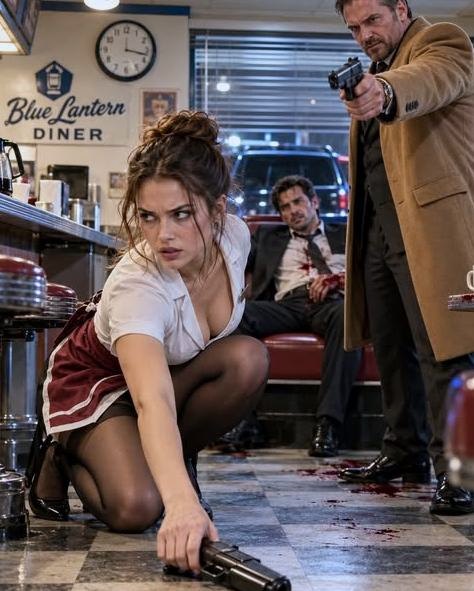
PART 4
The line went dead before Evelyn could say the name.
For half a second, nobody moved.
Then the emergency lights outside painted the diner windows red.
Calder pushed himself onto one elbow. Blood ran from his shoulder into the collar of his camel-colored coat.
“Give me the key,” he said.
I kept Adrian’s pistol pointed at him.
“You’re done giving orders.”
His gaze slid toward the other two men. “You think they’ll protect you? They work for whoever pays them.”
The younger man near the pie case looked at the knife in his hand as if he had just noticed it.
“Who signed the order?” he asked.
Calder did not answer.
The older man grabbed his coat. “You said nobody was going to die tonight.”
Calder’s eyes hardened. “You believed me?”
That was enough.
The older man dropped the knife and shoved the younger one toward the back exit. Neither waited for permission. They ran through the kitchen, knocking over a rack of clean plates. Porcelain shattered behind them.
Calder tried to crawl toward his pistol.
I kicked it beneath the counter.
“Stay down.”
He looked up at me. “You really want to know what your father did?”
“My father’s actions are not your shield.”
“He was no hero.”
“Neither are you.”
The sirens stopped outside. Footsteps pounded along the pavement, but I did not wait for uniforms to decide what happened inside my diner. I had spent fourteen years allowing other people to write the ending of Harlow Street.
Not again.
Adrian grabbed my wrist.
“The locker is at South Halsted Station,” he said. “We have minutes before Calder’s people reach it.”
I pulled free.
“You’re not coming with me.”
“You need someone who knows the access route.”
“I need the truth. You’ve been carrying it around like a weapon.”
His face tightened.
“Then shoot me after you get it.”
It was not a plea. It was an agreement.
I looked at Calder, bleeding on my floor, then at the red shoelace tied to the brass key. My father had tied knots like that while teaching me how to organize invoices in the back room of his warehouse. He had called every knot a promise.
I hated that I still remembered his hands.
We left Calder behind with the arriving officers and ran through the kitchen. The back alley smelled of wet cardboard, diesel, and the cinnamon rolls my neighbor baked before dawn. Adrian staggered, pressing his wounded arm against his chest.
“You’re losing too much blood,” I said.
“I’ve lost more.”
“That was not meant to comfort me.”
“It wasn’t.”
At South Halsted Station, the platforms were nearly empty. A maintenance train groaned somewhere beneath the street, shaking dust from the ceiling. Adrian led me down a service corridor and stopped before a row of rusted lockers.
“Locker seventy-two.”
The brass key turned with a dry click.
Inside lay a leather ledger wrapped in oilcloth, three photographs, a hospital bracelet, and a sealed envelope bearing my childhood name.
Mara Vale.
My hands began to shake.
Adrian touched the wall beside me. “You don’t have to open it here.”
“You brought me here.”
“I brought you to the truth.”
“No. You brought me to the part you thought you could survive.”
I tore open the envelope.
My father’s handwriting filled two pages. The first lines were an apology. The next lines made my stomach fold in on itself.
He had discovered the shipments through a company called Northstar Logistics. Calder was only the man who collected the payments. The person controlling the operation had access to police files, hospital records, and the city’s evidence storage.
The final page held a signature.
Arthur Bell.
My mother’s brother. My uncle. The man who had taken me in after my father’s death, paid for my academy training, and sat beside me at Daniel’s funeral.
I read the name again.
Adrian watched my face.
“You knew,” I said.
“I suspected.”
“You used me to reach him.”
“I used the only person he never expected to come back.”
I struck him across the face.
The sound echoed through the corridor.
Adrian accepted it without raising a hand.
“You should have told me,” I said.
“I should have told you fourteen years ago.”
“Yes.”
“I was afraid your uncle would kill Daniel.”
“He already destroyed him.”
“No,” Adrian said. “He kept Daniel hidden because Daniel was the only witness who could identify him.”
A voice came from the far end of the corridor.
“Still blaming Arthur for my decisions?”
I turned.
A man in a navy overcoat stood beneath the flickering security lamp. His hair was silver now, but I knew the posture, the careful smile, and the small scar beside his left eyebrow.
Arthur Bell held a pistol against the temple of an old man in a wheelchair.
Daniel.
He looked thinner than the photograph in my memory. A breathing tube rested beneath his nose, and one side of his face was marked by pale scars. But his eyes were the same.
They found mine.
Arthur smiled.
“Your father always believed paperwork could save people,” he said. “He was wrong.”
I raised Adrian’s gun.
Arthur pressed his pistol closer to Daniel’s head.
“Put it down, Mara.”
Daniel’s scarred hand moved weakly against the wheelchair arm. His fingers tapped twice.
A signal.
I remembered it from Harlow Street. Two taps meant wait. Three meant move.
He tapped twice again.
Arthur continued speaking, unaware that the dead man beside him was still giving orders.
“You were supposed to remain a waitress. Quiet. Invisible. Instead, Adrian dragged you back into the world.”
“You signed the order that killed my father.”
Arthur’s smile faded at the edges.
“He was going to expose everything.”
“You signed Daniel’s death certificate.”
“He was supposed to die.”
Daniel tapped three times.
I fired at the sprinkler pipe above Arthur.
Water burst from the ceiling. Arthur flinched. Adrian lunged, slamming into him, while I ran toward Daniel’s chair. Arthur fired once, and the bullet struck the ledger in my hand, tearing through the oilcloth but missing my palm.
Adrian drove Arthur into the locker doors.
Daniel seized the dropped pistol with both hands.
His fingers barely held it, but they held it long enough.
“Arthur,” he rasped.
The sound was broken and thin.
Arthur stared at him as if seeing a ghost.
Daniel pointed the gun at his chest.
“You left me in the fire.”
Arthur’s face collapsed.
“I came back.”
“After you signed.”
“I was trying to protect you.”
Daniel’s hand shook violently. “You protected yourself.”
I stepped between them.
“Daniel, give me the gun.”
His eyes moved to mine.
For fourteen years, I had imagined asking him why he never came back. I had imagined anger, accusations, even forgiveness. I had never imagined seeing him hold the answer in his trembling hand.
He surrendered the pistol.
Arthur sagged against the locker doors. The ledger lay open at his feet, its pages bleeding ink beneath the sprinklers. Every payment, every name, every false death had begun to blur.
But the signature remained.
Adrian looked at Daniel. “The ledger is damaged.”
Daniel reached into his coat and pulled out a small metal memory card sealed inside a plastic medical pouch.
“Copies,” he whispered.
I stared at him.
Arthur laughed weakly. “You think copies save you?”
“No,” I said. “People do.”
The officers arrived minutes later. This time, I gave them the ledger, the photographs, and my father’s letter myself. I told them exactly what happened at the diner, in the station, and fourteen years earlier on Harlow Street.
Arthur was taken away. Calder was taken to a hospital under guard. The two gunmen turned themselves in before sunrise and led investigators to the warehouses listed in the ledger.
Adrian refused treatment until Daniel was safely transferred to a real hospital.
I made him sit on the station floor while I wrapped his arm with the cherry-stitched towel from the diner. The fabric was stiff with his blood.
“You knew my name before you walked in,” I said.
“Yes.”
“You knew I could shoot.”
“Yes.”
“You expected me to save you.”
He looked at the ruined towel. “I hoped you would choose yourself.”
I did not forgive him there.
Forgiveness was too large for a wet station corridor and a man who had kept a living ghost from me for fourteen years.
But when the paramedics wheeled Daniel past, his hand reached for mine.
I took it.
His fingers tapped twice against my palm.
Wait.
Then three times.
Move.
I looked down at the bloodstained cherry stitches and tightened my grip around his hand.
“Tell me everything,” I said.
Daniel’s eyes opened fully.
And for the first time since Harlow Street, he began.
Missed the beginning?






