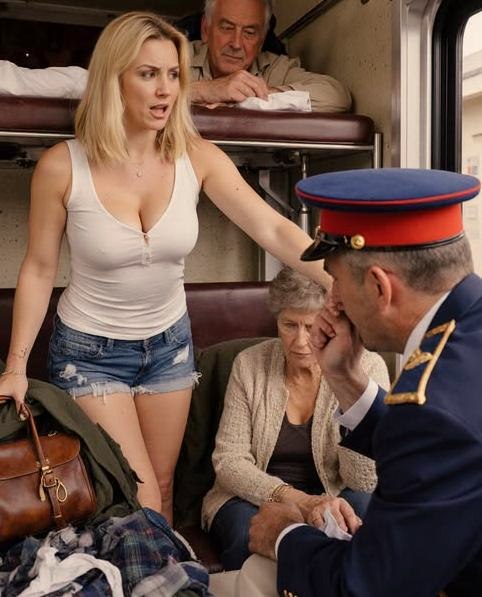
The train chief picked up my ticket, glanced at my passport, and then looked at the young woman sprawled across my berth as if he had just discovered a fire.
His fingers tightened around the paper. A brass button on his dark jacket caught the harsh ceiling light, flashing once between us.
“Lower berth nine,” he said quietly. “This belongs to Irina Sergeevna.”
“That’s me,” I replied.
Milana tossed her hair over one shoulder. Her ring light, clipped to the reading lamp, painted her face an artificial pink.
“I already explained,” she said. “I’m not climbing anywhere. I have a medical condition.”
“You said you were pregnant,” I reminded her.
“I am.”
“Then show the certificate.”
Her eyes sharpened. “Who are you to interrogate me?”
The train chief did not answer immediately. He looked at the scattered chips, my suitcase shoved against the door, and the blanket Milana had spread over my pillow. Then he returned his attention to me.
“May I see the medical document?”
Milana pressed a hand to her stomach. Her long acrylic nails clicked against the plastic case of her phone.
“I left it in my other bag.”
“You have three bags,” I said.
“And you have no right to count them.”
My patience had not broken. It had become something colder.
“I’m not asking you to climb,” I said. “I’m asking you to move to the berth printed on your ticket.”
Milana laughed sharply.
“Listen to her. She thinks because she’s wearing glasses and a jacket, she’s some kind of minister.”
The train chief’s expression changed. Not much. Just a small movement near his mouth, as if he had heard a name he did not expect.
“Your ticket,” he said to Milana.
She shoved her phone toward him instead.
“My followers are watching. If you harass me, I’ll post everything. This train will be famous by morning.”
“Your phone is not a ticket.”
The corridor outside had grown quiet. Someone stopped near our compartment. A child whispered, “What happened?” and an older man answered, “A berth dispute.”
Milana raised her camera again.
“Say that one more time,” she told him. “I want my viewers to hear how you treat paying customers.”
He stepped inside and gently pushed the ring light downward.
“No filming in a passenger’s face without permission.”
“Don’t touch my equipment!”
“I didn’t.”
“You did!”
She sprang up so quickly that her knee struck the table. A glass bottle rolled across the floor and hit the metal wall with a hollow crack.
For one second, her confidence vanished. Then she saw the people gathering and restored it.
“I’m calling my father,” she announced.
The train chief looked at me again. His eyes were dark, tired, and suddenly alert.
“Are you sure your name is Irina Sergeevna Volskaya?” he asked.
The compartment seemed to contract around that question.
“Yes.”
He lowered his voice.
“Then please wait here. I need to make one call.”
Milana smirked. “See? He knows I’m right.”
But the chief was no longer looking at her. He was staring at the small red thread woven into the handle of my leather travel folder—the thread I had kept for twenty-three years because it was tied there on the night everything changed.
He touched the edge of the folder, swallowed, and reached for the door…
PART 2
His hand stopped inches from the folder.
“May I?” he asked.
I nodded.
He lifted it with both hands, as though it contained something fragile. The leather was cracked at the corners, and the red thread around the handle had faded to the color of dried rust.
Milana rolled her eyes.
“What is this, a ceremony? I have places to be.”
The chief ignored her. He opened the folder, saw the first page, and went completely still.
“Where did you get that?” he whispered.
“It was given to me by the railway safety office in 2001.”
Milana leaned across the table.
“What’s in it?”
I closed the folder before she could see more.
“Nothing that concerns you.”
The chief looked from me to the page and back again.
“Your full name is Irina Sergeevna Volskaya?”
“Yes.”
“Senior structural safety engineer?”
“Formerly.”
Milana stared at me. “You’re an engineer?”
“I was.”
“Then why are you traveling in an ordinary carriage?”
“Because I bought an ordinary ticket.”
The man in the corridor gave a low whistle. Someone behind him muttered, “This is getting interesting.”
The chief stepped outside and spoke briefly to the conductor. I could not hear every word, but I caught “manifest,” “medical certificate,” and “compartment seven.”
Milana’s face changed at the last phrase.
Only for a moment.
Then she raised her phone.
“Everyone, update,” she said to the camera. “They’re trying to intimidate me because I’m young. This woman is pretending to be important, and the staff are helping her.”
I reached for the ring light and unplugged it.
The sudden darkness made her gasp.
“Give that back!”
“Your battery is not more important than the safety system.”
“What safety system?”
“The emergency lighting. You blocked its access with your bags.”
The chief turned toward the pile of luggage. His jaw tightened.
Milana stepped in front of it.
“Don’t touch anything. Those are designer items.”
“Move,” he said.
She blinked. “Excuse me?”
“Move the bags.”
His voice had lost its professional softness. It was the voice of a man who had spent years giving instructions while people decided whether to obey.
Milana glanced at the crowd, searching for support.
“My father knows the regional director,” she said. “He can have you dismissed before the next station.”
The conductor, a narrow woman named Vera, suddenly appeared at the doorway. She was holding a clipboard against her chest so tightly that her knuckles had turned white.
“Pavel Andreyevich,” she said to the chief, “there is a problem with her ticket.”
Milana turned on her.
“You told me it was fine!”
The words came out before she could stop them.
Vera’s face drained of color.
The train chief looked at her. “What did you tell her?”
“I didn’t—”
“You said it was fine,” I repeated. “That means you knew she had taken the wrong berth.”
Milana’s phone lowered by a fraction.
“No one took anything,” she snapped. “The lower berth was empty.”
“It was assigned to me,” I said.
“You weren’t here.”
“I was in the vestibule with my suitcase when you pushed it away.”
“And who will prove that?”
A quiet voice answered from the corridor.
“I will.”
An elderly man stepped forward, holding a folded newspaper. A small metal hearing aid glinted behind his ear.
“I saw her kick the suitcase,” he said. “I also saw the conductor open the compartment before the passenger arrived.”
Vera gripped her clipboard harder.
The train chief turned toward the elderly passenger, then toward me.
“Please come with me to the service compartment,” he said. “There are documents you need to see.”
Milana moved to block the passage.
“No. She stays here.”
“Why?” I asked.
Her lips parted, but the answer did not come. The chief’s hand moved to the radio at his shoulder.
Then Vera whispered, “Pavel Andreyevich, the man who paid for her reservation is already on the train.”
Every face in the corridor turned toward us.
Milana’s phone slipped from her fingers and struck the floor…
PART 3
The phone landed screen-first, but the glass did not crack. It continued recording from the floor, pointed toward Milana’s expensive sneakers.
“Who paid for the reservation?” the train chief asked.
Vera looked at me, then at Milana.
“Her ticket was purchased with a corporate account,” she said. “The account belongs to NorthLine Passenger Services.”
I felt something tighten beneath my ribs.
NorthLine was not a travel agency. It was the private contractor responsible for inspecting and certifying passenger carriages on this route.
Milana laughed too quickly.
“That proves nothing. My father’s company buys tickets for employees.”
“What is your father’s name?” I asked.
She stared at me.
“Why do you care?”
“Because I designed the inspection standards NorthLine is paid to follow.”
The corridor went silent.
The chief’s eyes met mine. This time there was no uncertainty in them.
“You never told me,” he said.
“You never asked.”
Milana pointed at me. “She’s threatening me because she has some old job title!”
“No,” said the elderly passenger. “She is saying what happened.”
Vera finally lowered her clipboard.
“Pavel Andreyevich, I need to tell you the truth. Milana called me before departure. She said her father had arranged the berth and that I was to keep it free. She promised me a gift if I let her take it.”
Milana’s head snapped toward her.
“You stupid—”
She stopped.
The chief’s radio crackled. A dispatcher’s voice announced that the train would reach the next station in twelve minutes.
“Why did she need this berth?” he asked.
Vera swallowed.
“She wanted to film a complaint. Her father’s company is trying to secure a new maintenance contract. They planned to make the railway look unsafe and disorganized.”
I looked at Milana’s carefully painted face. Beneath the makeup, she seemed suddenly very young.
“You were going to accuse the railway of mistreating a pregnant passenger,” I said.
“I am pregnant!” she shouted.
“Then show us the certificate.”
Her hand went to her handbag.
The chief held out his palm.
“Slowly.”
She pulled out a folded sheet. Vera recognized it immediately.
“That is not a medical certificate,” she whispered. “That is a copy of a clinic receipt.”
Milana’s fingers began to shake.
The chief took the paper and read it aloud. The receipt listed a consultation, not a pregnancy diagnosis. The patient’s name was abbreviated, the stamp was blurred, and the date was three months old.
“You lied,” he said.
Milana’s eyes filled, but there was no performance left in them.
“I only needed the berth.”
“Why?” I asked.
“Because my father said if I got the footage, he could destroy this route’s reputation. Then he would buy the contract cheap.”
The train chief went pale.
“Your father’s name.”
She whispered it.
“Boris Karpov.”
The chief stepped back as if she had struck him.
Karpov was not merely a contractor. He was the man who had signed the emergency maintenance certificate for this very train three weeks earlier.
I opened my folder and removed the report I had been carrying. The red thread slipped from the handle and brushed the paper.
“There is a reason I am traveling incognito,” I said. “I was sent to verify whether NorthLine falsified its last inspection.”
Milana looked at the report.
“What did you find?”
Before I could answer, the train lurched hard. The ceiling lights went out. Somewhere behind us, metal screamed against metal.
A red warning lamp blinked above the corridor.
The chief grabbed the doorframe.
Vera shouted, “Emergency brake pressure is dropping!”
I unfolded the report with one hand and saw the signature at the bottom.
It was not Boris Karpov’s signature.
It was Pavel Andreyevich’s.
He looked at the page, and his face collapsed.
“That is impossible,” he said.
Then the dispatcher’s radio crackled again.
“Pavel, we have a second train entering the same section. The signal system is not responding…”
The signature on the report changed everything…
I thought the humiliation in that compartment was the whole story. I was wrong. The truth waiting beyond the berth could have cost far more than my dignity.
“Someone tampered with the signal.”
The color vanished from his face.
👇 The final part of the story is open






