
That morning, in front of everyone at the hotel entrance, I drove away a man whose airplane would later refuse to take off without me.
“This car cannot stay here,” I told him, looking at his old, dented pickup.
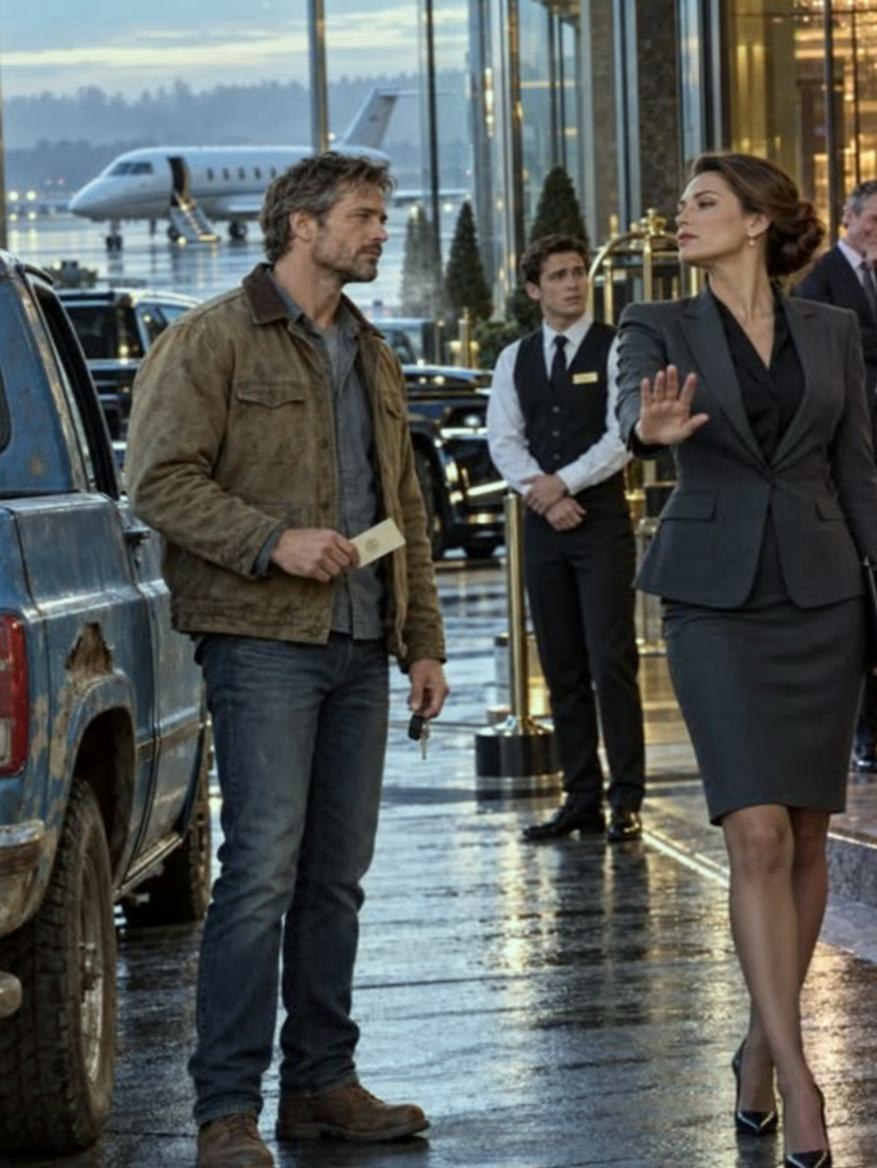
It was seven o’clock on a November morning. Wet asphalt gleamed in front of the Blackridge Grand, while security brought my business partners out one by one from expensive cars. Black sedans, shining shoes, silent assistants—everything was proceeding exactly as I had planned.
Then the old blue pickup appeared.
Its paint had almost turned gray, and a large dent could be seen on the rear left fender. The driver opened the door and got out—a tall, broad-shouldered man in a worn canvas jacket and twice-resoled brown boots. He held a leather folder in his hand.
One of the valets quietly chuckled.
I heard it.
“Who allowed this car in?” I asked the hotel manager.
“I don’t know, Mrs. Ashford.”
The man walked toward us.
“Good morning,” he said.
There was neither embarrassment nor fear in his voice.
“This place is only for meeting participants,” I told him.
He took a heavy cream-colored card from the folder and handed it to the valet. It said: “Caleb Rowan—Strategic Partner.”
I took the card, but read the name only from the corner of my eye. First I looked at the jacket, then the boots, and finally the car.
I had already made my decision.

“You should enter through the north entrance,” I told him.
“I came here for a meeting,” he replied.
“Everyone has their place.”
“Do you know who I am?”
“If you were an important person, you would not have come in this car.”
I said the words too loudly. I knew everyone around us was listening.
The valet glanced over awkwardly.
“Ma’am, the rear parking lot is almost a kilometer away.”
“Then he should leave on time.”
The man looked at me again. No anger appeared on his face. He only had such a calm gaze, as if he were studying not my decision, but my character.
“Are you sure?” he asked.
“Completely.”
He nodded once.
“Okay.”
That one word irritated me more than an argument would have. He got into the pickup, and the engine started with a heavy rumble. My assistant, Peter, stood beside me and smiled.
“The VIP lane belongs to the main people,” he said. “Drivers do not.”
The man stopped for a moment, but answered nothing. Then the pickup descended the hill and disappeared into the rainy morning.
I exhaled with relief.
Order had been restored.

Only eight minutes later, the financial director, Grant Holloway, called me over to the window.
“Where is Caleb Rowan?”
“Who?”
“The man with the pickup.”
“I sent him to the rear parking lot.”
Grant turned pale.
“You didn’t speak to him?”
“I did. Why?”
“Because we are waiting for his signature.”
“On which document?”
He closed the room door and lowered his voice.
“You really don’t know who he is?”
“If you know, tell me.”
Grant did not have time to answer. My phone rang. The call was from the private terminal.
“Mrs. Ashford,” the captain told me, “everyone is ready, but we cannot begin takeoff.”
“Why?”
“We are waiting for the owner.”
“Which owner?”
After a pause, the captain said:
“Mr. Rowan.”
At that moment I imagined again the same cream-colored card in my hand—the card I had taken, looked at, and not read. Grant began to say something behind me when the terminal door opened and the sound of familiar footsteps came from outside…


The door opened and Caleb entered. Dust from the open parking lot still clung to his jacket.
“Mr. Rowan,” the captain immediately went toward him.
Caleb nodded.
“Is everyone ready?”
“We were only waiting for you.”
I froze in place.
Grant quietly said to me:
“This is his airplane.”
“The company’s?”
“His.”
Caleb looked toward me. There was no victory in his eyes. Only tiredness and a strange calm.
“Mrs. Ashford,” he said, “you may come in.”
The sign of his name was visible everywhere on the airplane—on the glasses, on the seat cards, on a small silver wing. A few minutes later, Grant opened my folder.
“You need to look at the capital structure of this deal.”
“Why?”
He placed his finger on the first page.
“Because six hundred and twenty million dollars comes precisely from him.”
My heart clenched.
But that still was not the worst.
Grant took out the next sheet and told me:
“And the condition for transferring this amount changed this morning…”

Grant’s finger stopped on the sheet. The airplane engines were already rumbling, but such silence fell in the cabin as if every sound had remained beyond the walls.
“What changed?” I asked.
Grant looked at Caleb.
“Tell her,” Caleb said.
Grant took three pages from the folder.
“Caleb Rowan is not simply an investor. His company owns the land of the twelve regional airports, the fuel terminals, and the maintenance network that we plan to acquire.”
I smiled, but the smile resembled self-defense.
“All of this could have been in the briefing.”
“It was,” Grant replied.
“Where?”
“On the very first page.”
Caleb stood by the window. His canvas jacket hung over the back of the seat, and on its sleeve was a small, copper-colored sewing emblem—the emblem of an old airfield.
“Why didn’t you tell me who you were?” I asked.
“I told you my name.”
“I meant your role.”
“You were holding my card.”
That answer made my face burn.
Peter, who had been laughing all morning, carefully said:
“Caleb, there was a misunderstanding at that moment.”
“No,” Caleb said. “A misunderstanding happens when you do not have information. Here, she had the information.”
He looked toward me.
“She simply did not read it.”
I wanted to defend myself. To say that I had no time, that I had to protect the hotel’s security, that the car really did look strange. But every reason seemed emptier than the previous one.

“And what changed this morning?” I repeated.
Grant turned over the last sheet.
“Caleb temporarily suspended the transfer. Until he is certain that the management team can manage his property and not merely use his money.”
“Does this stop the deal?”
“Yes.”
Caleb calmly added:
“I do not bring money to people who judge a partner by his car at the entrance.”
The words struck me directly in the heart.
“If you wanted to humiliate me, you have already succeeded,” I told him.
“I did not want to humiliate you.”
“Then why didn’t you tell me anything?”
“I wanted to see how you treat a person from whom you cannot get anything at this moment.”
The captain stood silently. Grant lowered his eyes. There was no color left in Peter’s face.
I looked out the window. Below, the city was disappearing into the clouds.
“And your final decision?” I asked.
Caleb took out his phone. A message lit up on the screen.
“I have not made it yet.”
“What are you waiting for?”
He looked at the screen and suddenly his face changed.
“This message was not for me.”

“What happened?” Grant asked.
Caleb slowly raised the phone.
“My lawyer sent it to me. He says that a new document has been uploaded to the deal’s data room. A document whose existence neither I nor Grant knew about.”
“Who uploaded it?” I asked.
Caleb looked at the screen once more.
“In your name, Vivian.”
The sound of the engines disappeared from my ears.
“I uploaded nothing.”
Grant dropped the folder from his hand.
“That is impossible.”
Caleb told the captain:
“We are not taking off. We are going back.”
“Caleb, if the document is forged…” I began.
“Then we must find out who used your access to the system.”
The airplane left the runway and turned back toward the terminal.
A message came to my phone from an unknown number. Only one sentence was written:
“If you tell the truth, your company will survive; if you remain silent, everything will remain in your name…”
მისი საკუთარი ხმა ყველამ მოისმინა, მაგრამ შემდეგ კიდევ ერთი კარი გაიღო…
მე მეგონა, რომ ყველაზე მძიმე უკვე გავიგე. მაგრამ ნამდვილი პასუხი მაშინ დაიწყო, როცა სიმართლე ჩემს წინააღმდეგ აღარ მუშაობდა.
„მე შენ წინააღმდეგ არაფერს ვაკეთებ.“
და პირველად მივხვდი, რას ნიშნავდა თავისუფლება.
👇 ისტორიის ფინალი უკვე გახსნილია






